UHF-AWG
Arbitrary Waveform Generator Option

Caratteristiche principali
- Dual 600 MHz arbitrary waveform generator
- 14-bit resolution, 2 markers per channel, 1.8 GSa/s
- 128 MSa waveform memory per channel
- Amplitude modulation with internal and external phase reference
- Cross-trigger engine for low-latency triggering and sequence branching
- Field-upgradeable option
Prezzo
Contattateci for pricing information
The UHF-AWG option brings state-of-the-art arbitrary waveform generation capabilities to the UHFLI Lock-in Amplifier. The result is a powerful combination of complex signal generation and analysis tools conveniently orchestrated through the LabOne® platform-independent control software.
The innovative AWG programming concept provides a quick route to customize signals on the UHFLI's two 600 MHz output channels with 14-bit vertical resolution. The available detection schemes include pulse counters and a digitizer for time-domain analysis. Sequence branching based on internal measurement results enables the implementation of feed-forward protocols at unparalleled speeds, opening the way for quantum error correction protocols.
The modulation features of the UHF-AWG ensure the necessary phase coherence for demanding measurement environments such as quantum computing, mixed-signal device testing, NMR spectroscopy, and more.
UHF-AWG upgrade and compatibility
- Upgradeable without the need for hardware changes
- Compatible with all other UHF options 1
1 In some cases, simultaneous operation of the UHF-AWG and the UHF-DIG options can reduce the maximum AWG sampling rate to 900 MSa/s for waveforms longer than 32 kSa.
- Quantum technologies: quantum communication, semiconductor spin qubits, RF-reflectometry
- Band-excitation SPM
- Electrical pump-probe schemes
- NMR spectroscopy
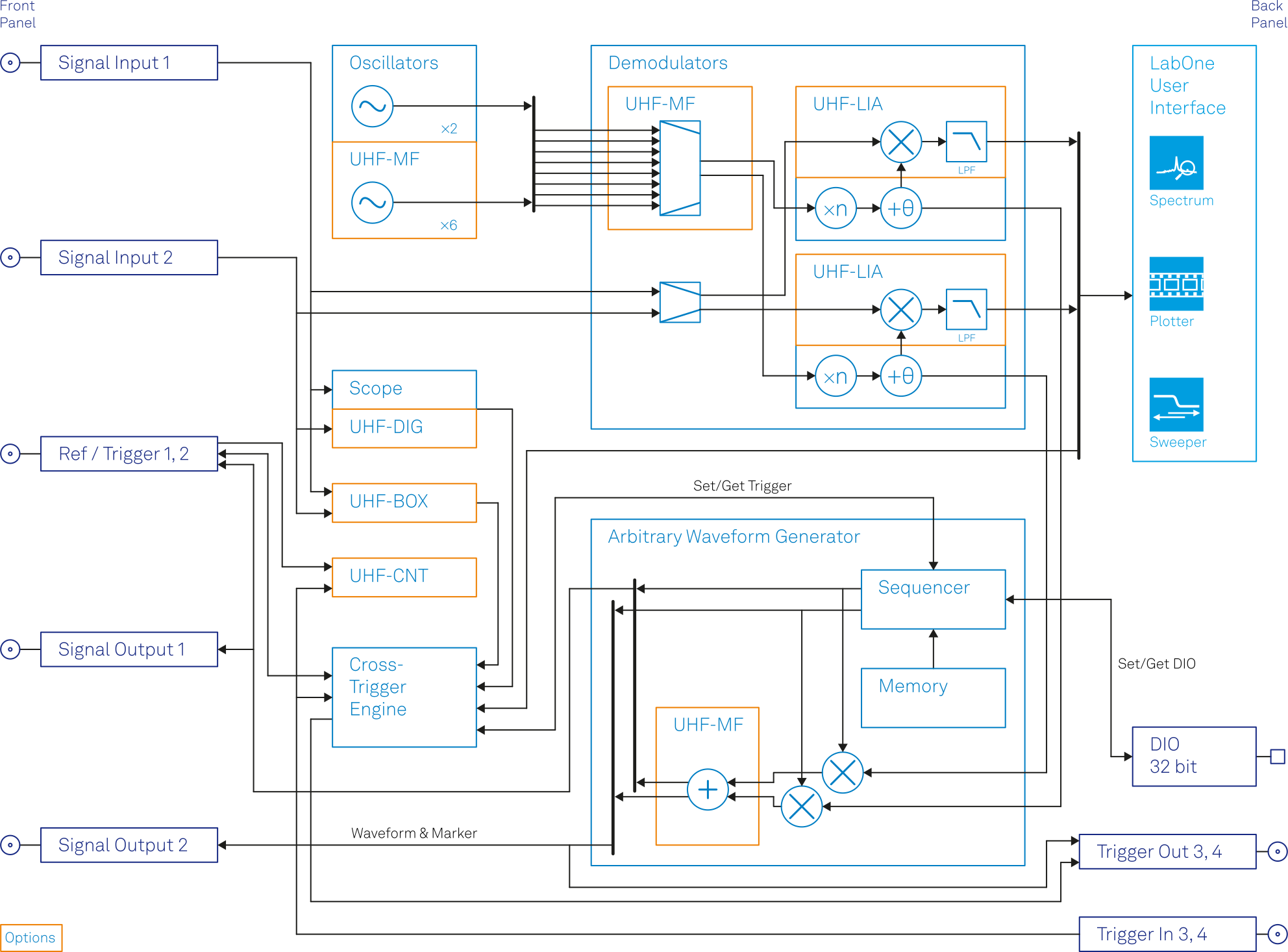
The UHF-AWG option allows you to reproduce any waveform from a user-programmable 128 MSa memory on the UHFLI's two 600 MHz output channels. The high-level compiler integrated into the LabOne® user interface centralizes the tools for waveform creation and editing, sequencing, and instrument configuration, ensuring an efficient workflow towards the desired output signal. Find out more about the AWG's programming concept here.
Moreover, the UHF-AWG functionality is supported by a measurement toolset offering a variety of synchronous and asynchronous detection methods. The cross-trigger engine enables bidirectional triggering between the AWG and the internal detection units, thus replacing the inter-device triggering used in traditional measurement setups. Notably, this eliminates the need for complicated synchronization methods between separate instruments for signal detection and signal generation. As shown in the example below, the measurement procedure is controlled from a single AWG program.
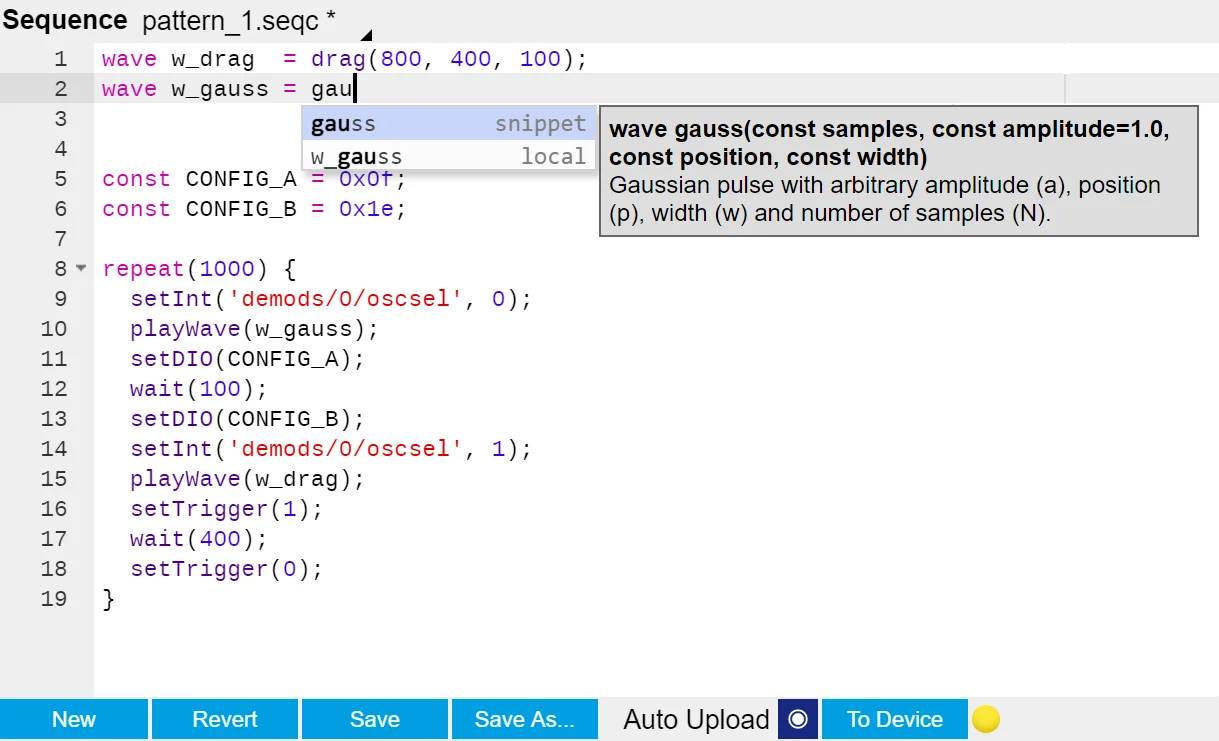
The AWG program in the LabOne sequence editor window features waveform playback, control of multi-bit digital output, and dynamic change of carrier frequency.
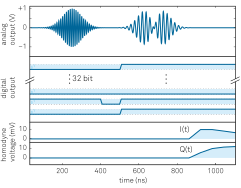
These are the analog and digital AWG signals generated by this program. Data acquisition (homodyne detection, here) is performed synchronously with signal generation.
LabOne provides an extensive measurement and analysis toolset:
- With the Sweeper, it is straightforward to characterize the dependency on AWG parameters such as waveform amplitude, delays, carrier frequency, and phase.
- Continuously streamed measurement data are visualized thanks to the Plotter tool and offer a close monitoring of the effect of the AWG signal.
- Triggered recording is available with either the built-in Scope or the DAQ tool to accommodate for the frequent shot-like character of AWG measurements.
- The LabOne APIs for Python, C, MATLAB®, LabVIEW™ and .NET allow for quick integration into existing control software.
Waveform generation, modulation, and chirping
The UHF-AWG option offers two output modes:
- In direct output mode, the waveforms are routed directly to the DC-coupled signal outputs. The 128 MSa waveform memory and 14-bit, 1.8 GSa/s D/A conversion enable the generation of high-resolution pulse shapes to reproduce a wide range of device testing conditions or to compensate for distortions occurring in the signal path.
- In amplitude modulation mode, each AWG channel shapes a sinusoidal signal generated by an internal oscillator. It optimizes the generation of phase-coherent pulse patterns using the sequencer and generic pulse envelopes, without which the entire waveform would need to be uploaded. This saves time and increases throughput. Variation of carrier parameters helps in cases where frequent tuning of the phase or frequency is required. In applications such as NMR spectroscopy, which requires long patterns at the full 600 MHz bandwidth of the instrument, users can reduce the waveform size by specifying envelopes with a lower sampling rate than that of the final signal.
Find out more here about the capabilities in terms of modulation and triggering. The UHF-MF Multi-Frequency option further enhances the modulation features, as it enables fast switching between up to 8 frequencies in a pulse sequence and precise inter-channel phase control ideal for external I/Q mixing.
The UHFLI's internal oscillators are references for both signal generation and signal detection, which in combination with the UHF-AWG option opens the way to phase measurements for applications such as pulsed radar. Two digital marker signals per channel can be generated with the same time resolution as the analog signal both in direct output mode and amplitude modulation mode.
With the UHF-AWG option, the UHFLI also offers new approaches to frequency chirp generation for scanning vibrometry, high-Q resonator testing, band excitation SPM, or radar. Direct output of a periodic chirp is suitable for fast, high-resolution frequency response measurements. The amplitude modulation mode combined with the UHF-MF option makes it possible to generate a chirp centered around an oscillator frequency that is freely controlled, e.g. in a phase-locked loop. Finally, sweeping the oscillator frequency with the AWG Sequencer enables generation of long chirps with zero waveform memory.
Detection schemes
The UHFLI upgraded with the UHF-AWG option gives access to a wide range of signal detection schemes within the same instrument:
- Phase-sensitive detection with a 5 MHz measurement bandwidth is within reach for pulsed RF measurements.
- The UHF-CNT Pulse Counter option is for convenient processing of PMT or similar pulse-like signals with rates up to 225 MHz.
- The Scope and Digitizer tools in LabOne enable direct visualization of the system's response to a waveform stimulus and chirped FRA measurements with leakage-free FFT.
- The Spectrum Analyzer tool provides high-frequency resolution.
- The UHF-BOX Boxcar Averager option offers a precise analysis of fast periodic signals with low duty cycles.
Sequence branching and feed-forward
Thanks to the LabOne AWG Sequencer's branching capabilities, it is possible to select the next waveform based on external conditions such as the state of the 32-bit digital input or on internal conditions such as the value of a demodulated signal quadrature. The flow diagram below illustrates the flexibility in defining branching conditions for different applications. Achieving sub-microsecond feed-forward times is a matter of a few sequencer commands, without the need for low-level digital signal processing.
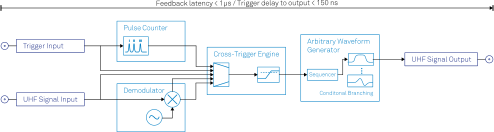
This example shows the signal path for a fast feedback protocol. A feedback latency below 1 µs is reached for a protocol including demodulation and conditional branching. The direct AWG trigger delay is smaller than 150 ns.
Arbitrary waveform generator
| Channels | 2 |
| D/A conversion1,2 | 14 bits, 1.8 GSa/s |
| Waveform memory1,2 | 128 MSa per channel |
| Sequence length | 1024 instructions in core memory + dynamic extension |
| Output modes | Amplitude modulation, direct output, 4-channel aux output |
| Conditional branching input signals |
32-bit digital input, trigger input, internal trigger (lock-in, scope, counter) |
| Conditional branching feedback latency |
< 1 µs |
| Sequencer output | UHF analog output, 2 markers/channel, 32-bit digital output, auxiliary output |
| Trigger delay to output | < 150 ns |
| Trigger uncertainty | 2.2 to 4.4 ns |
1 Operating the UHF-AWG option in parallel with the UHF-DIG Digitizer option leads to a reduction of either the AWG sampling rate or the waveform memory size.
2 For non-repetitive waveforms longer than 32 kSa played on both output channels simultaneously, the maximum sampling rate is 900 MSa/s.
UHF-AWG Q&A
The LabOne AWG Sequencer allows you to work in a high-level language derived from C that is natural to read and write in, rather than having to pile up the sequence as a table of machine instructions as you would do with most AWGs. The LabOne language comes with waveform generation tools and thus lets you define the waveforms together with the sequence, rather than having to split this task out into a separate waveform generation tool or even third-party software. Editor features such as code completion and debugging messages allow new users to program quickly and easily.
This feature reduces the need for time-consuming waveform uploads, and it simplifies operation when using signals with a sinusoidal carrier. This is because amplitude modulation makes the carrier independent of the programmed waveform. The carrier parameters (frequency, phase, amplitude, offset) are then adjustable with few mouse clicks.
These registers increase the flexibility in pattern generation. User registers can be used as delays, as an index to select a certain waveform, or to output DIO values. You can change them manually from the user interface or perform a sweep.
Yes. To include a sequence branch, use an "if" statement in the sequence program.
Common waveforms (Blackman, Gauss, chirp, sine, square, sinc, DRAG, and more) can be generated right away. You can also add, multiply, cut/concatenate, and scale waveforms, as well as use loop iterations to generate systematic series of waveforms. External waveforms based on CSV files can be easily imported.
It cannot replace it entirely, because - unlike the UHF-MOD option - the UHF-AWG option does not enable AM/FM demodulation. The UHF-AWG can generate amplitude-modulated signals, but for sinusoidal modulations the UHF-MOD option is better suited. The UHF-MOD option enables phase-coherent addition and subtraction of frequencies, including frequencies that are locked to external references and their harmonics.
The lock-in detection does not change when the UHF-AWG option is installed, but the lock-in sine wave generator makes use of the same signal outputs as the UHF-AWG option. Therefore, the two cannot be used in parallel. However, the UHF-AWG signal can be easily phase-locked to the lock-in amplifier reference.
You can lock in phase the AWG to the UHFLI by synchronizing it with a common internal reference oscillator. There are two ways to achieve this: one is to use that oscillator signal as the AWG carrier signal in amplitude modulation mode; the other is to trigger the AWG by the oscillator phase, thus synchronizing the AWG repetition rate with the lock-in frequency.
You can lock in phase the AWG and the Boxcar Averager by synchronizing it with a common internal reference oscillator. To this end, the AWG can be triggered by the oscillator phase, thus synchronizing the AWG repetition rate with the boxcar averager frequency.
If you rely on custom MATLAB®, LabVIEW™, Python or C software, the integration is straightforward with the LabOne APIs. LabOne helps you find the right API command for a given instrument setting thanks to its command log feature.
The UHF-AWG option provides control over every sample of the output signal. It is the right tool when you need precise control of the signal shape or if you require complicated sequences of pulses. A function generator is better at generating standard signals such as sawtooth waves or pulse bursts. This is because its user interface can be simpler, and its technology enables rescaling of a waveform in time to change the frequency.
No, it does not support a DDS mode.