Zurich Instruments Test & Measurement Newsletter - Edition Q1/2021
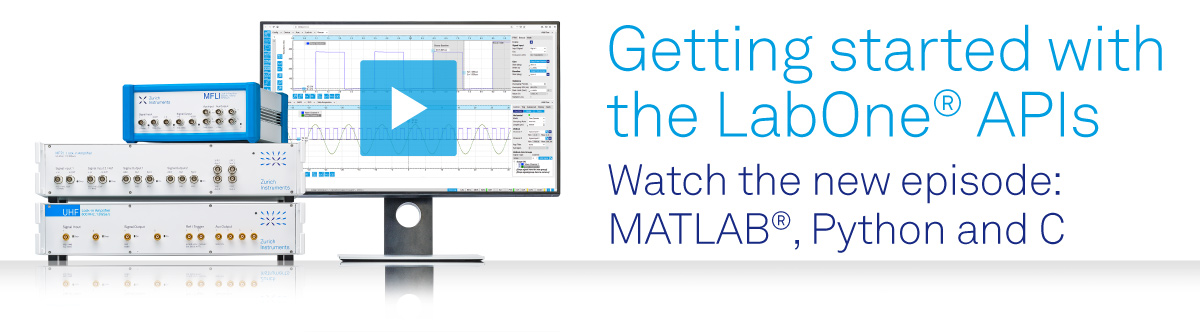
Welcome to the Q1/2021 Test & Measurement newsletter!
We hope that you will be inspired by the new content selection. We have moved from a single quarterly newsletter to two thematic newsletters: one focuses on the field of test and measurement applications, whereas the other looks at the area of quantum technologies. If you'd like to share with us what you think of this new format for our newsletters, write to us at info@zhinst.com.
Are you interested in receiving our Quantum Technologies newsletter too?
In this edition of the Test & Measurement newsletter you'll learn about impedance-based proximity sensors, find out how to generate different functions at low frequencies on lock-in amplifiers, and read about our review of content on lock-in measurements, from fundamentals to practical tips and tricks.
Knowledge Bits
Video: Getting started with lock-in amplifiers and Python, MATLAB®, C and .NET APIs
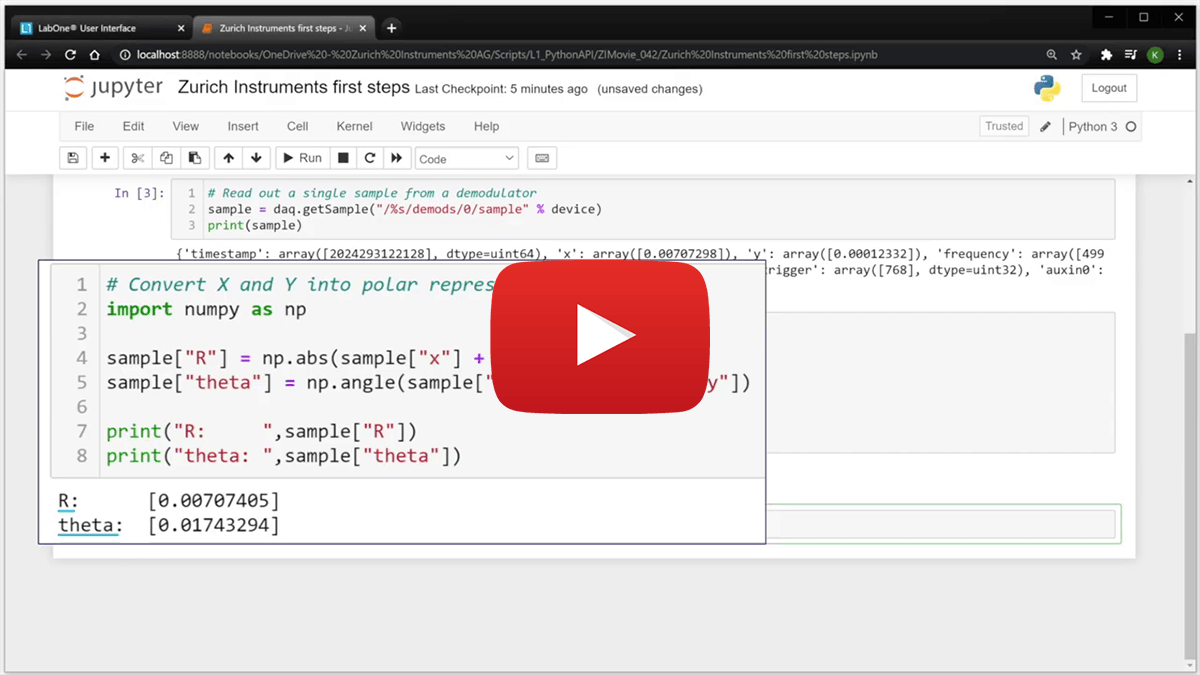
Would you like to incorporate Zurich Instruments' device control and data acquisition into your code? In this video, Claudius Riek presents a basic example that you may use as the perfect starting point when working with your own programs: reading data out of a lock-in amplifier. Claudius highlights the resources available to build on this example and make the integration of Zurich Instruments' products in your code fast and straightforward, so that you can keep focusing on your research.
Blog Post: Content review – Lock-in detection
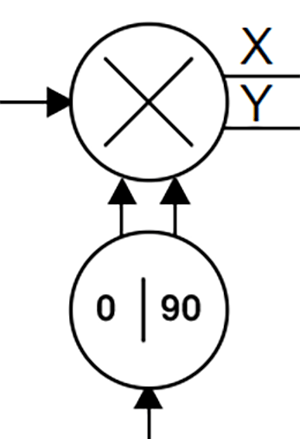
Do you work with lock-in amplifiers but would like to truly master them? We create videos, write application notes, and publish blog posts to help you achieve the best signal-to-noise ratio and to provide insights into Zurich Instruments' products. In this blog post, Kıvanç Esat takes you on a tour of our content dedicated to lock-in measurements, from fundamentals to best practices.
Blog Post: Function generation via auxiliary outputs on your instruments
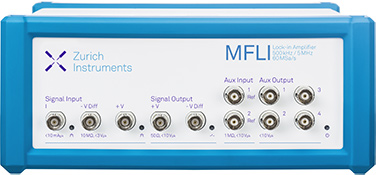
Zurich Instruments' Lock-in Amplifiers and Impedance Analyzers are equipped with four auxiliary outputs on the front panel. Have you ever wondered how to make the best use of them in your applications? In this blog post, Meng Li offers some tips on how to generate different functions – including sawtooth and square waves – at low frequencies.
Blog Post: Proximity sensors, inductive or capacitive?

Would you like to know how impedance-based proximity sensors typically work? In this blog post, Meng Li describes methods to characterize proximity sensors with the MFIA Impedance Analyzer. These approaches include how to determine different sensing regimes for a given device under test, how to capture fast impedance changes in real time, and how to trigger external circuits using digital or analog outputs.
News
Release of the first HTML-based user manuals
To improve the usability of our technical documentation, we have been developing HTML versions of our user manuals and have just released the HTML-based LabOne Programming Manual. Its online version can be found here, and an offline version is provided to all users with the LabOne installer.
Now we would be thrilled to hear from you: to let us know what you think of our HTML-based documentation, send your feedback to us by clicking on the 'Feedback' button in the top-right corner of the Documentation page or by writing an email to info@zhinst.com.
Webinar – Microfluidic EIS for cell and particle detection
2020 witnessed an increased interest in single-cell research and characterization methods. Electrical impedance spectroscopy (EIS) is a technique that guarantees fast throughput and label-free sensing, so that it can be used to characterize electrical properties, size or morphology of cells in microfluidic devices. Fluigent and Zurich Instruments drew on their domains of expertise to propose a complete solution for EIS in microfluidics. In this webinar we present an EIS system consisting of a lock-in amplifier and microfluidic flow controllers, and put it to work on the detection of microbeads and water-in-oil droplets.
Company & Community
Recent publications featuring the UHFLI and the MFLI
- Song, Z., Xu, L., Xie, H. & Cao, Z. Random vibration-driven continuous-wave CRDS system for calibration-free gas concentration measurement. Opt. Lett. 45, 746-749 (2020).
- De Leon, S.E., Cleuren, L., Oo, Z.Y., Stoddart, P.R. & McArthur, S.L. Extending in-plane impedance measurements from 2D to 3D cultures: design considerations. Bioengineering 8, 11 (2021).