Quantum Sensing Instrumentation
Quantum sensors have shown exciting progress towards practical applications in recent years. A prime example is that of magnetic field sensing and imaging with nitrogen vacancy (NV) centers in diamond and with superconducting quantum interference devices (SQUIDs). Striving for higher sensitivity, speed, and spatial resolution requires advances in the control of the sensing device as well as in the detection of its signal.
The Zurich Instruments Lock-in Amplifiers and Arbitrary Waveform Generators (AWGs) empower you with the most advanced signal recovery tools and specialized quantum control solutions. Read on to discover how hardware and software designed to work in concert help you reach your goals faster.

Magnetometry with Ensembles of NV Centers
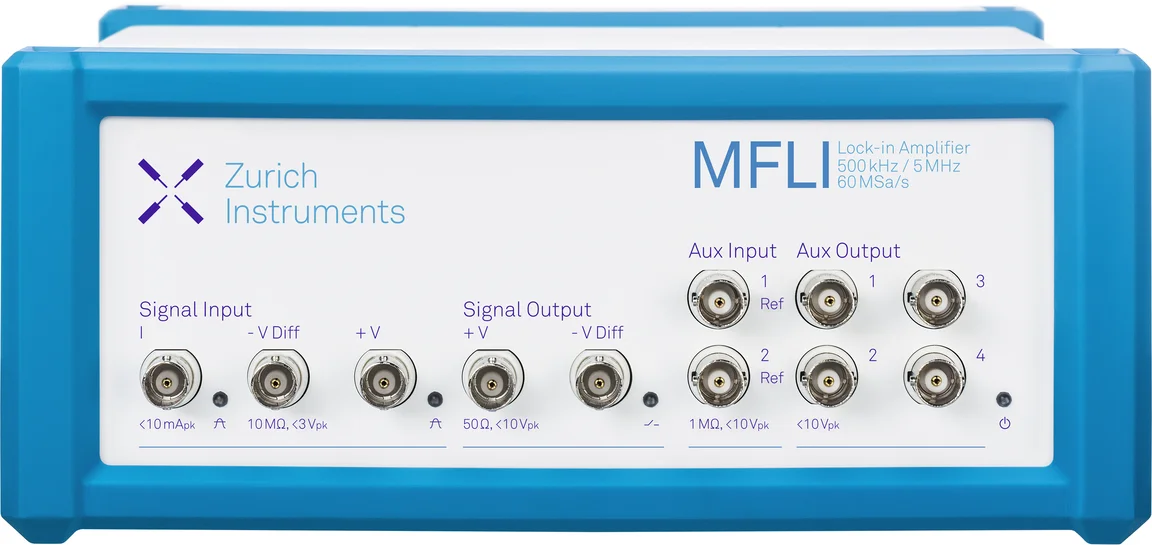
An instrument combining all tools needed to simplify your magnetometry setup within one high-performance package will allow you to make the best use of your time. With its integrated closed-loop feedback capability, low input noise and multiple demodulators, the MFLI Lock-in Amplifier can speed up scanning applications and adapt quickly to new experimental needs. All tools for data logging, triggered acquisition, and time- and frequency-domain data analysis are provided with our LabOne® control software.
Coherent Control of NV Centers
Our AWGs allow you to break down the complexity of generating coherent control sequences by simplifying the software control and the radio-frequency setup. A high-level sequencing interface makes it possible to maintain precise control over timing and phase coherence even for long pulse sequences, and it helps you integrate real-time decision-making in a straightforward manner. Direct signal generation from DC up to 8.5 GHz means that you can remove IQ mixers from your setup, too.
Product Highlights


Videos
In this webinar, Jelena Trbovic (Zurich Instruments) and Prof. Martino Poggio (University of Basel) present the basic principles, methods, and applications of magnetic imaging techniques that include NV-center, nano-wire magnetic force microscopy and scanning SQUID microscopy.