Zurich Instruments Quantum Technologies Newsletter - Edition Q4/2021
Welcome to the Q4/2021 Quantum Technologies newsletter!
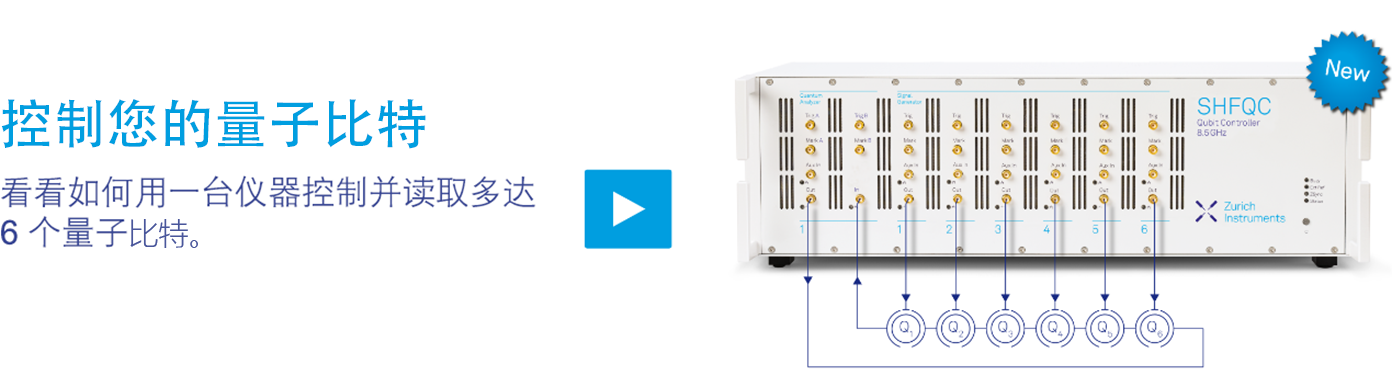
This edition of the Quantum Technologies newsletter brings a few announcements. We have released the new LabOne® QCCS Software, a user interface capturing our system control approach to quantum computing. On the hardware side, we have launched the SHFQC Qubit Controller, an instrument specifically conceived for small systems of superconducting qubits. Along with the latest news, find out more about quantum technologies in South Korea by reading Dr. Jinwoong Cha's interview.
Knowledge Bits
Video: Qubit control and measurement solutions to accelerate quantum computing applications
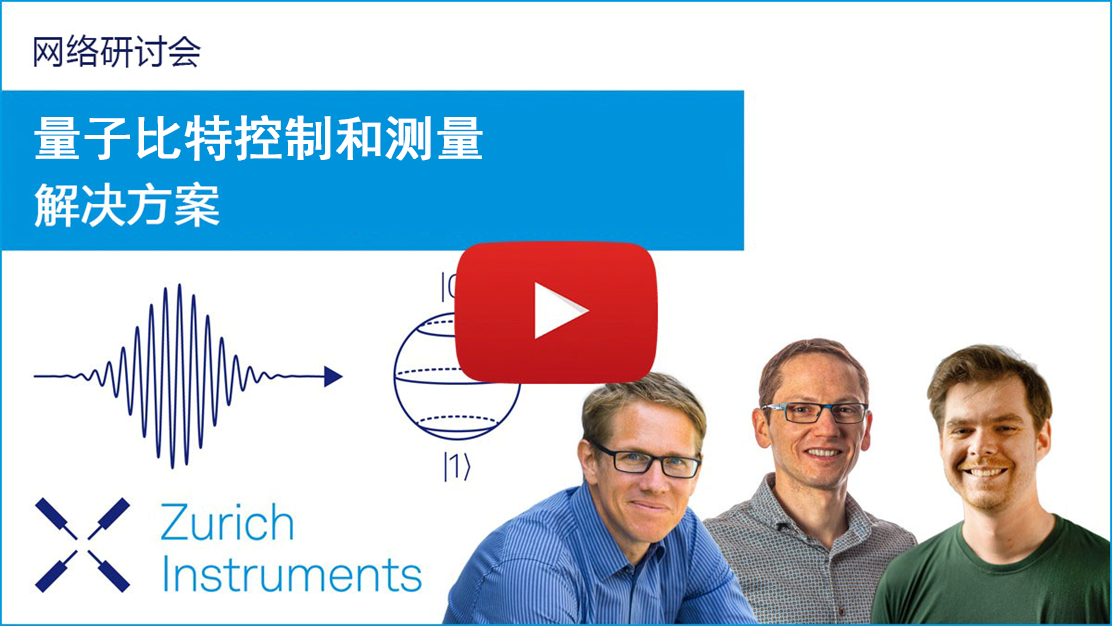
Have you ever wondered how to control and measure superconducting qubits with minimal overhead in instrumentation and software? Watch the video recording of our recent webinar for an introduction to superconducting qubits by Prof. Stefan Filipp, followed by a discussion on how to build a qubit control setup that answers your needs and a hands-on demonstration of efficient qubit control and measurement directly from Prof. Filipp's laboratory at the Walther-Meißner-Institute in Germany.
All our videos are available on our YouTube channel: take a look and subscribe!
Interview: Dr. Jinwoong Cha, KRISS
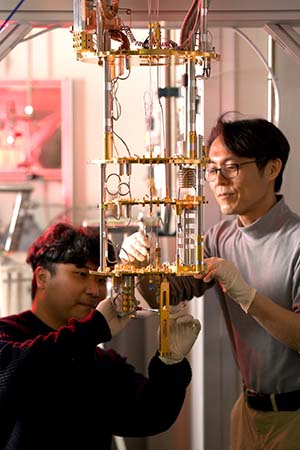
Dr. Cha is a senior research scientist at the Quantum Technology Institute of the Korea Research Institute of Standards and Science.
Can you tell us about your journey as a researcher?
I started my academic career as a mechanical engineer at Hanyang University in South Korea. When I was a third-year undergraduate student, I took a course in electrical engineering for mechanical engineers where I was exposed to the field of micro-electromechanical systems (MEMS) for the first time. This field excited me because of how nanoscale and microscale force interactions significantly influence the dynamics of the mechanical devices. This experience then led me to study quantum mechanics, electrodynamics and condensed matter physics, which are all essential to understand nanoscale physics. With this background I moved to ETH Zurich in Switzerland for a master’s degree in Micro and Nanosystems, where I had fantastic opportunities to study and gain research experience on a wide range of nanoscale physics phenomena and devices. Once I completed my master’s degree, I joined the group of Prof. Chiara Daraio (now at Caltech in the USA) at ETH Zurich as a PhD student in Mechanical Engineering. During my PhD I worked on the development of micro and nanoscale phononic metamaterials by employing nano-electromechanical systems (NEMS) as a platform. Based on these NEMS metamaterials, we achieved the electrical tuning of elastic wave propagation and the experimental realization of nanomechanical topological insulators operating at radiofrequencies.
Following my PhD, I stayed at Caltech as a postdoctoral researcher for 6 months and I then came back to South Korea for personal reasons. My experience with nanofabrication and NEMS devices and my personal interest in quantum mechanics led me to work on superconducting electromechanical devices as a senior research scientist at the Quantum Technology Institute of the Korea Research Institute of Standards and Science (KRISS), which I joined in 2020.
Could you tell us a bit more about the research group where you currently work at KRISS?
The Quantum Technology Institute of KRISS is led by Dr. Heesu Park. At this institute, we develop a variety of quantum technologies based on single photons, ultracold atoms, NV centers, spintronics, and superconducting quantum circuits. I work in the Quantum Nanomechanics Team led by Dr. Junho Suh: our team studies and develops various types of hybrid quantum devices based on superconducting microwave circuits, NEMS, optomechanical systems, and novel nanomaterials. Some examples of our recent research activities include nanomechanical measurements of quantum interference in a topological insulator-nanowire and niobium-based superconducting nanoelectromechanical devices.
Our team will also work on a new project about quantum interconnects funded by the National Research Council of Science & Technology (NST) in South Korea. For this project, we will collaborate with researchers at the Korea Institute of Science and Technology (KIST) and at the Korea Advanced Institute of Science and Technology (KAIST) to develop quantum transducers by integrating nano-optoelectromechanical devices, superconducting microwave circuits and integrated photonic circuits. Our ultimate goal with this project is to realize efficient and reliable remote entanglement between two superconducting qubits through an optical fiber at telecommunication wavelengths.
You've used several Zurich Instruments’ products since your days at ETH. How do these instruments help you with your experiments?
I used the UHFLI Lock-in Amplifier to characterize my nanomechanical lattices operating at tens of MHz frequencies. The UHFLI is a really powerful addition to my experiments due to its large frequency bandwidth, the versatile sweeper function, and the additional UHF-AWG option. The LabOne software also made it easy to operate the instrument and provided useful coding guidelines when writing my own MATLAB® and Python scripts to customize experimental settings. In the study of nanomechanical lattices, I used the output of the UHFLI to electromechanically excite my devices in the vacuum chamber and the UHFLI’s input to measure the vibration-induced laser intensity modulation coming from the photodetector. Then I performed steady-state response measurements using the sweeper functionality. The UHF-AWG option allowed me to design chirped pulses containing large frequency components, which I used to measure the transient responses of my devices.
Recently, we purchased an HDAWG for new experiments on superconducting quantum devices, and we hope to purchase other quantum-oriented products from Zurich Instruments for our project on quantum transduction. We really look forward to this journey, and to the scientific and technical achievements we will attain.
What trends do you see in the research and development of quantum computers in South Korea?
Just like other countries, South Korea is actively investing in quantum information science and technology (QIST). The National Research Foundation (NRF) of South Korea has run a scientific program for the development of quantum computing technologies with a total funding amounting to ~35 million CHF from 2019 to 2023. This program supports research on superconducting qubits, semiconductor quantum-dot qubits, trapped-ion quantum systems, photonic quantum computing and simulations, among others. Additionally, various research topics related to QIST have been supported through other programs offered by the NRF as well as by other funding agencies such as the Samsung Science & Technology Foundation.
The Government of South Korea also supports directly several national research institutes such as KRISS, KIST, and the Electronics and Telecommunications Research Institute (ETRI). These three institutions have their own research centers focused on developing a wide range of quantum technologies. In particular, with its Quantum Technology Institute KRISS has the largest quantum center consisting of a quantum spin team, a quantum nanomechanics team, a quantum information team, a quantum magnetic measurement team, a quantum magnetic imaging team, an ultracold atom quantum research team, and a fabrication infrastructure team.
Are there overseas institutions that you like to think of as references or models?
There are many institutes in the world that we would like to refer to. ETH Zurich is the foremost example I can mention. ETH Zurich is one of the institutes leading the field of quantum science and technology, with many faculty members working on various quantum systems. The Quantum Center at ETH gathers faculty members from different departments, and education programs such as the master’s degree in Quantum Engineering also show the institute’s effort to promote this field.
News
The next generation of quantum programming
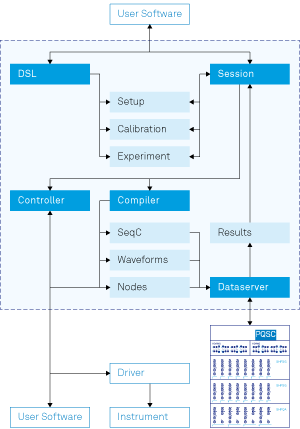
We're excited about the release of the LabOne QCCS Software. This is what you can expect to achieve with this new addition to our quantum computing systems:
- Experience complex setups as a single machine with intuitive programming in a domain-specific language in Python while keeping full control over hundreds of channels.
- Maximize your quantum computer system uptime through fast quantum circuit updates.
- Benefit from optimized code generation and code execution for optimized scheduling of custom gates, pulses and waveforms with ultrafast playback and decision logic.
An integrated qubit control system
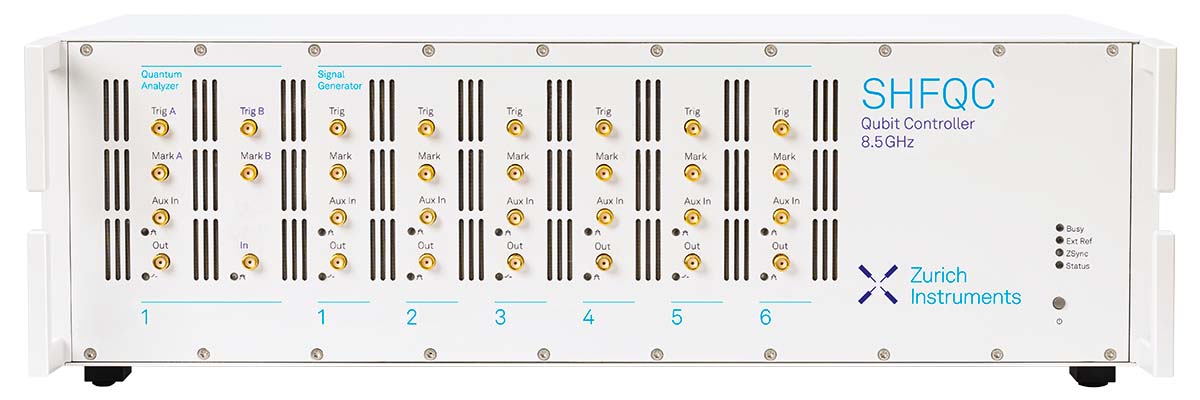
We're happy to announce the launch of the SHFQC Qubit Controller. This new element of our Quantum Computing Control System (QCCS) allows you to benefit from mixer-calibration-free frequency conversion and ultrafast active reset on small quantum systems with few qubits. The SHFQC was designed to offer a software-controlled, room-temperature qubit control system for up to 6 superconducting qubits within a single instrument. Take advantage of its capabilities to drive high-fidelity single- and two-qubit gates, to perform single-shot multiplexed qubit readout, and to implement fast feedback or error correction protocols.
Company & Community
Recent publications featuring the HDAWG, the UHFQA and the UHFLI
- Herrmann, J. et al. Realizing quantum convolutional neural networks on a superconducting quantum processor to recognize quantum phases. arXiv:2109.05909.
- Essig, A. et al. Multiplexed photon number measurement. Phys. Rev. X 11, 031045 (2021).