Next-Generation Long-Range LiDAR: Millimeter-Precision and Simultaneous Velocimetry with ordinary CW laser
University of California, Irvine

Profile
Customer: Ataberk Atalar
Country: United States
Industry: Research Lab
Research area: Optics & Photonics
Product: GHFLI 1.8GHz 락인앰플리파이어
Long-range coherent LiDAR is limited by the coherence length of its laser. Ataberk Atalar (UC Irvine) explains how quasi-CW multi-tone LiDAR extends phase-based ranging beyond that limit, reaching millimeter precision and simultaneous velocimetry at 1.8 km with an ordinary CW laser and a GHFLI lock-in amplifier.
What led you to work on LiDAR, and how did your background prepare you to tackle challenges you faced in this research?
My background is in physics. I did my BSc and MSc Middle East Technical University, where I worked on THz spectroscopy, distributed fiber acoustic sensing, and mode-locked laser development. By the time I joined Prof. Boyraz's group at UCI (University of California, Irvine), I had already spent a few years building and characterizing optical systems, so the transition to coherent LiDAR was a natural one.
The lab had a strong foundation to build on. The MTCW LiDAR concept had already been developed and published, and the group had been selected as one of three teams from top universities to develop a LiDAR payload for an ONR-funded CubeSat mission targeting ocean dynamics remote sensing. When I joined, I took over the experimental development and started pushing the system into new territory, both in terms of performance and the fundamental problems it could solve.
With your approach regarding how LiDAR focuses multi-tone phase-based ranging with quasi-CW operation, what are the key breakthroughs with this approach, and how does it fundamentally differ from established approaches?
FMCW requires a frequency-swept, very narrow linewidth laser, which adds complexity and limits operational range due to coherence length constraints. Our approach is different in how it handles the laser linewidth requirement. Instead of relying on very narrow linewidth lasers, we start with ordinary CW lasers and solve the linewidth problem through optical signal processing. We modulate the laser with multiple fixed RF tones and extract range from the inter-tone phase differences. Because these differences cancel the common laser phase noise, the system operates far beyond the coherence length of the laser, effectively as if we were using an ideal ultra-narrow linewidth laser.
The core limitation of phase-based ranging is that phase is periodic. Without knowing which repeat interval your target sits in, you get relative range, not absolute range. The QCW architecture solves this by temporally gating the multi-tone waveform into short bursts, embedding a coarse pulse time-of-flight estimate that identifies the correct repeat interval. The fine PB-MTCW phase extraction then pins the range within that interval with millimeter precision. The two channels run on the same hardware, referenced to the same clock, and neither compromises the other. We demonstrated unambiguous absolute ranging at 1.8 km with around 3 mm average precision and simultaneous velocimetry.
The pulsed operation also gives you a much higher peak-to-average power ratio compared to true CW operation. For long-range applications like space-based ranging, you need high instantaneous power to keep the return signal above the noise floor. QCW lets you get there while keeping average power and thermal load manageable.
Can you explain what are the fundamental challenges you are tackling with your approach?
Our goal and published paper are focused on making a coherentis to make a coherent LiDAR that is effective from several kilometers to several hundred kilometers and delivers both high precision and high sensitivity. Coherent LiDARs can deliver the precision and sensitivity, but their range is fundamentally limited by the coherence length of the laser. We are developing a coherent LiDAR technology that overcomes this limitation and delivers range, precision and sensitivity.
What new capabilities or application spaces does this architecture enable, particularly compared to current LiDAR technologies?
The combination of coherence-length independence, absolute ranging, and pulsed high peak power in a single coherent platform opens up application spaces that are simply out of reach for conventional LiDAR architectures. One concrete vision driving this work is developing technology that can replace large dedicated satellites with small CubeSat platforms while delivering the same ranging accuracy.
The most demanding target we are working toward is space-based ranging, specifically satellite-to-ground and eventually ISS-scale distances. That requires operating far beyond any practical laser coherence length, resolving range ambiguity without auxiliary sensors, and delivering enough instantaneous power to get a usable return from hundreds of kilometers away. QCW PB-MTCW addresses all three within the same system.
Closer to earth, the architecture is well-suited for long-range atmospheric sensing, airborne terrain mapping, and any application where you need simultaneous precise range and velocity at kilometer-scale distances without the complexity of a swept-frequency source.
Your system relies on precise multi-tone phase extraction. What role did Zurich Instruments’ lock-in technology play in enabling this level of performance?
The core measurement in PB-MTCW is extracting the phase of multiple RF tones simultaneously from a short burst signal. That is a demanding task. You need phase stability across all tones referenced to the same clock, and you need to do it over a burst duration short enough to still allow coarse pulse time-of-flight estimation. FFT-based approaches struggle here because spectral resolution degrades as the measurement window gets shorter.
The Zurich Instruments GHFLI lock-in amplifier solved this cleanly. It allowed us to demodulate all four tones simultaneously from a single cable return, with each demodulator phase-locked to the same 10 MHz reference clock. This gave us micro-radian level phase resolution over short burst durations without the FFT resolution trade-off. On top of that, the GHFLI oscilloscope interface gave us the time-domain burst waveform in the same acquisition, which is what we use for the coarse pulse time-of-flight estimate. The real-time FFT from the same instrument also let us look at the frequency-domain shift of the carrier tone directly for Doppler velocimetry. So ranging, coarse time-of-flight, and velocity were all captured in a single instrument, referenced to the same timing baseline. Beyond that, the speed of the instrument enabled near real-time data acquisition and processing through our ranging algorithm, improving overall measurement throughput. That level of integration is what made the QCW architecture practical to implement and validate.
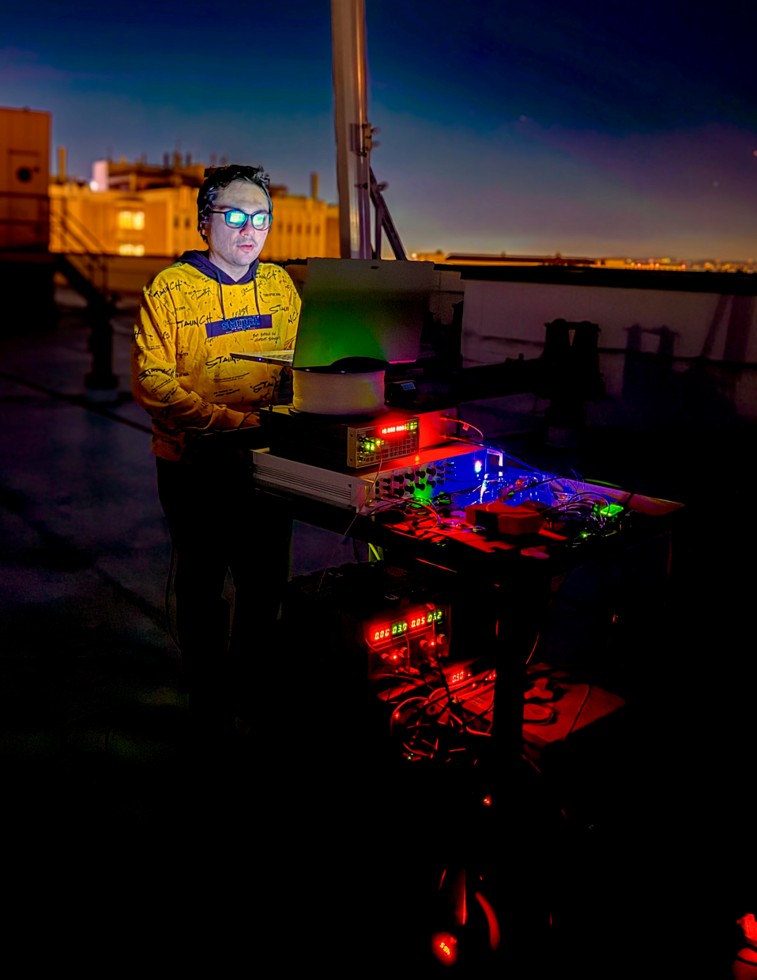
“We demonstrated unambiguous absolute ranging at 1.8 km with around 3 mm average precision and simultaneous velocimetry… Instead of relying on very narrow linewidth lasers, we start with ordinary CW lasers and solve the linewidth problem through optical signal processing.”
Looking ahead, what are the key challenges for bringing this approach into real-world systems, and how do you see coherent LiDAR evolving over the next decade?
The immediate challenges are well defined. Moving this architecture from a lab environment to real-world deployment. Diffuse targets in the open atmosphere will introduce speckle and turbulence-driven fluctuations in the received signal that will stress both the coarse and fine ranging channels. The inter-tone phase differencing is expected to provide some robustness against common-mode phase fluctuations. Our new work is already pushing this into real outdoor atmospheric conditions at up to 15 km distance.
On the hardware side, the current implementation uses bench-top components. Getting this into an airborne or spaceborne platform means moving toward photonic integrated circuits, which would bring down size, weight, and power while improving phase stability. That is a non-trivial engineering effort but the path is clear.
For the longer term, I think coherent LiDAR is moving toward architectures that are simultaneously more capable and less hardware-intensive. FMCW will continue to dominate short-range applications, but for long-range high-precision work, phase-based multi-tone approaches have a real advantage because they do not require a swept source or narrow-linewidth laser. As PIC technology matures, you will start to see these architectures become viable for deployment at scale, including space missions that are currently out of reach for most coherent systems.