Creating the Nodes of the Quantum Internet: A Journey Through Quantum Memories and Entanglement Distribution
Tell us about your journey as a scientist up to now. What’s your academic background?
My journey in experimental quantum physics started with several internships at the University of Innsbruck. In 2015, I finished my Master’s thesis research on single-qubit manipulation of trapped ions at and continued working with ions for quantum networking during my PhD research in Innsbruck. After graduating, I joined in 2022 the group of Prof. Hugues de Riedmatten at the Institute of Photonic Sciences (ICFO) in Barcelona, where I now develop quantum repeaters.
Can you tell us about your current research activities? Share something exciting about your Quantum Storage paper.
Currently, my research focuses on quantum memories based on crystals doped with rare-earth ions. These crystals are combined with sources of entangled photon-pairs and together build an elementary node of a quantum network. By connecting several of these nodes together, we will distribute entanglement over large distances, which forms the basis of a future quantum internet.
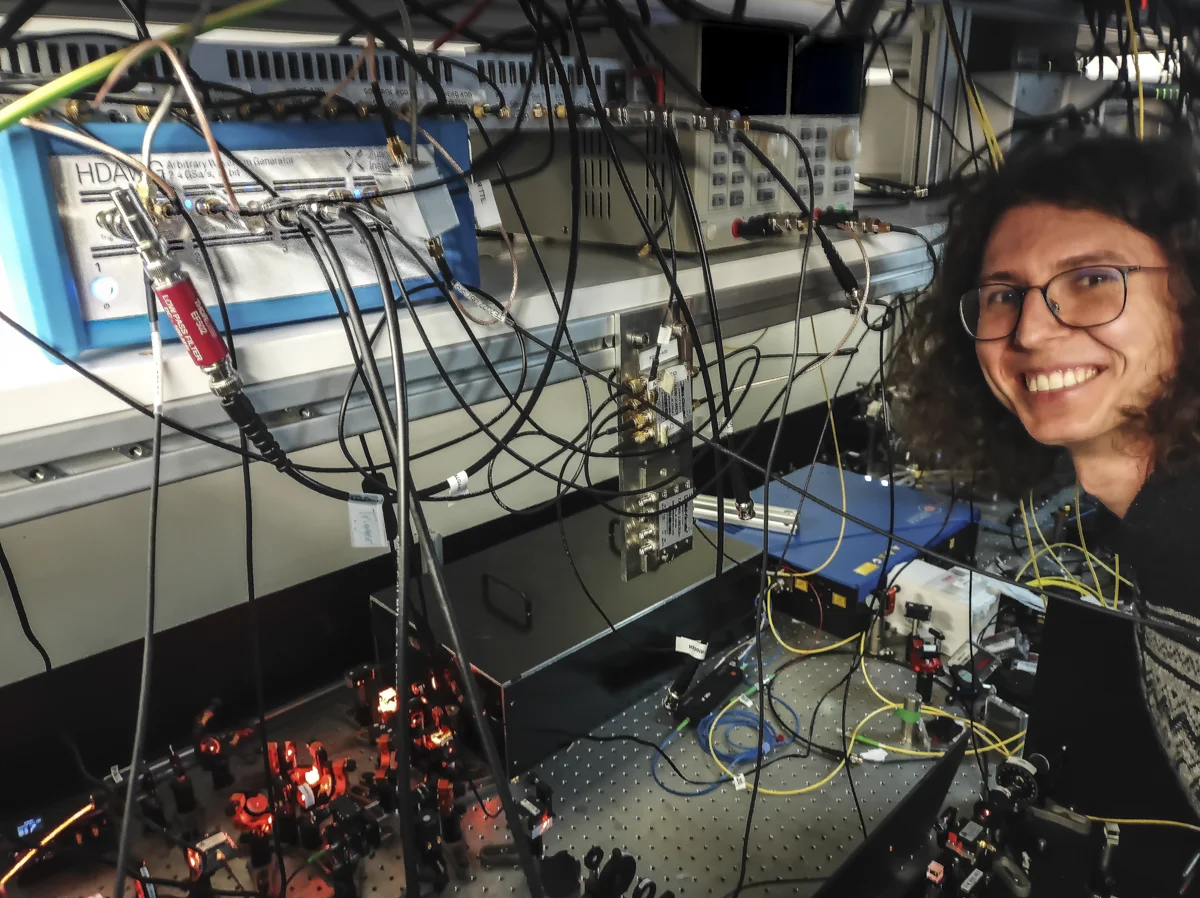
In our recent papers, we developed an array of solid-state quantum memories to increase the entanglement distribution rate and stored qubits, the quantum counterpart of a classical bit, in this array. This demonstration is a step towards a random-access quantum memory, which may enhance the capabilities of a future photonic quantum computer.
How do you see the technology that you are developing impacting everyday life in the future?
A future quantum internet has a wide range of potential applications, as distant quantum computers are connected to share quantum information. A practical example is blind quantum computing, where the quantum computer performs a task requested by a client without gaining information on the computation itself.
What are the next challenges you will need to face to achieve your goals?
One of the next challenges is to increase the efficiency of our quantum memory array, for which we will place mirrors around the crystal. Thus, incoming light passes the crystal multiple times and the storage efficiency increases.
How does the Zurich Instruments HDAWG support your research?
The arbitrary waveform generator (HDAWG) is the heart of the experimental control system of this memory array. The quantum memory preparation and storage sequences are controlled through a python API that connects to the HDWAG. Additionally, the photons retrieved from the quantum memory are counted with the built-in time taggers of the HDWAG.
What is the craziest thing you’ve done (or would have liked to do) in your scientific career?
During my PhD, I participated in an experiment in which we entangled two ions separated by 230m in different buildings. We were sending photons from one side to another while being on a videocall with our colleagues in the other building. Frequently, we were asking “Do you see the detector clicks?” This reminded us of the beginning of the classical internet – “Can you see the L?” during the ARPANET project.