From Molecular Spins to Fault-Tolerant Qudits: Dr. Junjie Liu’s Path to Scalable Quantum Memory
Tell us about your journey as a scientist up to now. What's your academic background?
I completed my undergraduate study at Tsinghua University and then pursued a PhD in Physics at the University of Florida, graduating in 2012 under the supervision of Prof. Stephen Hill. My doctoral research focused on quantum tunneling of magnetization in molecular nanomagnets. Following this, I joined the University of Oxford as a postdoctoral researcher, exploring a wide spectrum of research topics such as coherent magneto-electric coupling, single-molecule electronic and spintronic devices, and low-dimensional quantum magnets.
In 2021, I was awarded a Royal Society University Research Fellowship. This fellowship supports my current research on controlling and reading molecular quantum spins using electric fields instead of the more conventional approach using magnetic fields. I moved to Queen Mary University of London in April 2024 and started my current position as a Lecturer in Physics.
Can you tell us about your current research activities? What are you working on at the moment?
My research focuses on understanding the physics of quantum spin systems at the (sub)nanometre scale, including molecular nanomagnets and semiconductor dopants, and their applications in spintronics. I aim to explore the interplay between spin and electrical/optical degrees of freedom and to develop novel quantum technologies based on these interactions.
I also work on investigating hyperfine-coupled nuclear moments as qudits, physical systems with a Hilbert space dimension greater than two, for use as fault-tolerant logical qubits in quantum information science.
What is especially promising about this topic in your view?
Qudits are quantum systems characterized by d-dimensional quantum systems with d > 2. Their higher-dimensional structure allows quantum information to be stored with redundancy using a single physical object, providing a hardware-efficient platform for quantum error correction that is essential for quantum information science.
Among various qudit systems, quantum spins greater than 1/2 are particularly attractive as they offer a multidimensional but finite and, often, well-isolated Hilbert space. Electronic spins in condensed matter, with their well-defined quantum properties and relatively weak interactions with external excitations, are natural candidates for embodying quantum information; their hyperfine-coupled nuclear spins, which tend to be even more coherent, offer potential as quantum memory elements. Therefore, we exploit the nuclear spin subspace of Mn(II) ions (S = 5/2 and I = 5/2) doped in a ZnO diamagnetic host matrix as a practical platform for implementing a qudit-based fault-tolerant memory protocol [1].
How does the Zurich Instruments HDAWG support your research?
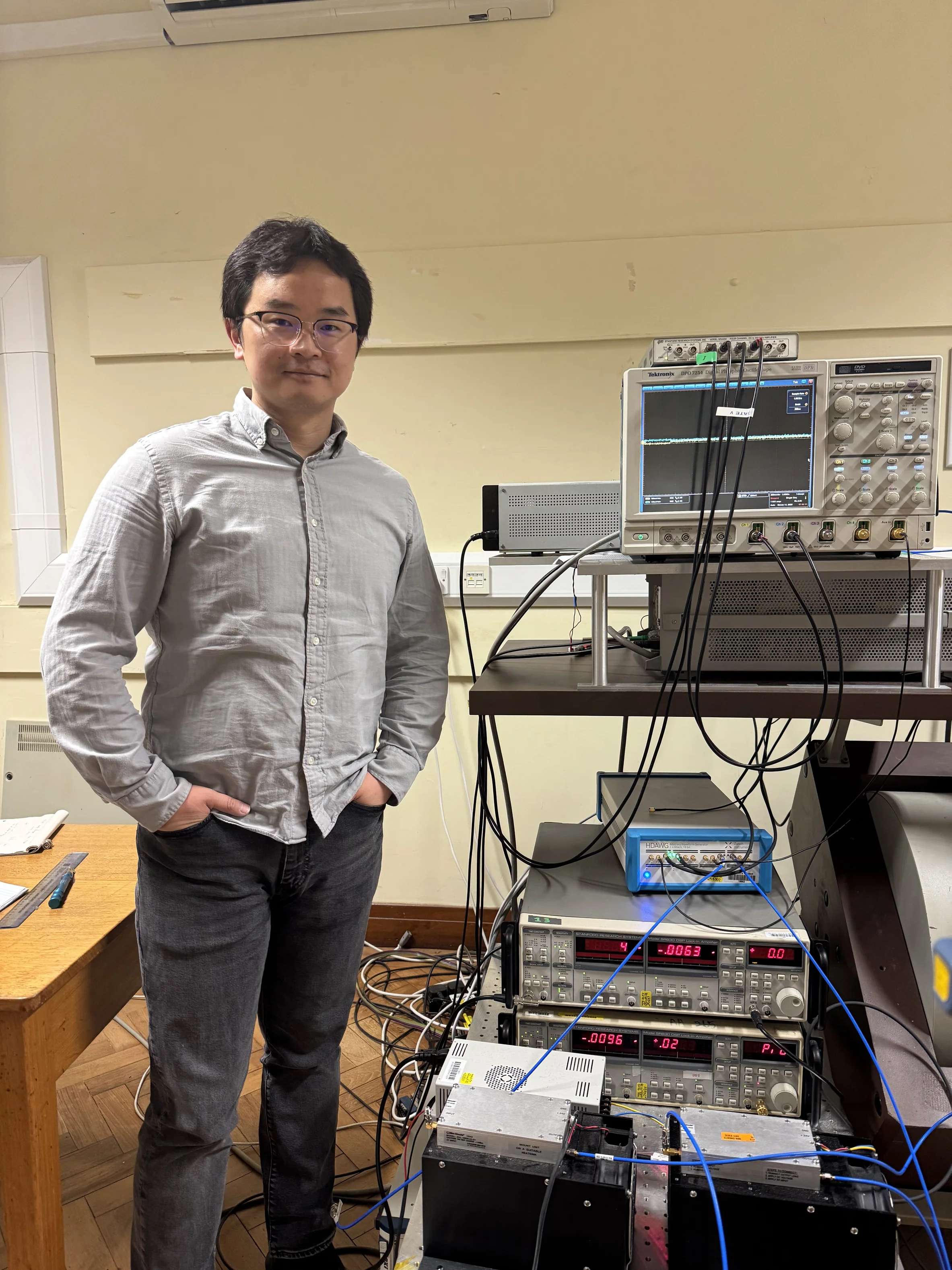
Our experiments require sophisticated pulse sequences involving multi-frequency and multi-phase microwave and radiofrequency pulses, which are challenging to implement using commercial electron paramagnetic resonance (EPR) spectrometers. To overcome these limitations, we developed a custom-designed EPR spectrometer based around a Zurich Instruments HDAWG, which serves as the central control unit.
The HDAWG synthesizes both radiofrequency and microwave pulses (through frequency upconversion), providing full and precise control over all pulse parameters. Additionally, its four analog output channels enable simultaneous manipulation of electron and nuclear spins with a single AWG. This simplifies the experimental setup by eliminating the need to synchronize multiple AWG units.
What would you recommend to young researchers nowadays?
I'm not sure I'm the right person to give inspirational advice to younger researchers. After all, we each have our own reasons for choosing this path. But one thing I've learned from my own experience is to not be afraid of trying new things, even if they don't immediately pay off with publications or results. Looking back, even the projects that seemed to be going nowhere ended up being valuable, often in ways I never expected. Admittedly, these detours meant it took me longer than I would have liked to secure a stable academic position, but they also made the journey a lot more enjoyable.
Reference:
- Demonstrating Experimentally the Encoding and Dynamics of an Error-Correctable Logical Qubit on a Hyperfine-Coupled Nuclear Spin Qudit.
https://doi.org/10.1103/PhysRevLett.134.070603