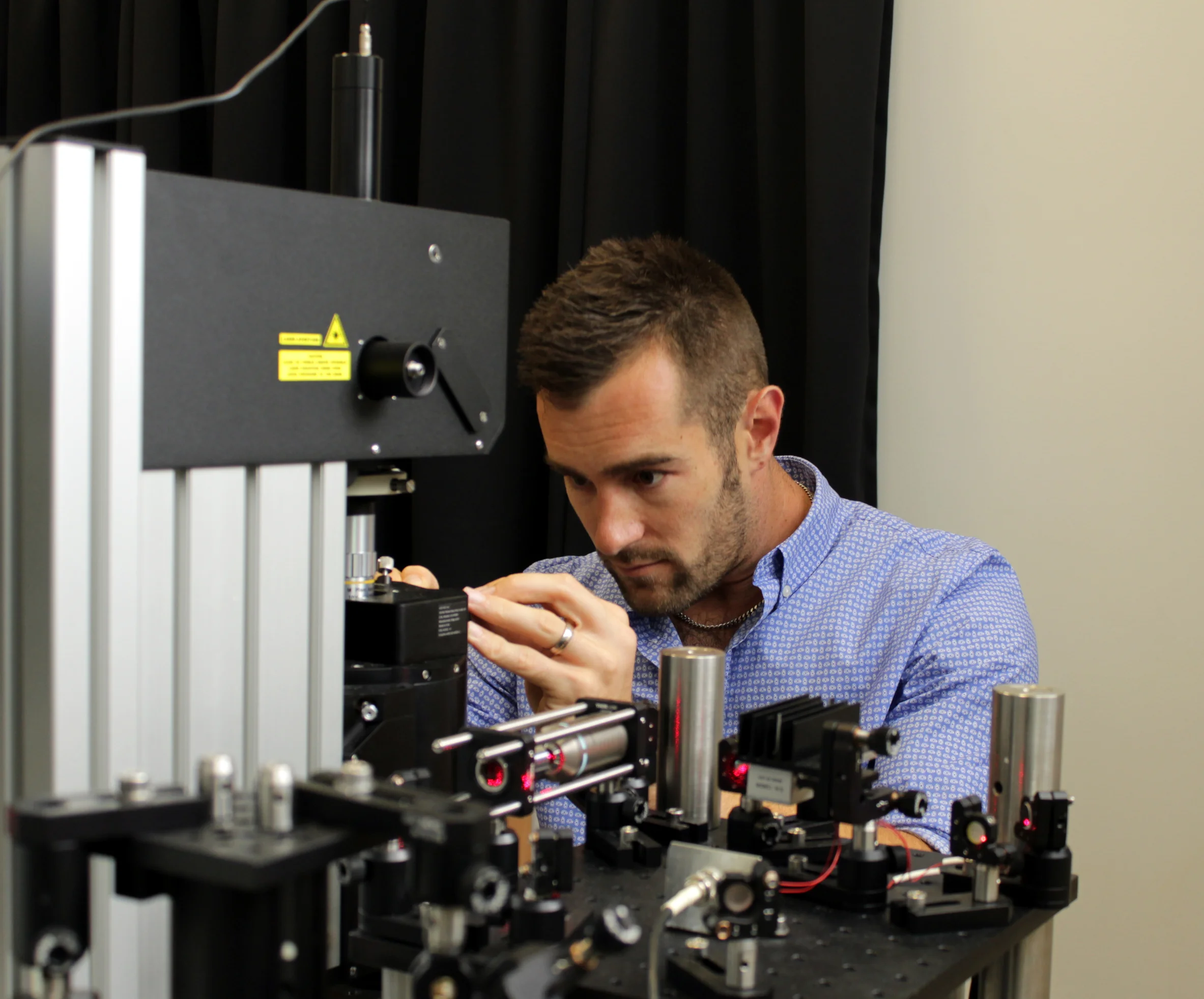
Interview: Michael Ruppert

Tell us about your journey as a scientist up to now. What's your academic background?
My academic background is a little non-standard. I pursued my PhD studies at the University of Newcastle, Australia, in the area of dynamics and control of nanosystems, with a specific focus on developing multifrequency sensing, control, and estimation techniques for Atomic Force Microscopy (AFM). During that period, I also spent some time at the University of Texas at Dallas with my former professor, setting up a new lab and working in the cleanroom. In Dallas, we also developed the first silicon-on-insulator AFM-on-a-chip which motivated me to pursue my work with microelectromechanical systems (MEMS). I then returned to Newcastle as a postdoc, taking on a project on the development of active AFM microcantilevers with piezoelectric layers as part of an ARC Discovery Project; the integration of actuators and sensors on the cantilever itself offers several interesting possibilities. Then, I had a little break from academia and moved to industry for two years, where I worked on piezoelectric transducer instrumentation and electronics design, which are actually also core challenges when working with MEMS and AFM. I really enjoyed this time and learned a lot about electronics and how to design to a high standard and at a commercial scale.
Towards the end of my industrial endeavors, I applied for a Discovery Early Career Researcher Award (DECRA) Fellowship. In the end, I was fortunate enough to receive both, an invitation from the University of Technology of Sydney as a lecturer for mechatronics and, shortly after, be awarded the DECRA Fellowship. This combination now gives me the opportunity to teach mechatronics and electronics while simultaneously pursuing my research on MEMS instrumentation for atomic force microscopy.
What do you view as the next big challenge(s) in this research field?
At the moment, a big challenge still lies in the fabrication and the cleanroom infrastructure one needs in order to produce MEMS. Usually, once you have a certain process worked out - a step of a deposition process, for example - the moment you move to a different cleanroom, or use a different fabrication tool, you will find the same recipe no longer works. As a result, I'm trying to follow the trend of open hardware. For instance, making use of established ‘open' MEMS foundries that provide high-quality yields and fast turnaround times and solve problems from a system perspective rather than from a fundamental process perspective. After fabrication comes the next challenge: integration. A common integration method is wire-bonding, especially for a small number of devices. It's a relatively widely used packaging technology, but as one starts dealing with hundreds of devices with many connections per device, the complexity increases significantly. That’s why we're also looking at other ways of packaging, tackling the challenge from different perspectives; for example, with 3D printing.
How do Zurich Instruments' products support your research?
I've been using Zurich Instruments' lock-in amplifiers ever since I started working on my PhD. For instance, we used the HF2LI to perform multi-frequency AFM measurements and to control our custom AFM nanopositioning stages and microcantilevers with the PLL/PID controllers, the simplicity of the setup helped tremendously. Additionally, I use the Zurich Instruments MFIA Impedance Analyzer, as I am interested in the electrical properties of different piezoelectric layer configurations and in tracking the impedance during heating or cooling of the devices. Overall, the Zurich Instruments devices, in combination with the LabOne® software suite, stand out as a one-stop instrument solution for MEMS research. Thanks to their capabilities - from performing frequency sweeps and single or multi-frequency analyses (Integrated Toolset), to utilizing phase-lock loops and amplitude controllers - they serve as comprehensive tools for these research applications.
What would you recommend to young researchers nowadays?
This is a tough question because I found that breaking into the academic job market is extremely difficult. My biggest recommendation would be to not be afraid of going down an unconventional path. My path was, in fact, quite unconventional, but in the end, the mix of academic and industry experience has put me in the position of being the most competitive candidate for my current position. On the other hand, I would recommend to try and apply for as many funding applications as you possibly can. Universities are ultimately businesses and, in many cases, operate as such, and your biggest selling factor may be how much money and interest you can attract for your research. By demonstrating that you can attract interest through funding, you will gain capacity and capability to pursue your research. And don't be afraid to submit 10 grant applications and only get one, because it's only the one that counts.
Do you plan to hire PhD students in your lab?
Absolutely. I am currently advertising for two PhD scholarship opportunities and shortly for a postdoctoral position. If you are interested, please get in touch with me for more information.