A Simple Path to Fast Graphene Qubit Readout: QPC Sensor in a Resonant Circuit
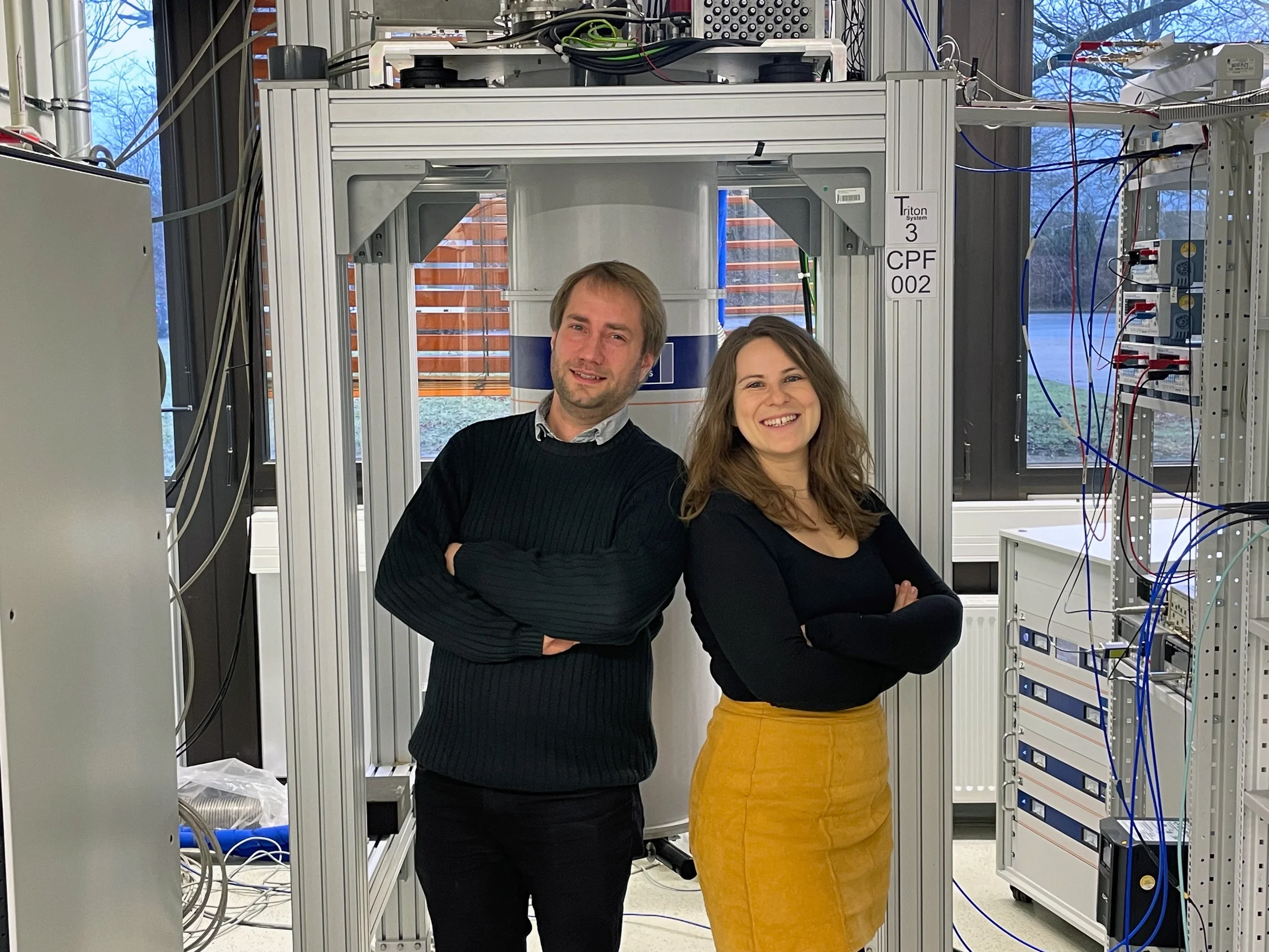
A User Story by Christian Volk and Katrin Hecker, Lehrstuhl für Festkörperphysik, RWTH Aachen
Introduction to Graphene Quantum Dots and Their Potential for Solid-State Quantum Computation
Quantum dots (QDs) in bilayer graphene are a promising new platform for spin- and valley-based solid-state qubits. The naturally low hyperfine interaction and low spin-orbit coupling in bilayer graphene suggest long coherence times, and the gate-voltage-tunable band gap facilitates the confinement of electrons and allows the formation of electron and hole QDs in the same device. Spin and valley relaxation times have been measured using pulse-gated DC transport techniques, and blockade mechanisms for spin and valley states have been demonstrated in bilayer graphene double QDs, enabling spin- and valley-to-charge conversion [1].
The Challenge
A fast readout mechanism for charge, spin or valley states is essential for operating QDs as qubits. So far, charge sensing on bilayer graphene QDs has been demonstrated both by transport through a capacitively coupled QD and by dispersive readout techniques. Detection bandwidths limited to the Hz to low kHz regime have been achieved. Further experiments require measuring the real-time dynamics of the QD state occupation with a large single-shot bandwidth, in the 100s of kHz to MHz regime.
Our Solution
We implemented a radio-frequency (RF) charge detection scheme using a capacitively coupled quantum point contact (QPC) as a fast charge sensor. By embedding the QPC in an impedance-matched resonant circuit, we monitor charge transitions in the nearby graphene double QD up to a bandwidth of a few MHz. The Zurich Instruments 600 MHz UHFLI Lock-in Amplifier plays a central role in this setup, as it provides the RF carrier, digitally demodulates the signal reflected by the resonant circuit and offers different filtering options. This significantly reduces the complexity of the experimental setup compared to home-built analog demodulation circuits.
The Results
With RF reflectometry-based charge detection in a bilayer graphene double QD, we achieve a detection bandwidth of 7 MHz, significantly faster than conventional DC measurements. We apply the readout scheme to an electron-hole double QD - a unique configuration in bilayer graphene - and we demonstrate time-resolved detection of charge states, which promises a high-fidelity readout scheme for graphene-based qubits [2].
What’s Next?
In future experiments, we aim to combine this readout technique with the robust spin-valley blockade in electron-hole double quantum dots (QDs) to investigate the dynamics of spin and valley states in bilayer graphene QDs, with the ultimate goal of establishing this scheme for qubit readout.
References
[1] L. Banszerus et al., Particle-hole symmetry protects spin-valley blockade in graphene quantum dots. Nature 618, 51 (2023)
[2] K. Hecker et al., Radio-frequency charge detection on graphene electron-hole double quantum dots https://pubs.acs.org/doi/10.1021/acs.nanolett.5c04648