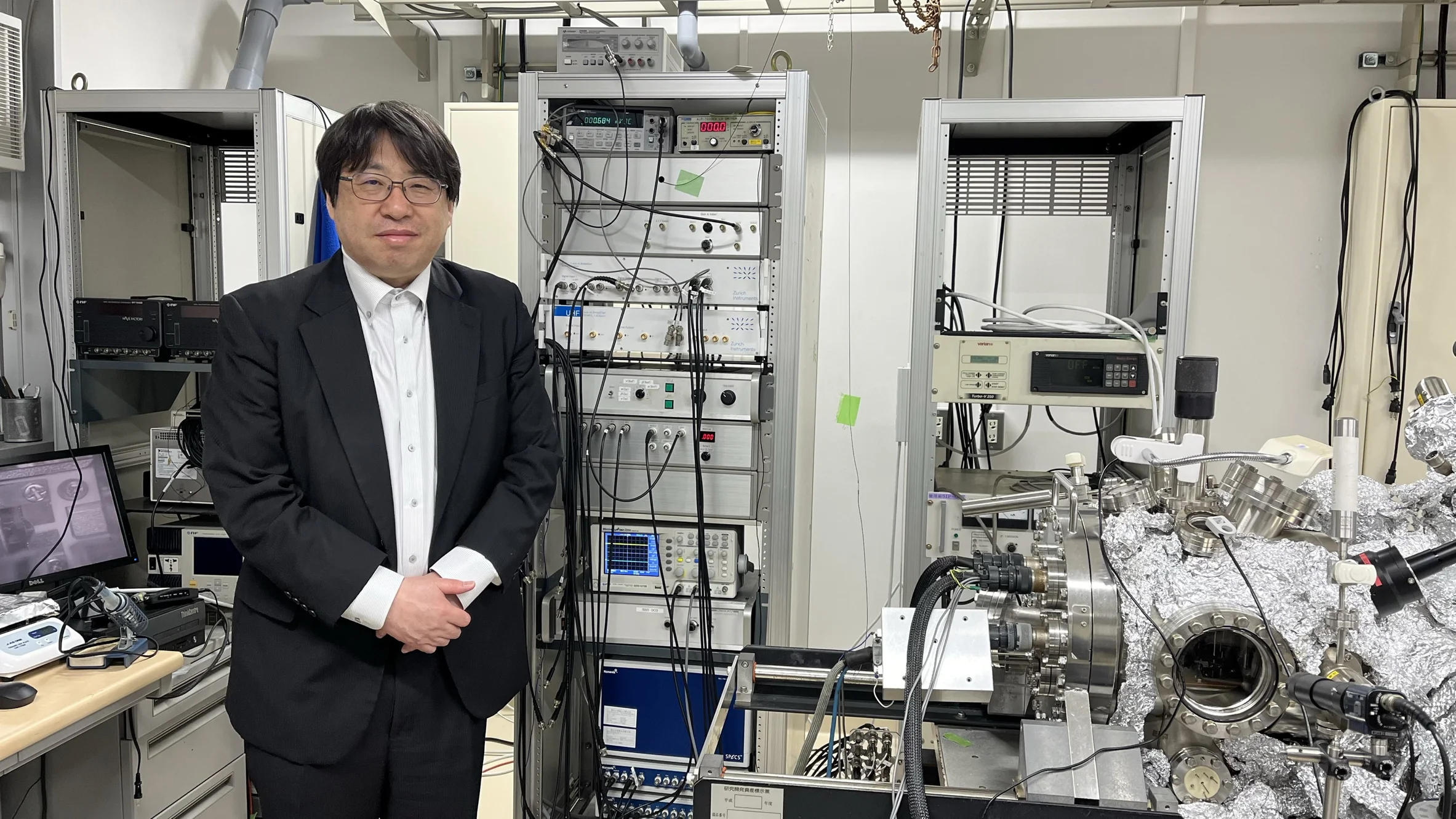
Interview: Prof. Yasuhiro Sugawara

First of all, can you tell us about your journey as a researcher?
In my PhD, I studied ultrasonics, the acoustic microscope. I learned a lot about ultrasound and high-frequency systems there. After that, I started working with Dr. Seizo Morita on Atomic Force Microscopes (AFM). At that time, atoms could be seen with an STM, but the AFM was still a simple device that could only capture surface features, and it was not possible to capture atomic images, but we felt the potential of that and started working on it.
Around 1989, I wanted to make an ultra-high vacuum AFM and get atomic images out of it. I had been consistently searching for a new microscope technology that would allow me to see atoms more clearly. For that, the displacement of the cantilever had to be measured very sensitively in UHV, so we developed optical interferometry technology. It took us about five years to develop such a technology to measure displacement using optical fiber. It could also be used at low temperatures, which led to the development of such applications of AFM at low temperatures.
In 1995 we were able to obtain atomic Images. Prof. Franz J. Giessibl published a paper on silicon 7X7 in Science in 1995, and I published my paper in Science in the same year on iridium phosphorus with defects.
You’ve been devoted to this research for a long time. Can you tell us what your main research interest has transitioned to by now?
I myself have two main research topics, one is the interface level inside solids, and the other is photo-induced force microscopy, which is based on the detection of the dipole - dipole interaction. One dipole is induced by the materials, which are radiated by optical fields. The other dipoles are induced on the metal tip, radiated by the optical light, and the dipole-dipole interaction is measured by using the force. It is possible to observe the optical properties of the materials with high spatial resolution. Recently, we succeeded in performing the 0.6 nanometer spatial resolutions of the molecules. Which resulted in the current world record of optical microscopes.
I always wanted to develop new technologies besides AFM, not only by it’s functionality. I believe that the technology combining light and AFM is important for the next generation, so that’s what I've been trying to achieve.
You have been quite focused on new technological breakthroughs for the future. What do you find to be the most exciting or interesting when a new breakthrough works well?
As a researcher, it is a pleasure to be the first to discover something that no one has ever understood before. And I aim to develop such new scientific breakthroughs.
Following the previous question, from your point of view, are nowadays' scientific breakthroughs more driven by good ideas or by good instruments?
I believe there are three important points: technique, science, and knowledge. I'd like to somehow intertwine all three. I am trying to learn and develop the science and then think about what to do with the other two. Even though it is not as interesting if I only focus on technique, I want to emphasize its importance. We develop original equipment in my lab, especially if our specific requirements are not met with commercially available instruments.
How have Zurich Instruments’s products contributed to your research?
When I would like to develop a new setup, the setup is easy to implement with Zurich Instrument’s products and LabOne software, which has continuous good updates and developments, and its performance is top-notch. That's a big advantage for us. For example, the development of the electric circuit normally requires several months. Especially when we need a single side band demodulation in our system. With the HF2LI MOD option from Zurich instruments HF2LI lock-in amplifiers, it is easy to obtain a single side band signal without spurious noise.
Also, in order to develop photo-induced force microscopy, the most important point is to illuminate the optical effect onto the cantilevers. For that purpose, high-frequency modulation of the optical light is needed. The UHFLI, which can cover from DC to 600 MHz, fulfills my purpose.
The applied and modulated light can generate a very small power to the cantilevers, due to the heat effect. The frequency then has to be increased dramatically in order to eliminate such heat effect. Therefore, we had to create a single side band at the raised frequency. We were able to achieve up to that level of high frequencies with the AM/FM modulation option on UHF Lock-in amplifier.
It may be difficult for young people to enter the field now, but what advice/encouragement would you give them from your perspective as an experienced researcher?
I have been trying to do quite a bit of work that not many people focus their research on, which makes it difficult to obtain budgets. Young people may think that they shouldn’t continue with such unpopular topics and may jump into shorter-term projects. However, I hope that young people will always keep one or two long-term topics in mind when conducting their research.
Researchers have to establish the foundations steadily over a long period of time. Without that, nothing exciting will come out of it. Can you imagine how many years I have been working on the current photo-induced microscope? I have been working on it for about 25 years now, and only recently has it been recognized. For a long time, many people told me it was impossible to establish.