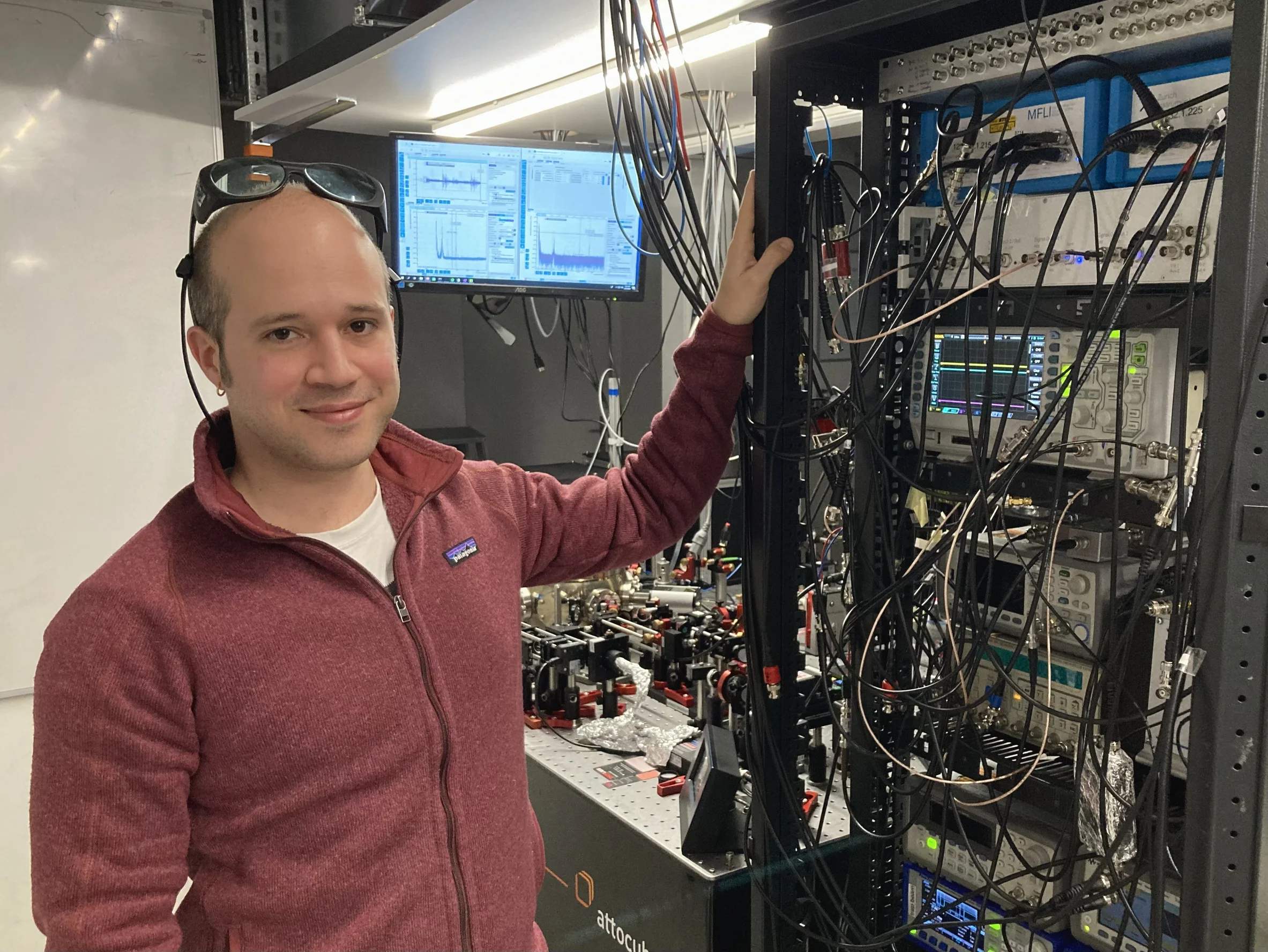
Interview: Nicola Carlon Zambon

Could you give us an intro of your scientific background up to now?
I did my undergraduate and part of my master studies in Padova University. Back then, I was quite fond of statistical physics and complex systems. It is because of one lab project during my master that I got interested in optics: I had to image one object without directly looking at it by using the statistical properties of a speckled light pattern. Then, I moved in C2N labs near Paris for my PhD where I worked on semiconductor microcavities hosting hybrid light-matter excitations called polaritons. It is an incredibly versatile platform, allowing for research topics ranging from many-body physics to nonlinear optics and topological photonics. During my PhD, I was attending a conference when I first heard about optomechanics with levitated objects. I was fascinated by the degree of control levitated systems could achieve, but I knew very little about this field of research. Hence, during the Covid outbreak, I took some time to learn about it. First, I stayed for a short postdoc at C2N where I tried to understand optomechanical interactions in semiconductor microcavities. One year later, I joined the Photonics laboratory thanks to an ETH fellowship to work on levitodynamics and precision optical measurements.
You recently got a new MFLI (not the first one in your lab). Can you describe in a few words the experiment you used the lock-in for?
The interplay of light with moving objects generates optomechanical interactions, an essential resource for sensing, metrology, and the investigation of fundamental aspects of quantum mechanics with mesoscopic systems. In the Photonics laboratory, we harness optomechanical interactions to probe and control, at the quantum level, the motion of levitated nanoparticles in ultrahigh vacuum.
So far, research on levitated nano-objects has mainly focused on measuring and controlling their center-of-mass and rotational degrees of freedom. Nevertheless, nanoparticles also possess highly discretized vibrational modes in the GHz band that are appealing for interfacing our system with other platforms. To probe the acoustic modes, we want to use a two-tone optical spectroscopy technique that enhances the optomechanical interactions among the nanoparticle vibrations and the laser field. Indeed, when the optical beat note matches an acoustic resonance, it leads to an increased energy transfer from the optical to the mechanical mode. This produces a small absorption dip in a differential measurement of the laser field intensity before and after interacting with the nanoparticle. The signal is likely to be as small as a part per million of the reference intensity; for this reason, we opted for a bichromatic modulation lock-in technique. The large dynamic reserve 16bit ADC, together with the versatile demodulator interface, made the MFLI a to-go choice for this application.
This MFLI has two additional options. In what ways are they going to help you with the measurements?
The digitizer option enables a dual-trace oscilloscope, which is ideal for hunting noise sources by comparing the power spectra of the electrical signals generated by different photodetectors or electronic amplifier stages. Moreover, while the particle is held in the optical tweezer, we need to monitor and perform diagnostics on its center of mass motion. To do so, we need to look at the trapping laser power spectral density that features characteristic sidebands resulting from optomechanical interactions. The multi-demodulator option serves two purposes. On one hand, we need a PLL to track the nanoparticle longitudinal motional frequency and generate a parametric feedback signal that reduces the particle oscillation amplitude (see the Application Note: Parametric Feedback Cooling). This is essential to avoid particle loss when pumping down to high vacuum and signal loss in unwanted motional sidebands. On the other hand, two additional demodulators were necessary to lock in the acoustic spectroscopy signal at the sum and difference frequencies resulting from the twin amplitude modulation of the optical tones.
If you could name your favorite feature of LabOne®, what would it be, and why?
I am personally a big fan of the API Log. It is a small feat, but it makes the automatization of the experimental sequence and of data acquisition straightforward. With other instruments, I spent several hours scrolling through the API manuals looking for the necessary command line that needs to be prompted to configure some instrument settings. Thanks to the API Log, controlling the experiment from Python is almost just a matter of copy-paste. I believe this feature also lowers the barrier for students who want to learn how to remotely interface and control experiments with a computer. This soft skill is becoming increasingly valuable, especially given the growing complexity of experiments in the quantum engineering era.
During your experience with our options, which is the most valuable or powerful one you tried, and why?
All experiments with levitated nanoparticles require many control systems, from PPLs tracking the motional frequencies of the nanoparticle, to the PI controllers that lock our optical interferometers or stabilize the laser power and frequency. We often use an MFLI supplemented with the Quad PID/PLL Controller Option to take care of most high performance active feedback loops. The fully reconfigurable settings of the loops make them a versatile, dial-in version of analogic controllers. When combined with the digitizer option, and with four demodulators, this enables both control of the experiment and the acquisition of data using a single instrument. Moreover, using the multi-device sync option built into the Zurich Instruments lock-in amplifiers, such an approach is scalable to more elaborate setups, where large numbers of inputs, outputs and control signals are needed.
What would you recommend to young researchers nowadays?
I don’t feel like I have some grand recommendation or inspirational message. What made me enjoy these years was mostly the beautiful people I met along the way. Both from a human point of view and because of all the things I learned from them. I think the academic world presents several criticalities, yet it still tries to foster a cultural and intellectual melting pot that I very much enjoy. I strongly believe in a collaborative approach to research, which I consider essential when facing challenging scientific endeavors.