Laser Thermal’s Approach to Measuring Thermal Conductivity: Hans Olson on Thin Films, Bulk Materials, and Heat Transfer Challenges
Can you take us through your company's origins? How did the initial idea come about and evolve into the company you are today?
Laser Thermal’s origins began at the Experiments and Simulations in Thermal Engineering (ExSiTE) Lab at the University of Virginia. The ExSiTE lab, led by Professor Patrick Hopkins, specializes in optical-based pump-probe thermometry for the measurement of thermal properties of materials, from thin film to bulk. A well-known issue with pump-probe thermometry is its complicated optical setup, implementation, and analysis. Motivated to solve these problems, while at the ExSiTE lab, five of the principal engineers at Laser Thermal invented an “all in fiber” pump-probe implementation and a new pump-probe metrology, Steady State Thermoreflectance (SSTR). SSTR provided a drastic simplification in optical design, in addition to the ability to directly measure thermal conductivity and thermal resistance of thin films and bulk materials. This, combined with the reduced cost and acquisition time of SSTR, provided a major breakthrough in optical thermometry of thin films.
It was at this point that John Gaskins and Patrick Hopkins co-founded Laser Thermal in order to commercialize the implementation of SSTR in fiber optics, leading to Laser Thermal’s first commercial product, SSTR-F. SSTR-F provides industrial customers and academics with accurate, fast, streamlined thermal measurements without the need for the expertise of a PhD. This product has been placed in the customer R&D and Failure Analysis lab, as well as enabling Laser Thermal to provide testing services. Beyond their first product, Laser Thermal continues to innovate user-friendly testing solutions across a range of length scales serving emerging customer needs.
Talk us through your flagship product. Could you explain how Zurich Instruments' HF2LI integration supports your startup and your mission? How does it contribute to what you can offer your clients?
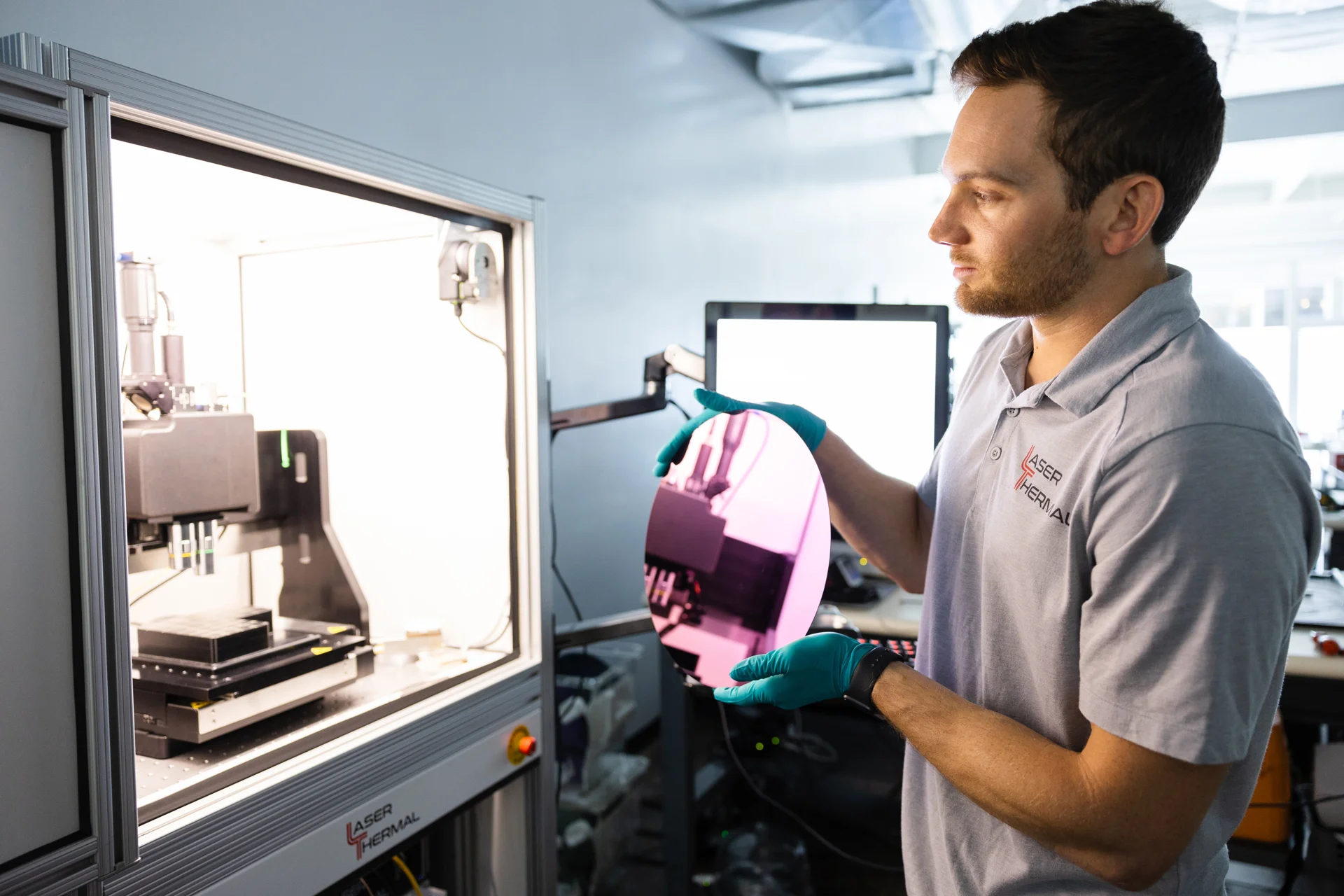
Laser Thermal’s flagship product is the Steady-State Thermoreflectance in Fiber optics (SSTR-F). SSTR-F utilizes optical pump-probe spectroscopy to determine the thermal properties of atomically thin interfaces, nanometer- to micrometer-thick thin films, and bulk materials with micrometer lateral resolution. SSTR-F differs from other technologies in that it independently measures thermal conductivity without requiring knowledge of heat capacity, whereas other technologies typically measure a convolution of the two via thermal diffusivity or effusivity measurements.
In SSTR-F, specimens of which the thermal properties are of interest are coated with a ~100 nm thick transducer layer, typically aluminum or gold. A modulated pump laser is focused at the surface of the transducer layer, creating a periodic temperature rise that is dependent on the thermal properties of the materials beneath the transducer layer. A continuous wave (cw) probe laser is coaxially focused with the pump laser at the surface of the transducer layer, and monitors the change in reflectivity arising from the pump heating event via the thermoreflectivity of the transducer, which is typically on the order of ~10-5-10-4 K-1. In order to measure such small changes in reflectivity, lock-in amplification is required, necessitating the use of the Zurich Instruments HF2LI.
The Zurich Instruments HF2LI is an integral component in delivering SSTR-F. Our mission at Laser Thermal is to provide rapid, accurate measurements of thermal properties, which is enabled by the HF2LI. Zurich Instruments provides exceptional hardware when it comes to the instrument, delivering an ultralow noise floor, high resolution, and high speed. We utilize virtually all of the available I/O on the instrument, delivering a more repeatable, more accurate measurement to our customers. Interfacing via software with the HF2LI is also incredibly simple thanks to their numerous APIs, helping us streamline data acquisition and reduce overall measurement time. The HF2LI is easy to use and was an obvious choice for implementation with SSTR-F.
What problem does your product, the SSTR-F, solve, and what need does it meet in the current market? How does the Zurich Instruments HF2LI Lock-in Amplifier support your semiconductor challenges?
SSTR-F provides rapid, accurate thermal measurements of atomically flat interfaces, nanometer- to micrometer-thick thin films, and bulk materials. Our product, therefore, serves a wide array of industries, from semiconductors to aerospace. In the semiconductor industry, a robust understanding of the thermal properties of materials at the atomic length scale has been largely unavailable. At these length scales, the thermal properties of materials differ drastically when compared to their corresponding bulk phases, and the thermal resistance at material interfaces can contribute significantly to the total thermal resistance of multi-layer material systems. Optical pump-probe spectroscopy techniques, like SSTR-F, are the only techniques that are able to perform non-contact, high throughput measurements at these length scales to provide accurate results.
Our customers in the semiconductor industry use SSTR-F to develop databases of thermal properties based on thickness, process conditions, and material system geometries so that they can thermally simulate their devices before physically manifesting them. To enable the throughput needed by our customers in the semiconductor industry, we leverage the HF2LI to quickly and accurately provide the data needed.
What do you find particularly promising or exciting about your industry and your startup’s role in it?
Thermal properties at any length scale are pertinent to functionality, and an understanding of those properties is therefore paramount to ultimately understanding device performance. As technologies continue to develop and thermal densities increase, there will continue to be a need to understand thermal properties. Laser Thermal’s mission is to offer cutting-edge solutions to our customers looking to optimize the thermal performance of their technologies. Currently, a limited number of metrologies exist which can provide rapid measurements of thermal properties at virtually any length scale, from nanometer thin films to bulk materials. Moreover, SSTR-F offers customers the ability to measure thermal conductivity independently of heat capacity. Thermal conductivity is the critical parameter when determining the appropriate heat flux a technology can withstand, and often cannot be determined independently from a material’s heat capacity. These capabilities bring new insights to modeling and design efforts driving customer
Beyond SSTR-F, there are a number of products in development at Laser Thermal to meet the demand of the thermal metrology industry. Laser Thermal is developing technologies to understand thermal properties with nanometer lateral resolution, serving biotech and semiconductor industries alike. Additionally, a metrology suited more for macroscale thermal conductivity measurements is in development, geared towards bulk materials with the ability to perform measurements in excess of 1000 °C. Laser Thermal is excited to continue to innovate new thermal solutions, meeting customer needs, and filling existing voids in the thermal measurement space.
What's a remarkable story from your startup's journey, and what would be your advice to other companies looking to leverage the power of high-tech equipment like Zurich Instruments' in their products/services?
We have established ourselves as a trusted source for thermal measurements with some of the largest customers in the world in a few short years. As a startup, focusing every possible effort on ensuring that your products are a market fit and serve your customer’s needs is of utmost importance. Part of ensuring we meet our customers stringent requirements requires judiciously testing each and every component our product relies on, and holding them to high standards. Equipment like the HF2LI have been instrumental in the development of SSTR-F, and ultimately reduced the time to market for our product. Between the exceptional hardware, robust software interface, and ease of use, the HF2LI was the obvious choice when it came to considering which lock-in amplifier to use. Having used a variety of Zurich Instruments products, we would recommend interfacing with their very knowledgeable technical staff to speed up the time to integration and understanding of the products to be as quick as possible in order to utilize them in applications where precision, accuracy, and speed are of the utmost importance.