Parallel MRI: Unlocking Multinuclear Imaging with a Single Channel
A user story by Mohammad Rasool Vaezi Kakhki, Karlsruhe Institute of Technology (KIT)
MRI is one of the few imaging techniques that can non-invasively visualize both structure and function deep within an object. While traditionally used in clinical imaging, MRI’s ability to detect various atomic nuclei makes it equally powerful in materials science, chemistry, and biology. By tuning to different nuclei, MRI can provide multi-dimensional insight into dynamic processes -- if the hardware allows it.
The Challenges with Conventional MRI
Standard MRI systems typically image only one nucleus at a time, requiring separate hardware for each nucleus and repeated scans. This sequential approach limits efficiency, increases scan time and cost, and complicates system design -- especially when studying multiple interacting species, such as in metabolic or multi-phase processes.
Our Solution: Parallel Multinuclear MRI
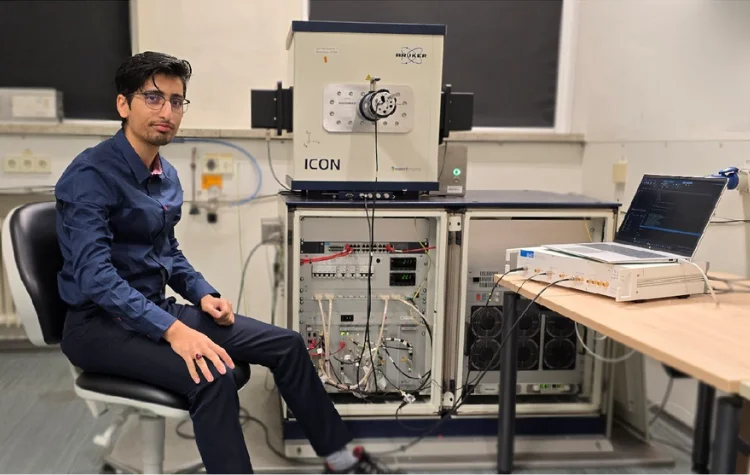
To overcome these challenges, we developed a hardware-efficient method for simultaneous multinuclear MRI using a single RF transmit/receive channel [1]. At its core is the Zurich Instruments 600 MHz UHFLI Lock-in Amplifier, which enables digital demodulation of multiple MR signals acquired in parallel. We built a broadband radiofrequency (RF) coil by lowering the Q-factor to support 1H and 19F frequencies simultaneously and processed the combined signal with multiple demodulators, each tuned to a specific nucleus. The setup features a custom gradient controller and low-field magnet, with the UHFLI handling high-speed acquisition and digital signal separation -- all without measurable crosstalk between nuclei.
The Results
Our system successfully acquired simultaneous 1H and 19F MR images in a single scan with no compromise in signal quality. The measured SNR of 54 even exceeded that of a commercial single-nucleus setup (SNR 43), Bruker. The method is inherently scalable: up to eight nuclei can be acquired concurrently using a single RF channel, limited only by the processing capacity of the FPGA inside the UHFLI. In principle, even more nuclei could be handled with faster hardware or online processing.
What’s Next?
The principle of parallel detection can be extended to other techniques such as electron paramagnetic resonance (EPR), where the signals are in the gigahertz range and thus call for instruments that work directly at those frequencies, such as the SHFLI 8.5 GHz lock-in amplifier.
Reference:
- M. Rasool Vaezi, Simultaneous multinuclear MRI via a single RF channel. Journal of Magnetic Resonance,368, 107782 (2024) 📄 https://doi.org/10.1016/j.jmr.2024.107782