Heterodyne Phase-Sensitive Dispersion Spectroscopy With QCLs: Single-Box Solution Using a GHz Lock-in Amplifier
Heterodyne phase-sensitive dispersion spectroscopy (HPSDS) measures the wavelength-dependent profile of the refractive index of a gas in the vicinity of its molecular resonances by tracking the phase of a GHz modulation imposed on a mid infrared quantum cascade laser (QCL). Unlike conventional absorption spectroscopy, e.g. tunable diode laser absorption spectroscopy (TDLAS), where the gas concentration in a sample is measured by how much light is absorbed as a laser is tuned across a transition, HPSDS takes advantage of dispersion, i.e., how the refractive index changes with wavelength, to infer the gas concentration of a sample. Dispersion-based detection presents some advantages: it is inherently robust to signal fluctuations in the optical path, and yields a signal that is linear with concentration, making it ideal for quantitative gas sensing.
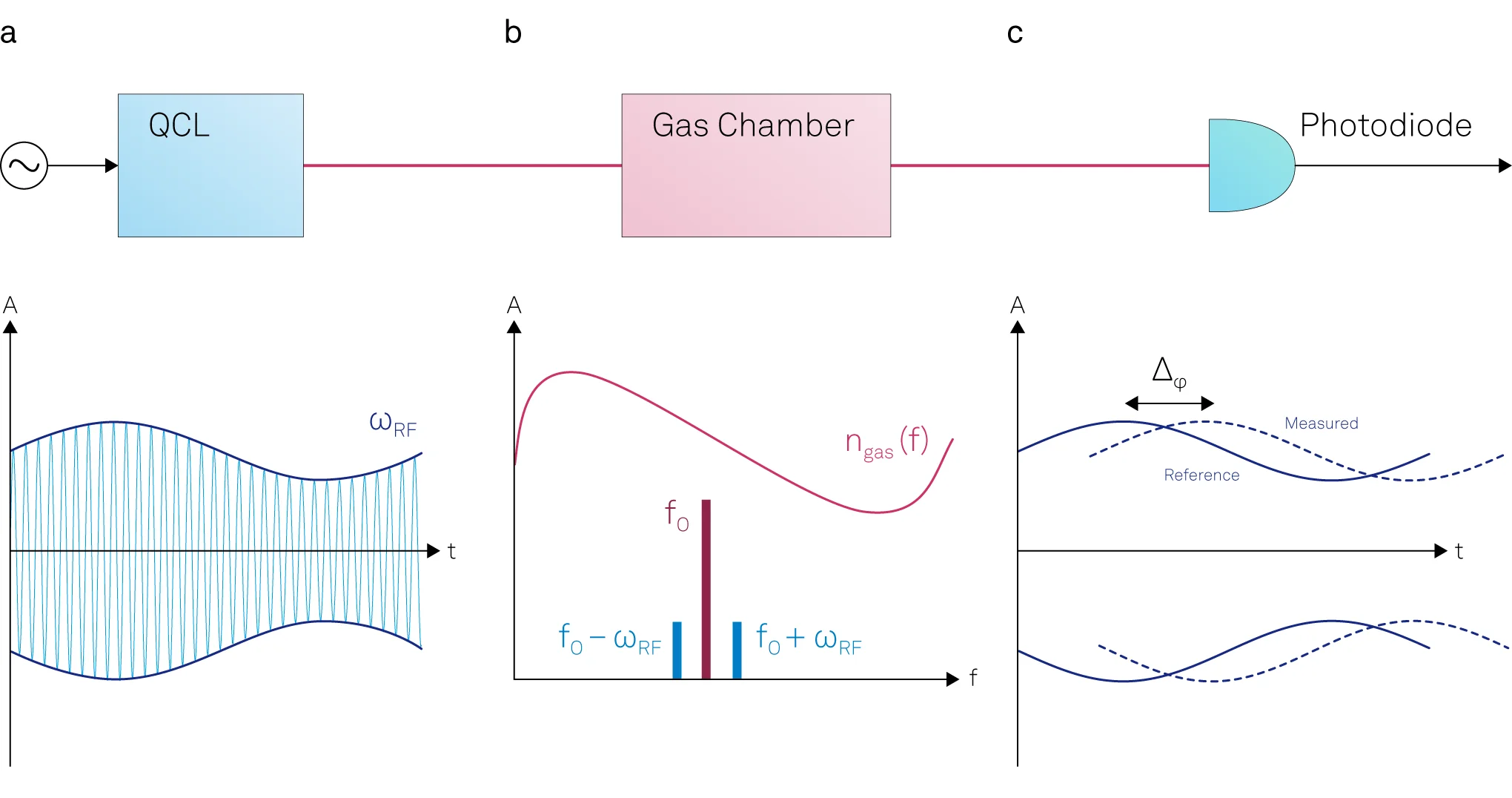
In HPSDS, the mid infrared QCL is intensity‑modulated with a GHz tone, ωrf. In the time domain, the fast THz carrier, f0 (light blue) is amplitude‑modulated at ωrf (dark blue) (Figure 1A). In the frequency domain, this produces a carrier at f0 and two sidebands at f0 ± ωrf. The beam then passes through the sample (Figure 1B), where the gas refractive index ngas(f) varies with frequency. The dephasing of the light is given by
\(\Delta\phi = \frac{ 2\pi f_0 L}{2 c} ( n_{gas} (f ) - 1)\),
where L is the length of gas cell and c is the speed of light. This shows that the carrier and sidebands accumulate different phase delays, causing the relative dephasing of the sidebands. A fast photodetector measures the intensity, effectively down‑converting the mid infrarred field to an electrical signal at ωrf and recovering the modulation envelope whose phase delay, with respect to the original modulation, encodes the dispersion (Figure 1C). More details on the experimental implementation of HPSDS can be found in [1].
Experimental Challenges
To carry out a successful HPSDS measurement, it’s important to be able to:
- Generate and analyze a clean GHz reference to extract phase with high precision; the frequency must be high enough to yield sideband separations in the GHz range for measuring a large number of gases of interest at ambient pressure.
- Probe multiple species simultaneously by driving multiple tones with enough frequency separation on separate QCLs and measuring them on a single detector, without crosstalk or detector-induced beatnotes.
- Sweep the QCL center frequency by ramping the power supply in a controlled, reproducible way to recover the dispersion profile of the molecular transition.
Traditionally, achieving this functionality required a fairly elaborate experimental setup, including local oscillators (LOs), signal generators, and mixers used for up- and down-conversion.
The Solution With Zurich Instruments’ GHFLI
A single-box workflow with the GHFLI Lock-in Amplifier simplifies HPSDS from source to analysis:
- Modulate and analyze in the GHz: drive the QCL(s) and demodulate at the modulation frequency directly on the instrument across the full 1.8 GHz span, no external LOs or mixers.
- Multiplex multiple tones: excite multiple arbitrary RF frequencies and read them out on one detector channel without the bandwidth compromises typical of down-converting into low-bandwidth lock-ins.
- Sweep with built-in ramps: generate stable current/voltage ramps for the QCL power supplies to scan the laser frequency without the need for additional equipment.
- Analyze with ease thanks to LabOne: use the Data Acquisition Module (DAQ) to record phase vs sweep, the Sweeper for parameter scans, and the Spectrum Analyzer for quick noise checks and sweet-spot optimization.
- Improve SNR on the fly with straightforward averaging of measurement traces.
HPSDS Experimental Setup
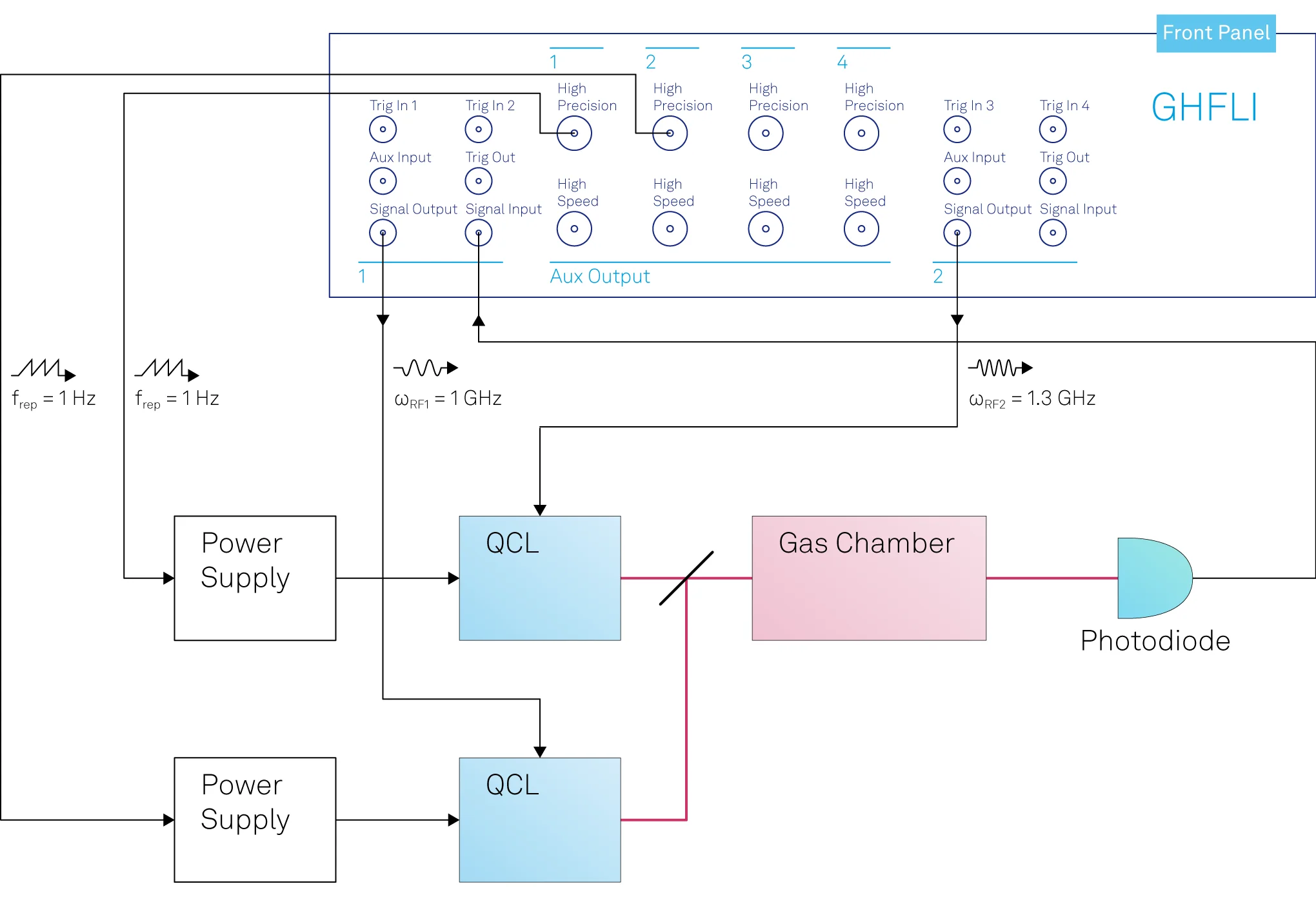
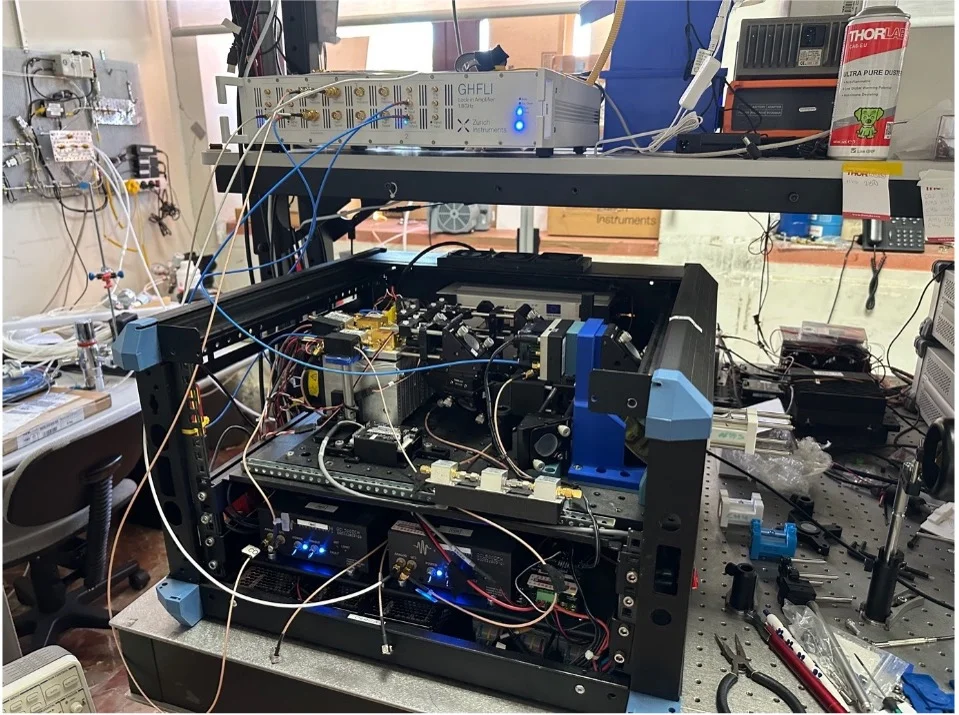
In the lab of Pedro Martin-Mateos, Oscar Elias Bonilla Manrique, and Aldo Luis Moreno Oyervides, we implemented a single-box HPSDS workflow using the GHFLI Lock-in Amplifier. Two mid infrared QCLs, specially selected to emit at the resonance wavelengths of methane and carbon dioxide molecules, are each driven with a distinct RF tone. The beams are combined and sent to the area to be scanned (or through a gas cell) and are detected by a single fast photodiode. The GHFLI provides the RF drives (with complete flexibility within its range to ensure optimal performance in estimating gas concentration), acquires the detector signal, and demodulates both tones simultaneously. The QCL power supplies are ramped around the target center frequency to scan across the dispersion feature (Figure 2).
Results
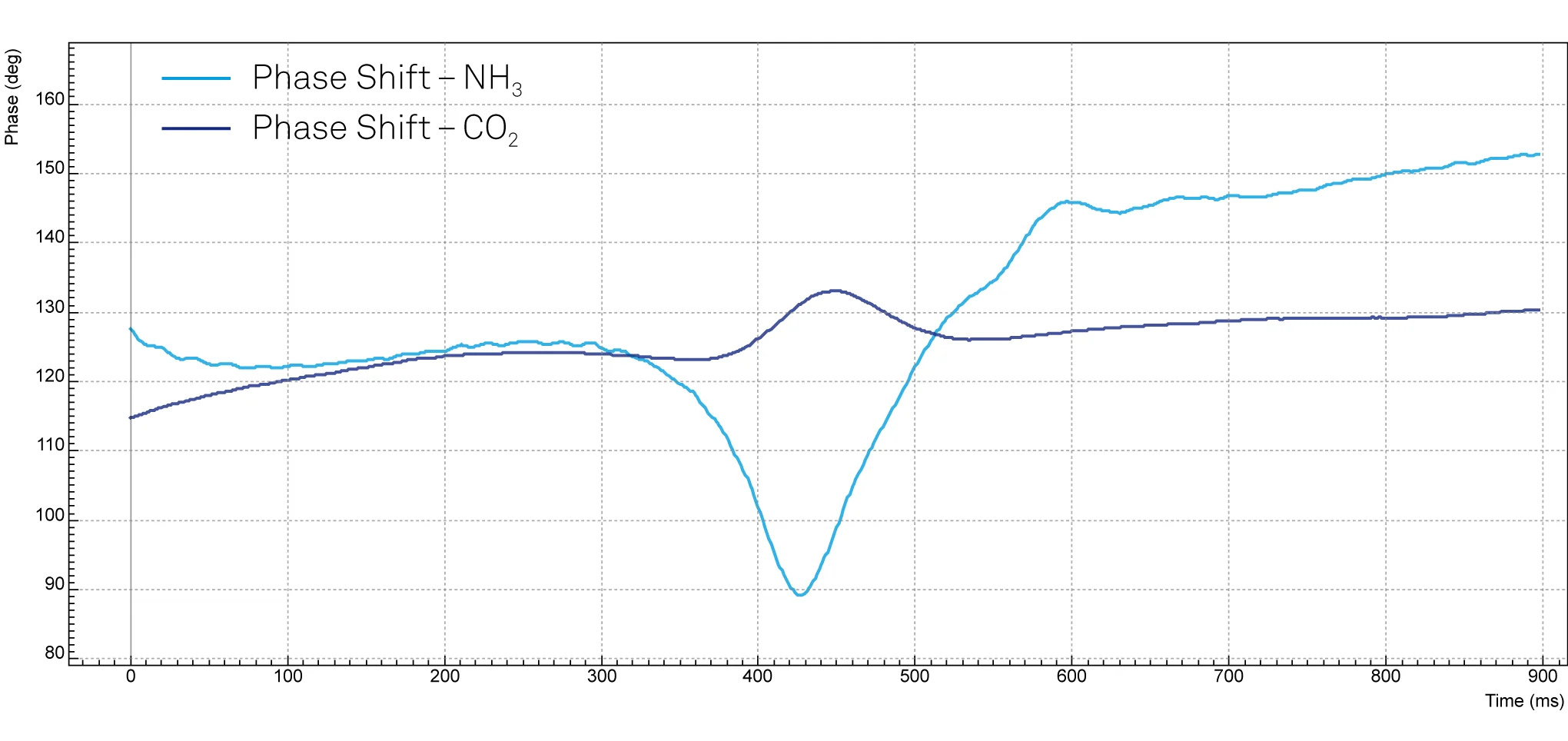
After configuring the setup and enabling RF modulation, the current sources are ramped around the center frequency of the molecular resonances of interest and the refractive-index-induced phase shift from both modulations is recorded with the LabOne Data Acquisition Module (DAQ). The resulting phase traces reveal the dispersion signature: a clear phase feature centered on the transition demonstrating high-contrast and linear readout from CO2 and NH3 gas concentration(Figure 4).
Conclusion
HPSDS becomes simpler, faster, and more robust when generation, sweep, and phase-sensitive detection live in one instrument. With the 1.8 GHz GHFLI Lock-in Amplifier, you can modulate multiple QCLs, sweep the center frequency, and read out phase (or intensity) on arbitrary GHz tones with no external RF complexity. The result is reliably measured phase shifts and straightforward gas concentration measurements. This single-box approach reduces setup time and drift, enabling repeatable phase measurements across the full 1.8 GHz range and simplified multi-tone operation.
Acknowledgements
We thank Pedro Martin-Mateos, Oscar Elias Bonilla Manrique, and Aldo Luis Moreno Oyervides for hosting us and conducting the experiments mentioned above at the University Carlos III of Madrid. Their work was supported by the European Union’s Horizon 2020 program under agreement 101000216–Project code Refarm. Their published work provides further details of the method and setup.
Reference
[1] Pedro Martín-Mateos, Jakob Hayden, Pablo Acedo, and Bernhard Lendl, Heterodyne Phase-Sensitive Dispersion Spectroscopy in the Mid-Infrared with a Quantum Cascade Laser, Analytical Chemistry 2017 89 (11), 5916-5922; DOI: 10.1021/acs.analchem.7b00303