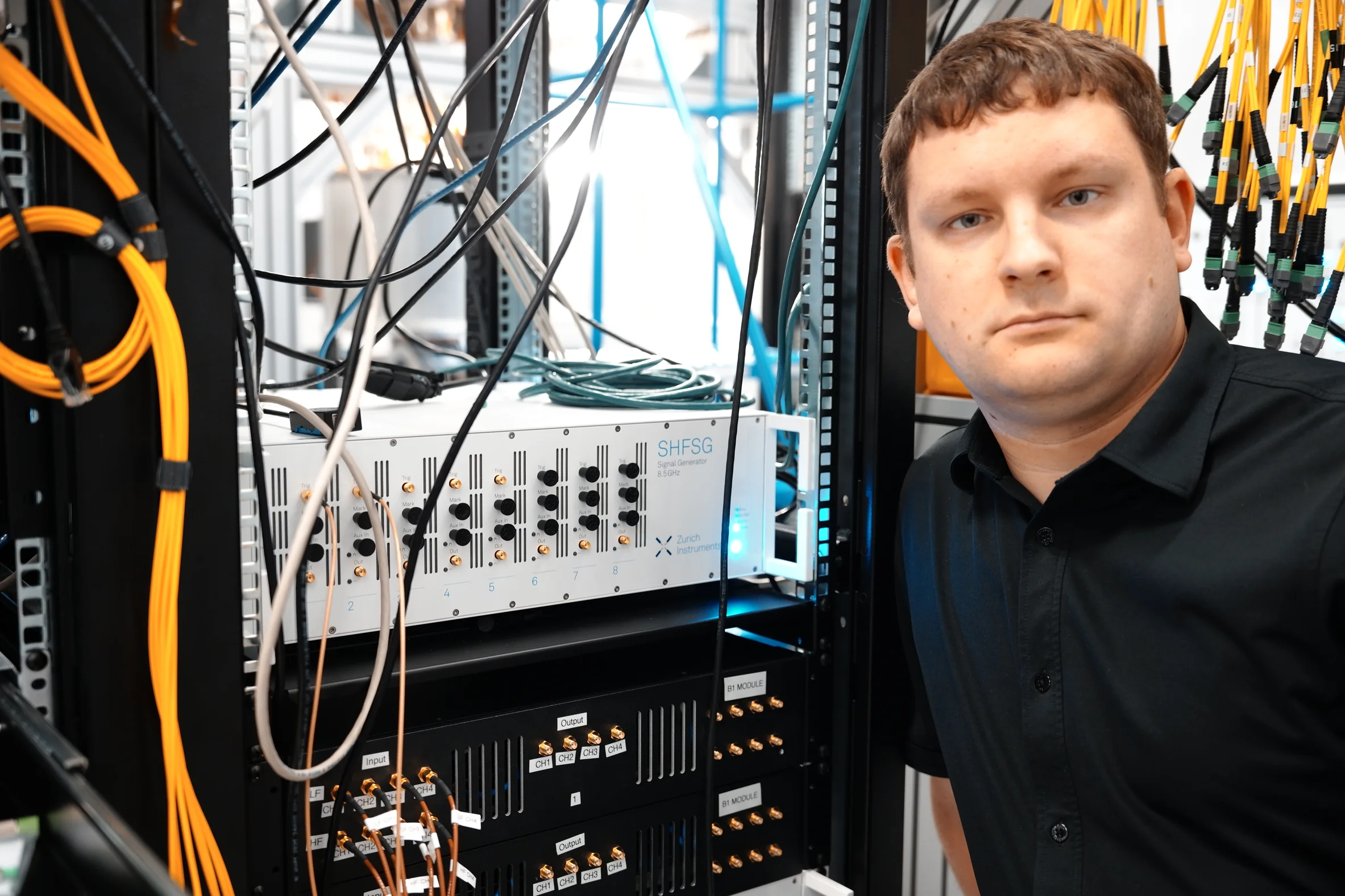
Interview: Kevin Morse

Can you take us through your company's origins? How did the initial idea come about and evolve into the company you are today?
Photonic exists because our Chief Quantum Officer, Dr. Stephanie Simmons, fell in love with the potential of quantum computing when she was 16 and dedicated her life to making it a reality. She focused her early career on becoming a world-leading expert in quantum materials and technologies, then chose to establish her research lab at Simon Fraser University in 2015. She co-founded the Silicon Quantum Technology (SQT) Lab at Simon Fraser University with Dr. Michael Thewalt, also an expert in Silicon material research, and in 2016, Photonic was incorporated as a private Canadian company. In late 2019, serial entrepreneur Dr. Paul Terry joined as CEO and they started quietly growing the company in British Columbia. Shortly after, in 2021, on the strength of its team, advisory board, and patent portfolio, Photonic secured 40M USD of venture capital financing to kickstart growth.
In Nov 2023, Photonic came out of stealth mode by announcing three major milestones: unique architecture poised to unlock scalable, fault tolerant quantum technologies; a collaboration with Microsoft to unlock the next stages of quantum supercomputing and quantum networking; and a 100M USD investment round. Photonic has established offices, R&D labs, and a manufacturing facility in Metro Vancouver, British Columbia, and has 140 team members across Canada, the US, the UK, and Europe.
Talk us through your qubit architecture and what advantages it brings compared to other qubit types.
We are building large-scale, fault-tolerant, distributed quantum computers. Our architecture is unique; based on the T centre in silicon. T centre qubits in silicon leverage the advantages of both spin qubits and telecom photons. Up to three nuclear spin qubits (two carbon and a hydrogen) can be used for memory and computation in each T centre, and one electron spin qubit can be used to do inter-T centre entanglement operations.
Our qubit combines the manufacturability, scalability, and controllability of spin qubits in silicon with a native telecom interface for each qubit, providing the on-chip and off-chip connectivity needed for high efficiency quantum low-density parity check (QLDPC) error correction. This approach enables quantum systems to scale both vertically and horizontally, providing the foundational building blocks for distributed, fault-tolerant quantum computing.
For a bit more detail on the qubit:
Spin Qubits: Spin qubits within silicon have proven to be exceptional quantum memories—they have set performance records for fidelity and lifetimes. The industrial dominance and extensive development of silicon offers such incomparable competitive advantages that, historically, if a solution is found using silicon, the silicon solution usually wins.
Telecom Photons: Telecommunications-band (telecom) photons can be flexibly routed with arbitrary connectivity to connect matter qubits both locally and remotely, with low loss in cryogenic-compatible waveguides and at room temperature using modern telecommunications infrastructure.
Telecom photonic qubits will be the backbone of any highly connected global quantum network and of modular quantum computers. Each T centre in silicon hosts an electron that can emit telecom photons.
Could you explain how Zurich Instruments' QCCS supports your company's project and your mission?
Photonic is focused on building reliable quantum computers that can scale to get us past the ‘commercially interesting’ threshold to the ‘commercially relevant’ phase. One of challenges that we’re dedicated to solving is building systems with sufficient capacity to run the quantum resource intensive, high value algorithms that are required to start to solve the globally impactful problems that are intractable for classical computers.
There are many technical milestones involved in building a commercial quantum platform from the ground up, and the Zurich Instruments QCCS was the right piece of equipment for us at the right time as we focused on the delivery of early proof points. It goes without saying that quantum systems are complicated, so working with a supplier, such as Zurich Instruments, who understands the underlying issues and builds products designed for quantum systems saved us time and money.
What challenges in quantum computing are you looking to address with your technology? And how does Zurich Instruments QCCS support addressing these challenges?
Scalability is the primary problem that Photonic’s architecture is looking to solve. Our approach focuses on achieving scale through distributed quantum computing made possible through high connectivity, telecom compatible qubit interconnects that support horizontal scaling.
We are fortunate to have the opportunity to work with innovators in the quantum space as we progress on this journey to scale. Zurich Instruments is definitely in that category. The QCCS helped us to deliver the initial proof points of our architecture.
Looking ahead, how do you view Photonic Inc. and Zurich Instruments' contribution to the thriving Canadian Quantum ecosystem?
Currently, quantum computing is a high risk/high reward technology, but we are starting to see a critical mass of quantum innovators across the country. We have projects taking place in the lower mainland of British Columbia, as well as Waterloo, Ontario, and know there is great work being done by a variety of organizations across the country. Photonic is on course to become a major player in the quantum ecosystem in Canada and across the globe.
Building quantum computers in Canada gives Canadians front row access to innovative technology that will have global impacts and provide significant opportunities for other industries to flourish right here. Partnerships like the one we have with Zurich Instruments have the potential to positively influence the Canadian quantum ecosystem by helping companies accelerate the development of their products, bringing quantum systems to market more quickly than they would on their own.
What's a remarkable story from your company's journey, and what would be your advice to other companies looking to leverage the power of high-tech equipment like Zurich Instruments'?
We know that to successfully run large-scale quantum algorithms across multiple quantum computers you need huge amounts of distributed entanglement. Our demonstration of distributed entanglement between modules was a remarkable achievement in this regard. Over the course of three sequential steps, ending with a teleported CNOT gate, we established and consumed distributed quantum entanglement – importantly, it was entanglement between qubits that were not in the same cryostat.
Our team and technology really came together to demonstrate the potential of our unique architecture in tackling the scaling challenge beyond single nodes. We would recommend that companies be clear about their needs from the start and do their research into the capabilities of the products or services that they are procuring. Having a clear expectation at the start for what you, as the customer need, and how that product is a fit can prevent problems down the road. Make sure that the providers you’re working with can deliver on their promises and work with you after delivery. Also consider the value of ongoing product support, which is especially in new applications of high-tech equipment when there isn’t a ‘plug and play’ standard.