Search
联系我们

Analyzing Art Like the Mona Lisa: Non-Destructive, Non-Invasive, and Now Portable With LFEPR

Tell us about your professional and academic journey. Why did you consider working on (LF)EPR with ~20 years of NMR/MRI background?

I started my scientific career at the DOE Radiation Research Laboratory at the University of Notre Dame, studying time-resolved electron paramagnetic resonance (EPR) of transient free radicals produced by pulsed radiolysis. Although it was relevant science, it was challenging to relate the relevance and significance of this work to the non-scientist, but I continued to work in EPR spectroscopy as a postdoctoral researcher at Cornell University. However, when I moved to my first teaching job at the Rochester Institute of Technology (RIT), I was looking for new research opportunities. MRI had then been recently commercialized and approved for routine use on humans, and I thought it couldn’t be too difficult to switch from looking at electron spins to nuclear spins, so I did. I started research projects in efficient MRI coil design for imaging extremities, multispectral tissue classification with magnetic resonance images, and designing phantoms to test the performance of MRI systems. Simultaneously, I edited the Encyclopedia of Imaging Science for Wiley and wrote two open-access hypertextbooks on the basics of MRI and NMR.
These projects were rewarding in that they were easy to describe to someone on the street. MRI was becoming more ubiquitous, and there was no shortage of research ideas to pursue. Unfortunately, research time on an MRI instrument was becoming more difficult to get and was only available late in the evening. Wanting to spend more time with my family (and sleeping), I began to look for projects that did not rely on clinical imaging time and could be done in my lab at RIT during an eight-to-five workday. I decided to pursue a new research field focusing on EPR of cultural heritage objects such as pottery and paintings.

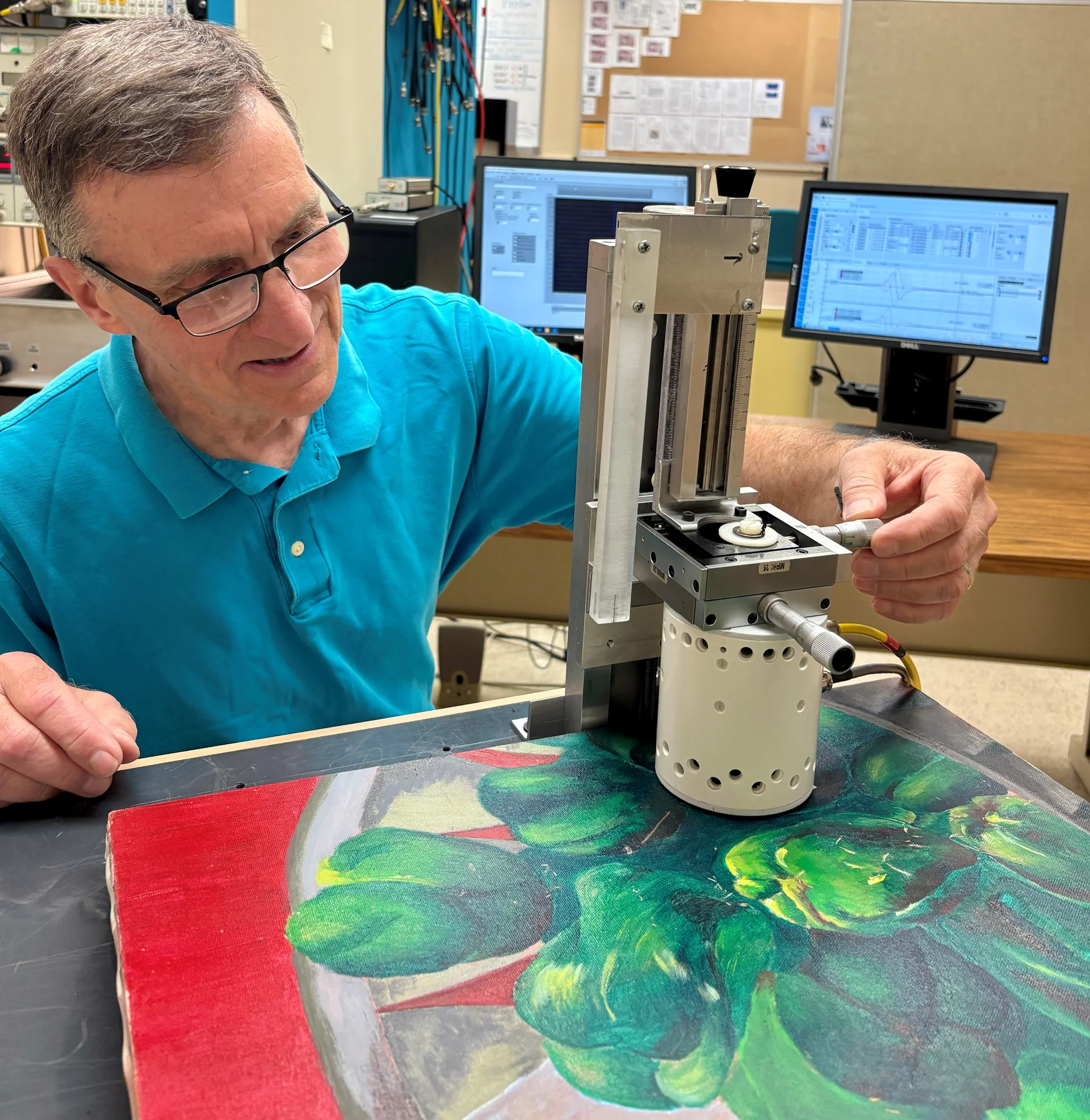
Joseph Hornak using the MOUSE

Joseph Hornak, Rochester Institute Of Technology

Would you agree that (LF)EPR is not the first technique that comes to mind for studying historically valuable artifacts? If so, what is the value that LFEPR can bring to this field from your point of view?

Yes, I agree. Most people think of imaging techniques for historically valuable artifacts as involving optical spectroscopies or X-rays, perhaps because they are easier to relate to and understand. In reality, no one technique will tell the cultural heritage scientist everything they need or want to know about a painting. The dozens of analytical techniques used by cultural heritage scientists complement each other. Take, for example, the study of hidden layers or underpaintings. You might think X-ray or X-ray fluorescence imaging would be perfect for this study, as X-rays penetrate deeper than the surface visible layer of most materials. An exception is lead white, a common white pigment used as a base layer on unpainted canvas, a covering over an unwanted painting, or a lightening pigment added to some pigments to achieve the desired color brightness. As one may know from a recent trip to the dentist, when you were given a lead apron to wear during an X-ray imaging session, that X-ray does not penetrate lead. X-ray imaging also has difficulties yielding meaningful results with lead white. Low-frequency EPR (LFEPR) spectroscopy has no difficulty seeing through lead white. Therefore, LFEPR and X-ray imaging complement each other for this application. But by no means is LFEPR perfect. EPR detects a signal from unpaired electrons found in free radicals and transition metal complexes. These are common in many Renaissance-era pigments; however, not in most modern organic-based pigments. Again, LFEPR complements many other analytical techniques used to study cultural heritage objects.

What was the bottleneck that you needed to resolve to implement your LFEPR solution for studying historically valuable artifacts?

There were many bottlenecks that needed to be resolved to implement my vision of using LFEPR in studying historically valuable artifacts.  Perhaps the greatest was finding a way to non-invasively and non-destructively analyze objects of any size. Conventional EPR spectroscopy requires that a millimeter-sized piece of the object be removed for insertion into the EPR spectrometer. Yes, the technique is very sensitive and yields valuable information, but it is difficult to get a museum, such as the Louvre in Paris, to give you 1mm-sized samples of the Mona Lisa for analysis, even if you assure them you will give the samples back unharmed when the analysis is finished. The painting is ruined in the sampling process, and gluing the samples back onto the painting is not an acceptable solution.


Our solution was to develop the EPR Mobile Universal Surface Explorer (MOUSE). The EPR MOUSE is a small, handheld addition to an LFEPR spectrometer, containing a small electromagnet and radio frequency pickup coil to detect the EPR signal. The MOUSE replaces a much larger electromagnet and detects the EPR signal from a 3mm diameter region on the surface of any size object. This means the MOUSE and LFEPR spectrometer can be used to non-invasively and non-destructively analyze a small region of a painting, whether in a laboratory or on the ceiling of the Sistine Chapel. Sample size is no longer a limitation.

With your pick in Zurich Instruments' UHFLI, could you tell us what value UHFLI brings to this field?

There are two major values of the Zurich Instruments UHFLI. The first is the improved limit of detection it affords us. Our studies show that, compared to the current LFEPR system, the UHFLI provides a 6.2 times greater signal-to-noise ratio and minimizes spectral baseline drift by a factor of ten. Both of these improvements enable us to see smaller signals.

The second value we see in the UHFLI is its utility. The direct digital detection of the UHFLI and the digital signal processing of the LabOne® software allow us to eliminate superfluous components in the LFEPR spectrometer, such as the analog RF demodulation, RF synthesizer, RF sweeper, and oscilloscope, while adding a phase-locked loop to control drift in the frequency of the sample probe relative to the RF source. I was pleased to see that the UHFLI provides all this functionality and thus helps us continue shrinking the size of the LFEPR spectrometer, so we can more easily bring the spectrometer to the paintings. We anticipate the UHFLI will reduce the size of the LFEPR to 30% of its current volume and the weight by 50%, approximately 23kg, thus making the LFEPR spectrometer more portable.

What do you view as the next big challenge(s) in LFEPR?

The next big challenge in LFEPR of cultural heritage objects is spreading the word about the instrument’s capabilities in order to gain its acceptance as a viable analytical tool that complements the more traditional techniques used for the analysis of paintings. Scientists are skeptical by training and need proof before investing their time or resources in a new approach. I would like to bring the spectrometer to them and demonstrate its capabilities.

What would you recommend to young researchers working in (LF)EPR nowadays?

My recommendation to young researchers interested in LFEPR and studying cultural heritage is this: LFEPR is a new and rapidly evolving field, full of opportunities to advance the discipline. It reminds me of the potential I saw in MRI when it was first introduced. New hardware, such as the Zurich Instruments UHFLI, is being developed and introduced periodically, continually expanding the capabilities of LFEPR.

阅读更多采访