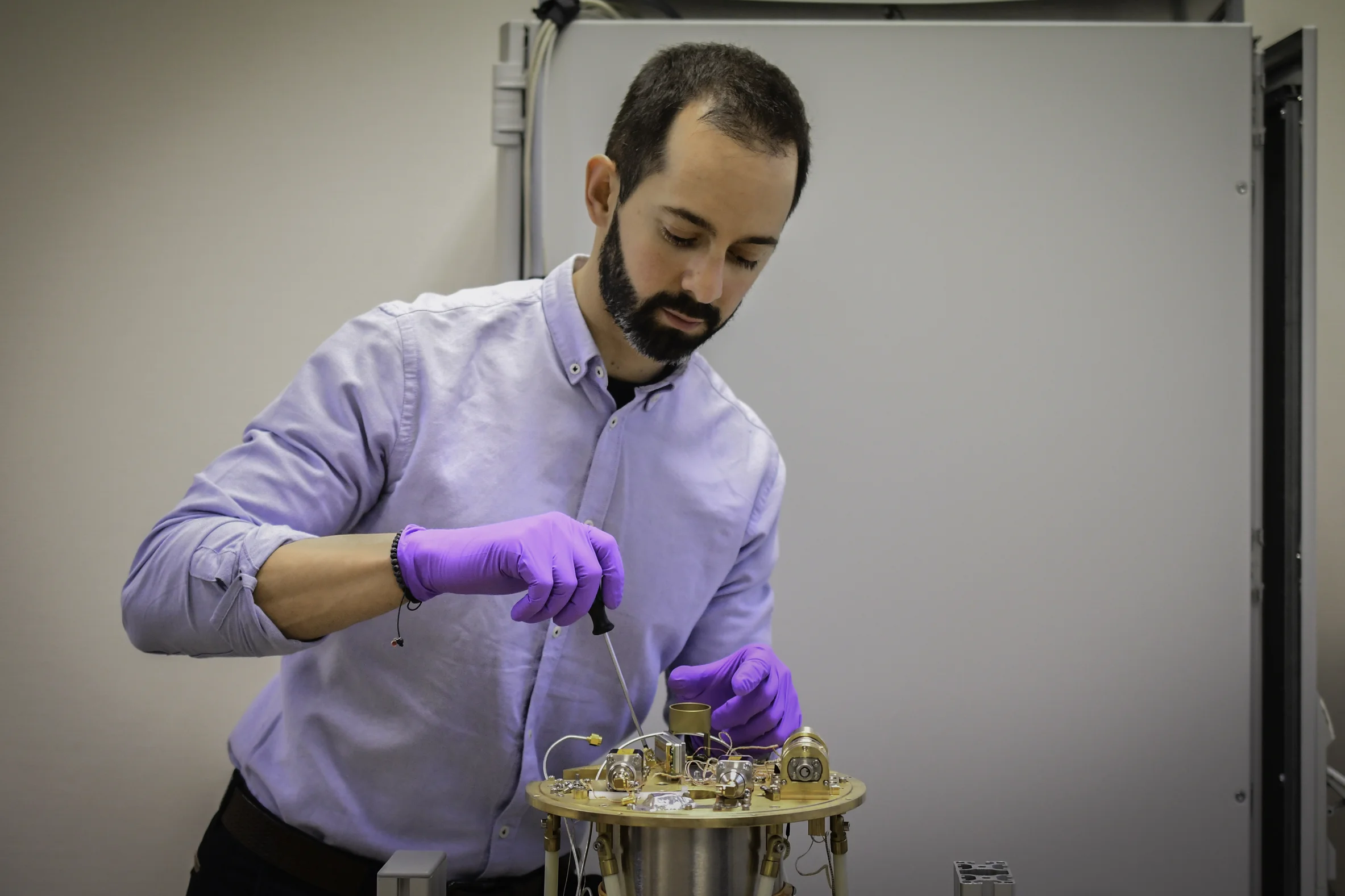
Interview: Marios Maroudas

Let's start off by asking a bit about your academic background.
I obtained my bachelor, master, and Ph.D. degrees from the Physics Department of the University of Patras in Greece, in the fields of Theoretical and Mathematical Physics, Astronomy, and Astrophysics. Alongside this, I also worked at University College London in the UK on sterile neutrinos, at NCSR Demokritos in Athens on heavy gauge bosons, and at CAPP/IBS in South Korea on RF cavity design. Then, from 2014 to 2022, I worked at CERN in Geneva on Astroparticle physics and the CAST experiment. Eventually, in 2019, I was made responsible for the hardware, software, and data acquisition for a dark matter detector called CAST-CAPP. There, we designed novel detection schemes for dark matter research, including phase matching and fast frequency scanning. These schemes enhance the probability of observing a signal for dark matter. Since 2022, I have been a postdoctoral researcher at the University of Hamburg in Germany. I’m continuing my research on dark matter with two new experiments, while at the same time working on the application of quantum detectors on dark matter research.
How does your theoretical knowledge help you to be an experimentalist?
It allows me to consider and apply different experimental approaches to any experimental framework. It also provides me with an overview of the big picture when designing new experiments, as well as helping to imagine and propose new experimental techniques.
What are you currently working on?
My research is primarily focused on dark matter, especially on one of the most prominent dark matter candidates: the axion. I am currently involved in the projects WISPLC and WISPFI at the University of Hamburg. WISPLC is primarily based on a lumped element approach. It uses a pick-up coil inside a solenoid magnet, and an LC, which enhances the expected signal from the axion-induced oscillating current. This experiment is mostly sensitive to the low axion mass regime (neV)x with frequencies lying in the MHz range. WISPFI, on the other hand, is a Mach-Zehnder interferometer, based on hollow-core photonic crystal fibers. This focuses on higher axion masses (100 meV) with corresponding frequencies in the THz regime. We are also investigating the use of quantum detectors to boost the sensitivity of the measurement.
Can you explain a little more about quantum detectors?
The biggest challenge has always been to build sensitive enough experiments capable of detecting dark matter. For this, we need to increase the signal-to-noise ratio either by boosting the measured signal or by reducing the various noise contributions. The signal can be boosted by having stronger and longer magnetic fields, while the noise can be reduced below even the standard quantum limit, by using quantum detectors such as graphene-based Josephson Junction bolometers and transmon qubits.
There is huge activity in the Hamburg area with a focus on dark matter research. How does this atmosphere help your research?
This is quite important as you cannot do everything on your own, especially when it comes to such a big mystery as dark matter. Every group here specializes and focuses on different detection schemes, meaning everyone benefits from such collaborations. At some point, we put forward the idea of implementing a network of detectors around the world. This would allow a signal to show up in more than one detector while, at the same time, providing full-time coverage and also securing a possible discovery. For this approach, more than one group needs to work together.
How does the UHFLI help your measurements?
For the WISPFI experiment, the photon-to-axon conversion leads to very faint signals, and the UHFLI is one of the most sensitive instruments out there with a very low input noise contribution at those frequencies. In addition, the various included modules such as the scope, sweeper, plotter, and multiple PIDs allow us to control and lock our interferometer much more efficiently.
Additionally, our data acquisition systems have to run for months in a continuous manner interfaced with Python environments. The API log feature of LabOne allows for easy migration of the settings into a Python file granting automation of the entire process. This saves us an enormous amount of time. During my time at CERN and Hamburg, I have worked with several companies, but I can say that the companys' customer support is some of the best I have seen. They go through the experimental details and difficulties of your experiment, while going further and even proposing new solutions. We appreciate that.
As a scientist, what is the craziest thing you have done?
In CERN it was very important to monitor data 24/7. For that, someone must be on call at all times. Manpower for these experiments is limited and, at some point, it was only me. It meant that I had to respond to any kind of experimental error at any time of the day and it can be very stressful. But eventually, it worked out, and we were able to publish a paper in Nature with very good results.
Lastly, could you give some advice to upcoming new researchers?
Working with mysteries of the universe is definitely one of the most exciting things you can do. Dark matter and dark energy are surely some of the biggest mysteries in Physics. Every day I go to the lab, there is a new challenge that we have to face and solve. While this could be a deterrent to some, it can also trigger your imagination. After all, it is inevitable if we want to contribute towards the exploration of uncharted territories in physics. So they must never give up, and do what they truly love. Especially if this is what they want to do for the rest of their lives.