Pushing the Limits of Quantum Sensing: Uncovering Axion Dark Matter
Tell us about your journey as a scientist up to now. What brought you to dark matter research?
I’m currently a graduate student working at the intersection of dark matter research and quantum sensors in the DMRadio collaboration. However, my interest in precision sensing and experiments searching for beyond-standard model physics actually started while I was still an undergraduate physics student. I had the opportunity to do hands-on research with two professors, Dave Moore and Reina Maruyama, who opened the door to new physics experiments and dark matter research.
With Professor Moore’s group, I helped build tabletop-scale experiments searching for new forces, and I even attended a workshop where I met many of the leading researchers in this area. With Professor Maruyama’s group, I worked on the Haloscope At Yale Sensitive To Axion CDM (HAYSTAC) Experiment, which gave me my first direct taste of dark matter research. Those experiences also introduced me to the broader community through summer schools and workshops, where I learned both the fundamentals of dark matter and the variety of experiments being run to detect it.
What kept me in this field was not just luck, but the fact that I enjoy the day-to-day work: building sensitive sensors, using hardware and electrical engineering skills, and connecting that back to fundamental questions about the universe. Transitioning from HAYSTAC as an undergraduate to the DMRadio project as a graduate student working with Professor Kent Irwin felt like a natural step, and I really value being part of a creative environment where people are working on such a hard but fascinating problem.
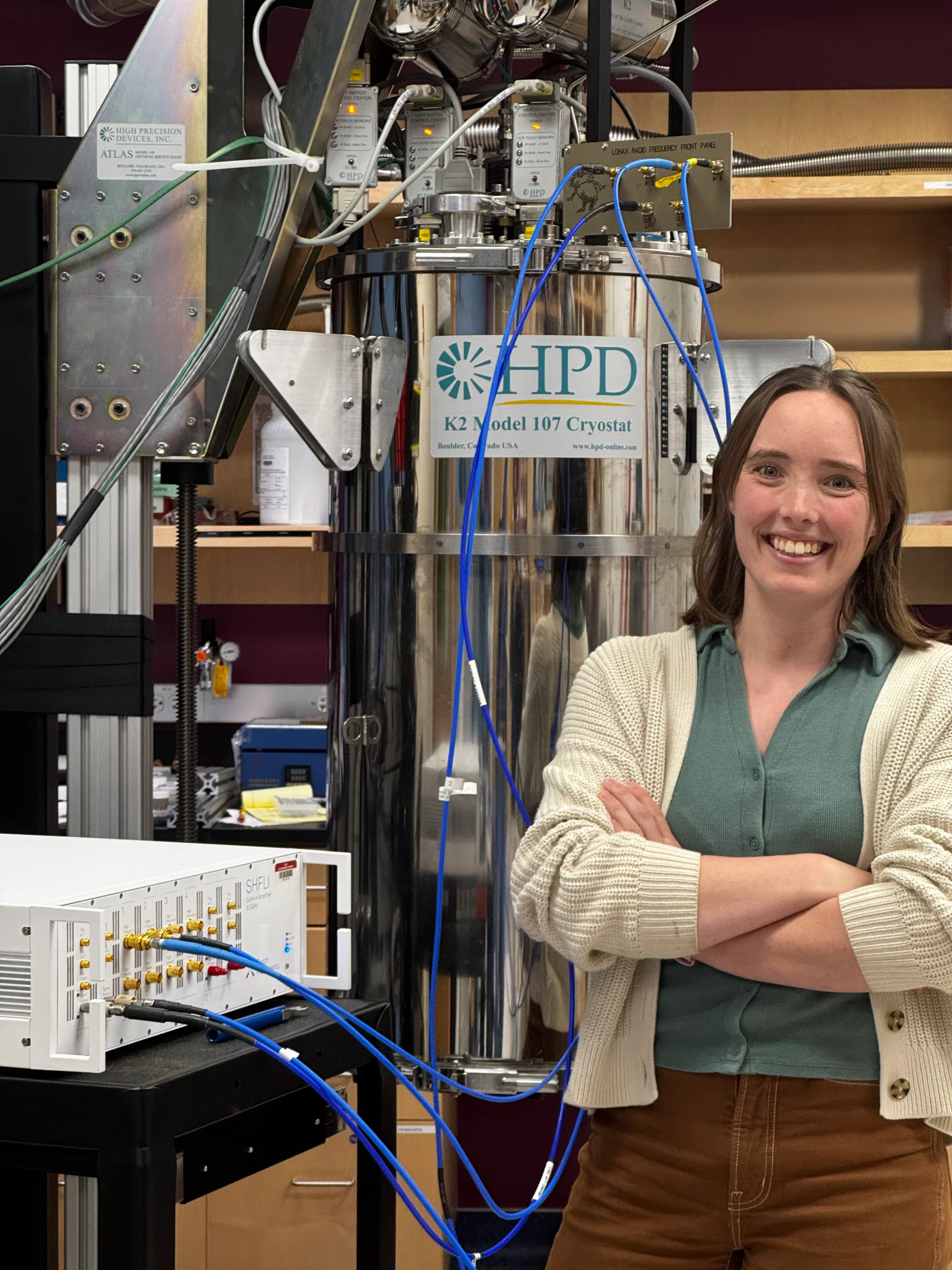
Can you tell us what you currently work on? What excites you about your research?
I’m developing new quantum sensors for axion dark matter experiments. The goal is to build devices sensitive enough to detect the tiny signals that dark matter might produce. Historically, superconducting quantum interference devices (DC SQUIDs) have been used for this frequency range, and they’re fantastic tools, but they have limitations.
With the sensors we’re developing, we hope to not only reach the standard quantum limit but also go beyond it by using novel quantum protocols. The devices up-convert low-frequency signals from the detector into the gigahertz range, where quantum metrology is more advanced and powerful techniques are available.
On a daily basis, I’m working with superconducting devices, Josephson junctions, and cryogenics, which is exciting on its own. But what really motivates me is that all of this contributes directly to the larger goal of dark matter detection. Even if my Tuesday looks like debugging a circuit, it’s tied to a bold astrophysical question: what is our universe made of?
Taking a more fundamental view on axion dark matter, what is especially exciting about this area in your view?
What excites me most is the creativity in the field. If this problem were easy, we’d have solved it already. Instead, there’s space for a wide variety of approaches: new experiment architectures, novel quantum sensors, and unique measurement techniques.
At a recent axion workshop at UC Berkeley, I was struck by the diversity of approaches in the room. Researchers were using everything from large-scale “light shining through walls” experiments to tabletop qubit-based detectors. Everyone is working toward the same goal – understanding dark matter – but with very different methods. That variety and openness to new ideas makes this area particularly vibrant and exciting.
What do you see as the next big challenges in this research field?
The biggest challenge is scale. The parameter space for axions is vast and, while we’ve ruled out certain regions, there’s still a huge amount left to explore. Many current experiments demonstrate sensitivity in narrow frequency bands, but covering the full parameter space at that pace could take thousands of years.
The field needs ways to scale up, both in terms of frequency coverage and sensitivity. New quantum sensors are one approach to accelerate measurements and make sweeps more efficient. Ultimately, the challenge is that we don’t know where in parameter space the axion might be, or how weakly it interacts, so there’s a lot left to rule out.
The dark matter radio project encompasses multiple groups. How does this level of collaboration help you drive the search for axions?
Collaboration is essential. Dark MatterDM Radio involves several institutions, each contributing their own expertise. My focus currently, is on developing quantum sensors, designing and fabricating them, and testing their performance. Other groups subsets of the collaboration concentrate on cryogenics, magnets, or data analysis.
No single person or group could tackle all of these challenges at once. By dividing the effort, each group can specialize and strengthen the overall experiment. The broader dark matter community is also very collaborative, and having that spirit within a single experiment makes the work much more effective and enjoyable.
How does Zurich Instruments’ SHFLI help you in your research?
The SHFLI is invaluable for us. Our devices take low-frequency signals in the kilohertz to megahertz range and up-convert them onto a gigahertz carrier. We need tools that can continuously and sensitively measure across these frequencies.
The SHFLI provides that capability, with the flexibility to measure not just at a single frequency but simultaneously at multiple ones. This is crucial when dealing with sidebands or more complex signals. Its flexibility also speeds up our characterization work; instead of building a new setup every time we want to change the type of measurement, we can configure it directly in the instrument.
Even for ancillary components, like characterizing an inductive transformer between readout stages, the SHFLI makes it simple. From kilohertz all the way to gigahertz, it’s a tool that has become central to our workflow.
What would you recommend to young researchers nowadays?
I’d encourage young researchers to think about two things: the big picture and the day-to-day. On one level, it’s important to ask whether the science motivates you; whether the overarching question excites you. On another level, you need to enjoy what your daily work actually looks like, whether that’s building hardware, coding simulations, or analyzing data.
If you only care about the big picture but dislike the daily tasks, you’ll burn out. If you only like the daily work but aren’t inspired by the goal, you may lose motivation. The sweet spot is finding research that excites you in both ways.
I was lucky to discover this during undergrad by trying different labs and realizing that I enjoyed both the physics questions and the hands-on lab work. I think it’s really important for young researchers to explore, reflect on what makes them tick, and then find the projects that align with both their interests and their working style.