Beyond Spintronics: Exploring Orbital Transport for Energy-Efficient Electronic Devices
Tell us about your journey as a scientist up to now. What’s your academic background?
I earned my PhD Thesis at the Department of Materials Science at the University of Milano-Bicocca and the Institute of Microelectronics and Microsystems Unit of Agrate-Brianza under the National Research Council (CNR-IMM) in Italy, under the supervision of Prof. Marco Fanciulli and Dr. Roberto Mantovan. During my PhD, I engaged in a multidisciplinary exploration that seamlessly integrated materials science and physics. My focus included comprehensive chemical-structural and magnetic characterizations of the Sb2Te3 topological insulator interfacing with various ferromagnets, such as Fe and Co. This research aimed to identify optimal materials combinations for achieving high spin-charge conversion (SCC) efficiency at room temperature (RT). Notably, my efforts led to the production of nearly-epitaxial Sb2Te3 thin films by means of Metal Organic Chemical Vapor Deposition on large area (i.e. 4 inch Si wafers), going towards the possible industrial transfer of the proposed technology. The latter result constituted the materials science background which allowed the observation of a record SCC efficiency in Sb2Te3/Au/Co heterostructures (Adv. Funct. Mater.2022, 32, 2109361). In my PhD thesis, I explored the chemical-structural and magnetic properties of systems based on topological materials, with the objective of contributing to energy-efficient and ultra-fast spintronic devices. Following the completion of my PhD, I received the "Celluprica Prize" for the best PhD thesis in 2023.
During my three years of postdoctoral activity, I extended my research to applications in memory storage and computational tasks within electronic systems. In my initial postdoctoral role at the CNR-IMM laboratory, I concluded aspects of my prior research, initiated, and executed new projects/experiments, as well as serving as a guest editor for a special issue in the Nanotechnology journal. Much of my work during the PhD and postdoc phases was conducted under the SKYTOP European project, providing insights into the intricacies of European-level projects.
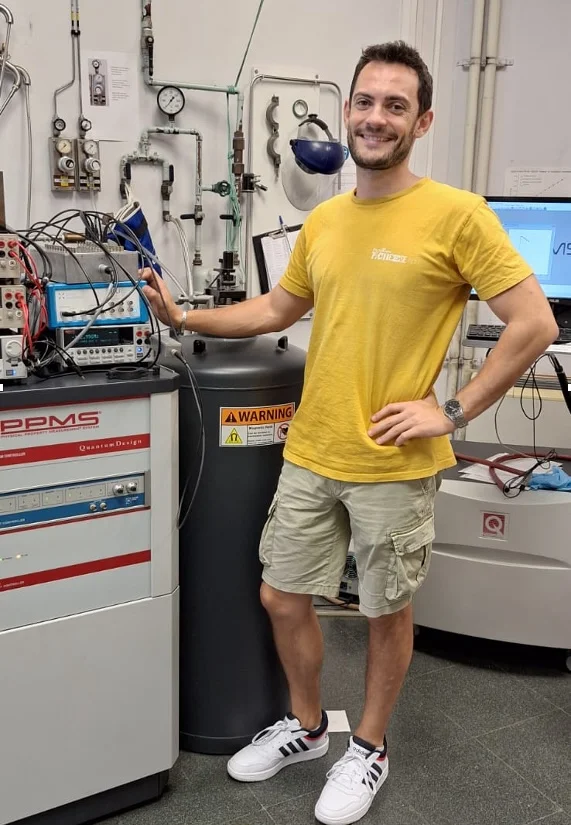
In my current position at the Institut de Ciencia de Materials in Barcelona (ICMAB) under Prof. Foncuberta's research group, I apply my scientific expertise and coordination skills to conduct interdisciplinary experiments in the field of spin/orbitronics. Responsibilities include coordinating a collaborative project with ALBA synchrotron and the University of Barcelona (UB), and focusing on pioneering X-ray magnetic circular dichroism experiments. Additionally, I oversee an experimental program concentrating on FMR and SP-FMR experiments at the University of Barcelona in collaboration with Dr. Ferran Macià's laboratory. Experiments devoted to reveal orbital accumulation in light materials through Magneto Optic Kerr Effect experiments are also ongoing at the CIC nanoGUNE research center in collaboration with Prof. P. Vavassori group, where I am coordinating the whole activity.
This comprehensive effort culminated in the publication of 14 papers in high-impact international journals and, over the years, my manuscripts have been featured in more than 10 national and international conferences, where my oral contributions have effectively disseminated the noteworthy findings of this research.
Can you tell us about your current research activities? What are you working on at the moment?
My research activity deals with the study of orbital currents in solids, especially in early transition metal oxides.
The main purpose of my investigation is to shed some light on the very fundamental aspects of the origin of orbital currents, with particular care about their use to build energy-efficient and environmentally sustainable electronic devices. This approach would enable the creation of new memory storage and logic systems that could be exploited in any electronic device, likely improving their performances when compared with the conventional ones employed in modern technology.
What is especially promising/exciting about this topic/area, in your view?
The orbital currents are ubiquitous in all materials, without particular requirements. Thus, in principle, it is possible to exploit materials that are abundant on the earth and likely environmentally sustainable.
What do you view as the next big challenge(s) in this research field?
The first big challenge is to identify a list of ingredients that the materials need to possess to be a good platform for the orbital currents’ generation. The second huge challenge is to find a fair compromise between physical principle and materials science to develop real electronic devices performing logic operations based on orbital current.
How does the Zurich Instruments MFLI support your research?
The Zurich Instruments MFLI is an exceptionally versatile and reliable lock-in amplifier, enabling a wide range of measurements with a single instrument. We utilize this equipment to conduct two distinct types of measurements: second harmonic magnetoresistance and spin pumping ferromagnetic resonance spectroscopy. This versatility is achieved simply by adjusting the instrument's settings. Additionally, the technical support provided by Zurich Instruments is invaluable. Their assistance significantly reduces the time required to implement new measurement setups.