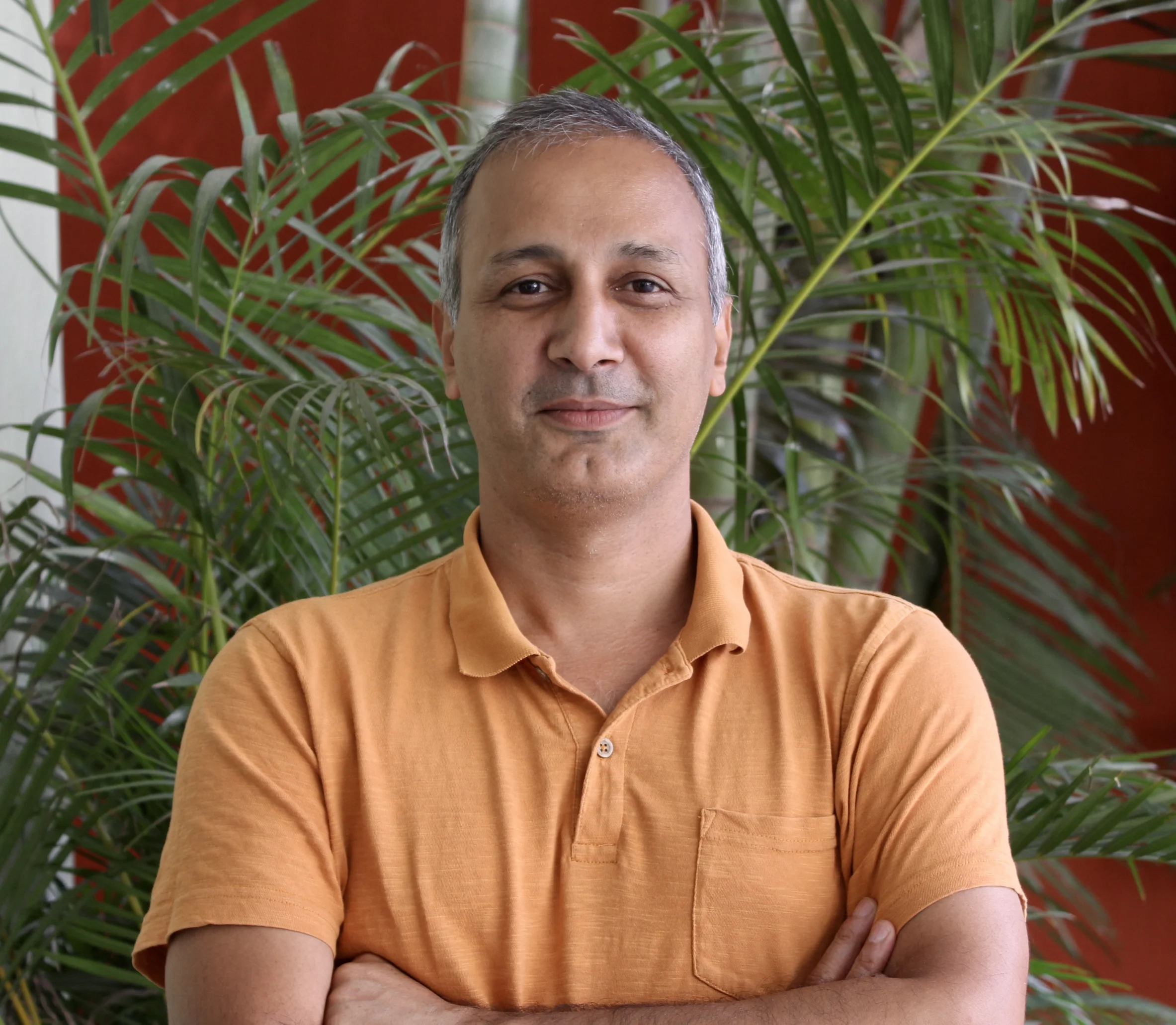
Understanding Nonlinear Dynamics: Insights from Prof. Naik on 2D Materials Based Mechanical Resonators
Tell us about your journey as a scientist up to now. What’s your academic background?
I did my MSc at IIT Bombay before doing my PhD at University of Maryland, mostly in quantum-limited detection of mechanical resonators. After that, I moved to Caltech. I was there for about five years, working on sensing aspects of mechanical resonators as well as mass spectrometry. Then I came to IISc Bangalore, because I always wanted to. I came back to India in 2011, so it's been close to 12-13 years now.
I always wanted to work on mechanics, and decided to work predominantly with 2D materials as opposed to traditional silicon/silicon nitride devices. This is because 2D materials are smaller, so they could make better sensors. This is how I started. However, because 2D materials were new, we did not fully understand how they were behaving. Therefore, we went in the direction of nonlinear dynamics, which has now become our main research focus.
Can you tell us about your current research activities?
Most of my research centers around mechanical resonators. We make nanomechanical resonators using traditional silicon/silicon nitride materials. We also make devices using 2D materials such as graphene. One aspect we are focusing on is sensing; we use these mechanical resonators for either gas sensing, mass sensing, or mass spectrometry. Furthermore, we use these devices to study the physics behind their motion. For example, in nonlinear dynamics, we study how different modes of these mechanical resonators interact with each other using, for instance, the Zurich Instruments UHFLI to drive these modes. We have also recently started working on quantum optomechanics, mainly because the signals that we are getting with electromechanics had poor signal-to-noise ratio and quite limited bandwidth. Both of these things can be improved in optomechanics.
What do you view as the next big challenge(s) in this research field?
I think there are a couple of main things that are likely to come up in the next few years. On the dynamics side, the nonlinear effects are becoming more and more important. People in my community try to avoid nonlinear effects as much as possible because they are mostly interested in sensing. But as you make devices smaller, these nonlinear effects become very important. You can certainly try to work towards getting rid of these effects, but more interesting things take place when you try to deal with them, using them in some way or another to make better sensors or even new devices.
The second thing is the coupling. Traditionally, mechanical resonators have a single mode; they do not interact with any other mode in the system. But this is changing quickly as you make devices smaller, especially in 2D materials where each mode can interact with multiple other ones because of the tension. That effect shows up in multiple ways. So it is very interesting to study these effects. For example, how does it affect the overall dynamics of these devices?
What would you recommend to young researchers nowadays?
I think it is a very common question to ask which technical or research area is most exciting - 'What should I work on?' It is very diverse; a bit like asking ‘Whom should I marry?’ There will always be areas where the current peak interests are. For example, quantum. It is good to work on these kinds of things, especially when it's really driving you to work on some niche technologies. But it's also important to have a long-term view because these peaks will come down, and unless you are interested in this topic yourself, you will just lose your head.