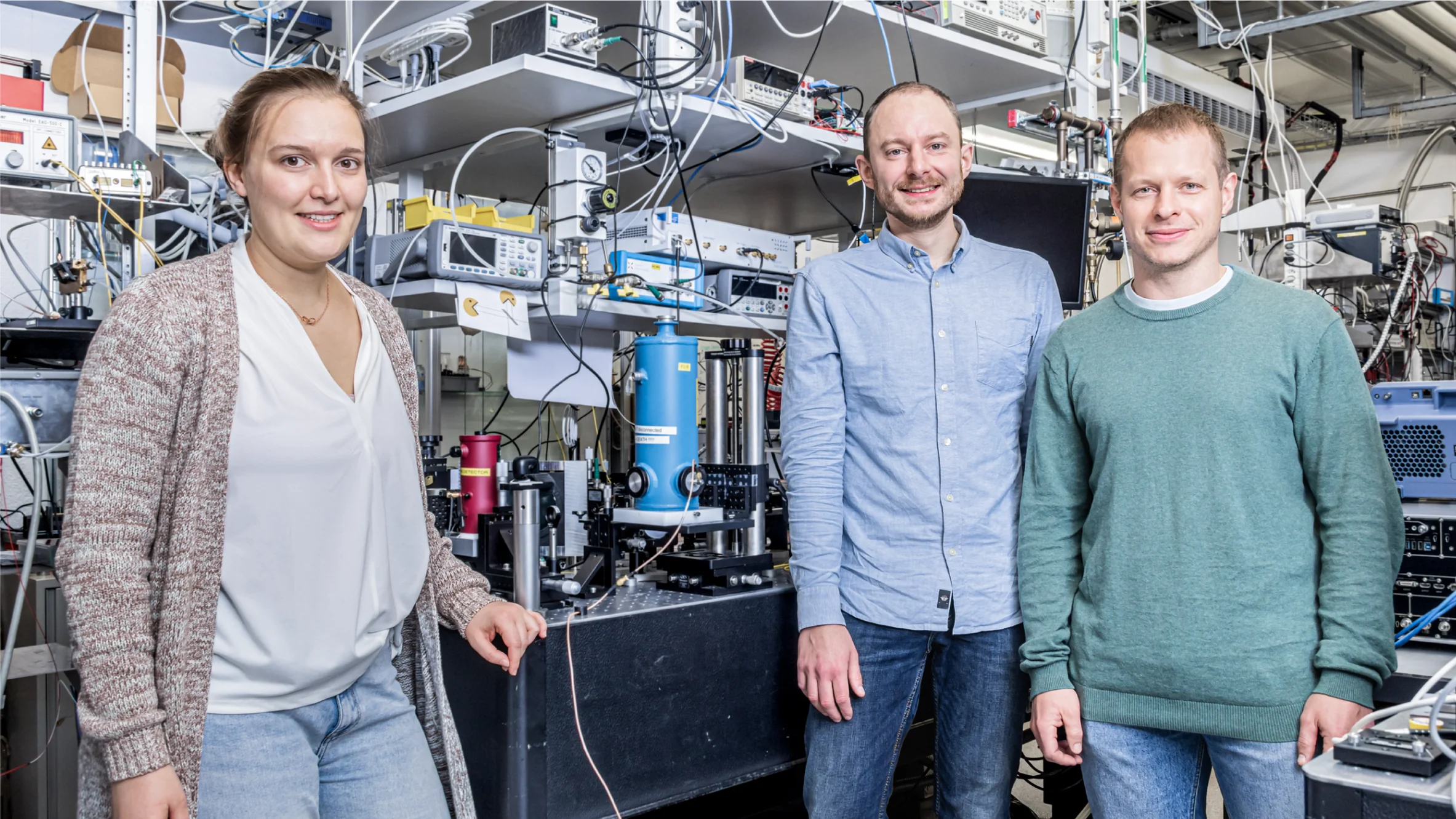
Interview: Ina Heckelmann, Mathieu Bertrand and Alex Dikopolstev
Hello Ina, Mathieu, and Alex. How would you present yourself to our scientific community?
We are three young researchers in the field of light-matter interaction, working in the group of Jérôme Faist at the Institute for Quantum Electronics at ETH Zürich. Even though we’d probably define ourselves as experimentalists, our backgrounds are quite mixed: from theoretical and computational physics to engineering, our skillset is well assorted.
Our research focuses on quantum engineering and, in particular, on complex semiconductor devices called “quantum cascade lasers”. These devices enable the generation of laser light at wavelengths that nature did not give us “for free”, like mid-infrared and terahertz. Coherent light at these wavelengths is in fact key to studying light-matter interaction on a molecular level.
We put a lot of effort into the development of long wavelength electrooptical devices, but we also always strive to see new phenomena in physics, even if they're not applicable, at least in the next few years. But after all, what makes science fun and interesting is the fact that you never know when or how you're going to use the knowledge you acquire.
You recently published a very impactful paper about a quantum walk comb in a fast gain laser [1] paving the way for broadband, stable, and tuneable frequency combs. What do you see as the next big challenge in this field?
What we have found is an entirely innovative mechanism for generating multi-wavelength laser light that could significantly improve spectroscopic applications, but not only. One of the first aspects we need to improve is the versatility of such a platform, by making it easier to adjust the parameters according to the requirements; for example, the available output power and the spectral width of the comb.
Then, another crucial aspect to focus on which is often overlooked, is the dissemination of the knowledge related to this novel platform. As such, a finding can impact a large variety of different research fields. Effectively communicating the function and the benefits of new tools across different fields can be a challenge if you don’t have the right vocabulary and concepts spelled out.
Finally, we also need to remain creative and open-minded and challenge ourselves to look at these devices not only from the perspective of laser physicists, to see what else we can obtain from them. For example, we have recently discovered that the photons in our platform can emulate solid-state phenomena, but with electronic statistics.
How did the UHFLI Boxcar Averager support your research?
It’s not an overstatement to say that the UHFLI Boxcar Averager turned out to be a crucial addition to our measurement setup, enabling a huge leap forward toward the acquisition of high-quality experimental results. Being used to working with old analog electronics from the 1980s, the UHFLI helped us remove 10 BNC cables, improve our signal-to-noise ratio by more than 15 dB, shorten measurement times, and reduce the overall complexity of the setup thanks to the ethernet connection and the LabOne software toolset. We could easily control the measurement parameters remotely and, additionally, this enhanced usability allowed us to smoothly train other people to use the setup or to run a measurement.
Overall, the time-resolved measurements performed with the UHFLI Boxcar Averager have been crucial for the support of the main claim in our recently published work, and for the initiation of many next-generation projects.
It was truly remarkable to see how much improvement a single piece of equipment can bring.
What do you like to do in your free time?
From being outdoors - climbing, hiking, and skiing - to playing board games and doing yoga, we have quite diverse ways of spending our free time. We enjoy the company of our friends, lab colleagues, and families, often taking advantage of the great nature and activity selection that Switzerland has to offer. At the same time, we also appreciate spending some quiet and relaxing time at home.
[1] Quantum walk comb in a fast gain laser. Science 382, 6669 (2023)