Broadband Optical Noise Analysis of LEDs with the MFLI Lock-in Amplifier
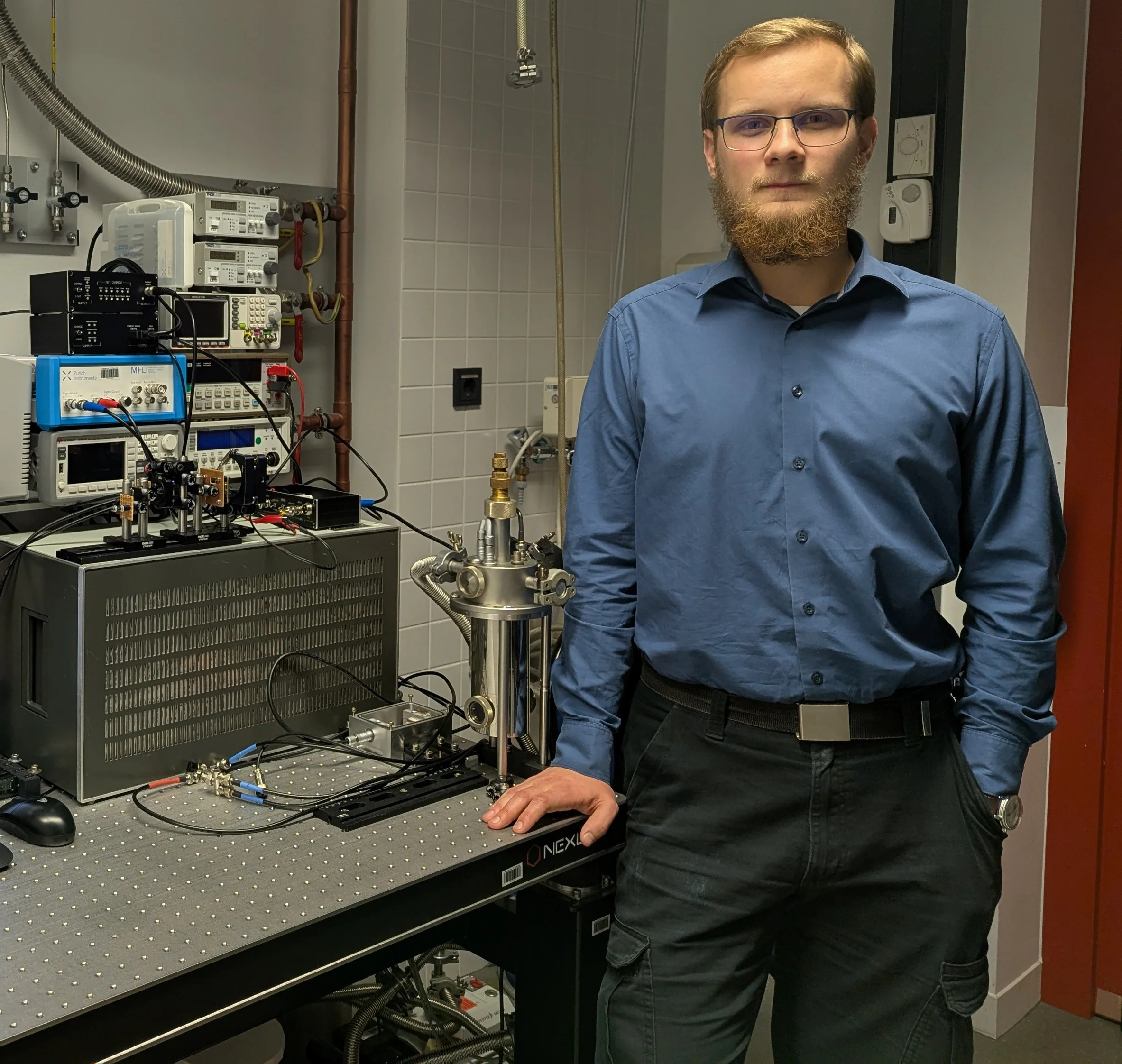
A user story by Danylo Bohomolov, Chemnitz University of Technology
Introduction
Light-emitting diodes (LEDs) have revolutionized modern lighting and display technologies through their high efficiency, long lifetime, and compact size. These semiconductor devices convert electrical energy directly into light through the recombination of electrons and holes in their active region. While LEDs are generally reliable, maintaining stability and longevity remains crucial for their widespread applications. Modern LEDs have been optimized for efficiency and lifetime; however, the noise level is equally critical when it comes to applications in sensing or data communication.
The Challenge
Indeed, a significant challenge in LED technology is that optical noise, which refers to random fluctuations in the emitted light intensity, can limit device performance. This noise originates primarily from crystal defects in the LED structure, which act as traps for charge carriers [1]. These defects are recognized as the main contributors to low-frequency noise, which significantly affects the overall light output noise power [2]. Understanding the relationship between defects and noise is therefore essential not only for improving device stability and signal-to-noise ratio, but also for developing non-destructive methods to assess LED quality and predict degradation.
In a recent study [3], we analyzed the noise of commercially available blue InGaN LEDs across an unprecedented frequency range from mHz to MHz. The comprehensive study revealed distinct behaviors across different frequency regions. In the low-frequency domain, the noise spectrum exhibits both typical \(1/f\) and \(1/f^γ\) components. The developed model attributes these features to a superposition of local generation-recombination (GR) processes with a uniform wide distribution of relaxation times.
The Solution
For the high-frequency measurements, a Zurich Instruments MFLI Lock-in Amplifier enabled precise characterization from the kHz to MHz ranges. The setup is shown in Fig. 1. The MFLI has excellent noise characteristics compared to other lock-in amplifiers, as well as a large dynamic range, which is important for studying \(1/f\) noise. The ability to synchronize two channels potentially allows for the investigation of correlations between optical and electrical noise. For precise customization of preamplification characteristics and the ability to simulate system noise, an external transimpedance amplifier and a DC-block filter were used. Then, photodiode current fluctuations were measured in sweep mode.
Results
The resulting optical power spectral density of the InGaN blue LED is shown in Fig. 2. These measurements revealed particularly interesting behavior: a discrete current-dependent GR component that accelerates with increasing current. Most notably, when the current exceeds 50 mA, the noise spectrum reveals a pronounced peak around 1 MHz, which systematically shifts toward higher frequencies as the current increases. This feature results from the interference of two generation-recombination processes — one with positive and one with negative amplitude. The negative component provides direct evidence of correlated defect-assisted electron-hole recombination [4], which can be associated with Shockley-Read-Hall recombination at deep trap levels under non-equilibrium conditions where electron and hole capture rates differ significantly.
Outlook
Current research has validated the proposed model by examining the transition from noise in localized micrometer-scale regions to macroscopic device-level fluctuations. This multi-scale approach confirms that local defect-related phenomena, i.e., blinking, scale up to determine overall device noise performance. The developed framework now potentially enables the estimation of noise-associated trap activation energies, opening the possibility of correlating these energies with defect levels determined through complementary techniques such as Laplace Deep Level Transient Spectroscopy (L-DLTS) and Deep Level Optical Spectroscopy (DLOS). This integrated approach promises to provide unprecedented insight into defect physics in LED structures, ultimately enabling better prediction of device reliability and the development of improved fabrication processes to minimize noise in next-generation LED devices for precision applications.
References
[1] Sawyer, S., Rumyantsev, S. L., Shur, M. S., Pala, N., Bilenko, Yu., Zhang, J. P., Hu, X., Lunev, A., Deng, J., Gaska, R.; Current and optical noise of GaN/AlGaN light emitting diodes. J. Appl. Phys. 100, 034504 (2006) doi:10.1063/1.2204355.
[2] Lee, I.-H., Polyakov, A. Y., Hwang, S.-M., Shmidt, N. M., Shabunina, E. I., Tal'nishnih, N. A., Smirnov, N. B., Shchemerov, I. V., Zinovyev, R. A., Tarelkin, S. A., Pearton, S. J.; Degradation-induced low frequency noise and deep traps in GaN/InGaN near-UV LEDs. Appl. Phys. Lett. 111, 062103 (2017) doi:10.1063/1.4985190.
[3] Bohomolov, D., Ivanova, V., Schwarz, U.T.; Low- and High-Frequency Noise in LEDs. Phys. Status Solidi A 222, 2400869 (2025) doi:10.1002/pssa.202400869.
[4] Rimini-Doering, M., Hangleiter, A., Kloetzer, N.; Electron-hole-correlation effects in generation-recombination noise. Phys Rev B. 45, 1163 (1992) doi:10.1103/PhysRevB.45.1163.