Transforming Human-Machine Interaction: The Journey of Neuranics and TMR Sensing

Can you take us through your company's origins? How did the initial idea come about and evolve into the company you are today?
Neuranics was founded in 2021 as a joint spinout of the University of Glasgow and the University of Edinburgh, building on years of pioneering research in Tunneling Magnetoresistance (TMR) technology. This research, spanning advanced sensor design and biomagnetic signal detection, laid the foundation for a breakthrough in human-machine interaction. Recognizing the transformative potential of TMR magnetic sensing in wearables, digital health, and XR (Extended Reality), we saw a clear opportunity to bring this innovation to market. Neuranics was established to lead this development and commercialization. Since then, we have secured investment, expanded our team with industry experts, and developed cutting-edge sensor solutions that are now attracting interest from major players in consumer electronics, healthcare, and beyond.
What do you find particularly promising or exciting about your industry and your startup’s role in it?
Magnetic sensing is evolving rapidly, expanding beyond its traditional industrial applications into high-growth areas such as digital health, wearables, and XR. The demand for ultra-sensitive, compact, and low-power solutions is growing, enabling new ways to monitor health, interact with technology, and improve user experiences. Neuranics is driving this transformation, pushing the boundaries of bio-magnetic signal detection—something previously considered impractical outside of controlled lab environments. By pioneering real-world applications of TMR sensing, we are unlocking new markets and shaping the future of human-machine interaction.
Talk to us about your TMR technology-fueled solutions. How and what advantages does it contribute to, and what can you offer your clients in the market today?
Our TMR magnetic sensing solutions combine ultra-high sensitivity, low power consumption, and a compact form factor, making them uniquely suited for bio magnetic signal detection. Unlike conventional electrical-based sensing methods, our sensors do not require direct skin contact, providing greater design flexibility and the potential for more comfortable, continuous monitoring. This creates key advantages in applications such as heart rate monitoring, muscle activity detection, and gesture recognition.
Today, we offer development kits that enable companies to create entirely new product categories. We are not just advancing existing applications, we are pioneering and addressing new markets in digital health, wearables, and human-machine interaction. Through close collaboration with industry leaders, we are paving the way for the integration of our technology into next-generation consumer electronics and medical devices, driving innovation and shaping the future of magnetic sensing.
Could you explain how Zurich Instruments' MFLI supports your company's project and your mission?
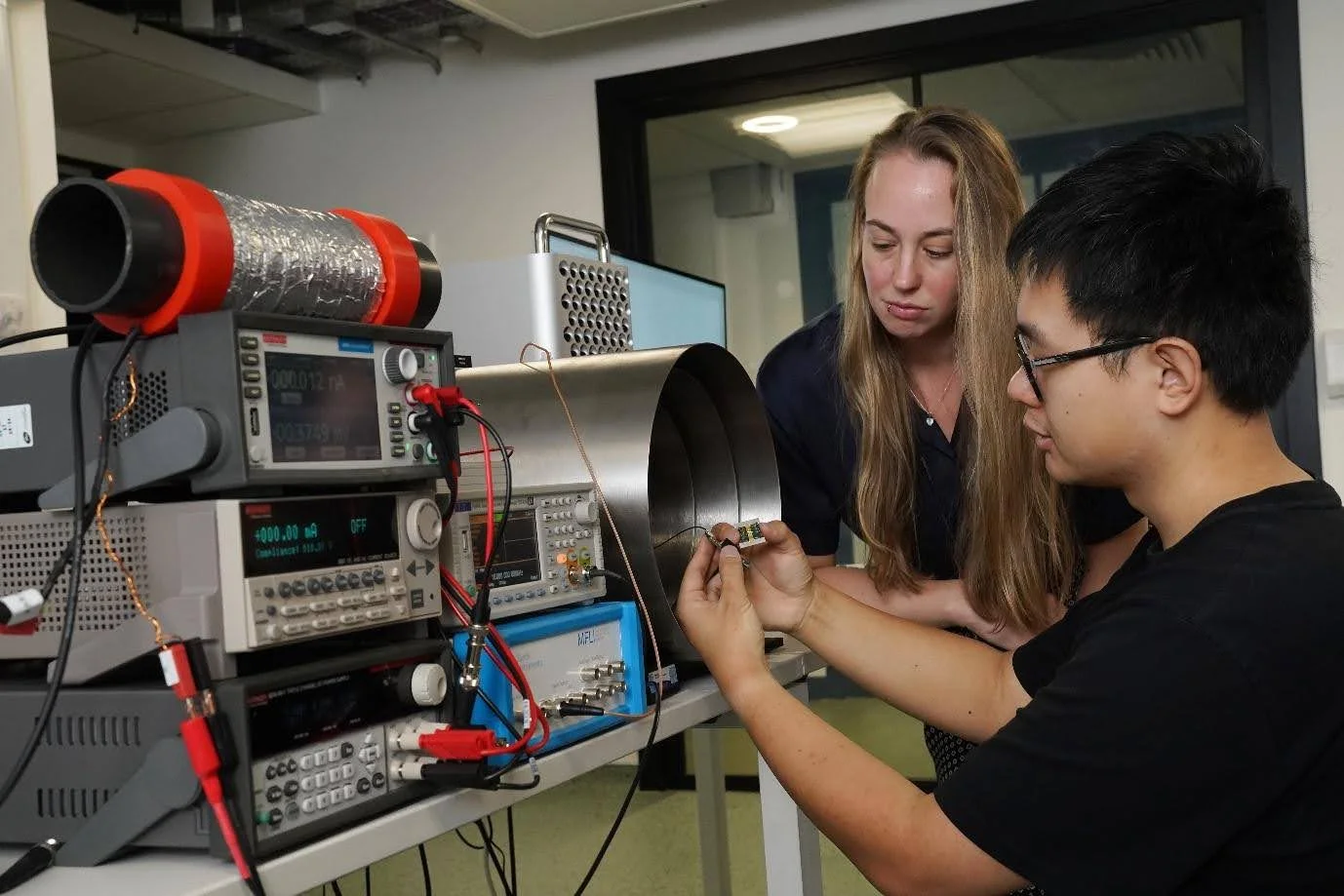
Zurich Instruments' MFLI lock-in amplifier has been instrumental in validating the performance of our ultra-sensitive TMR sensors. Achieving picoTesla-level sensitivity is essential for detecting weak biomagnetic signals, and the MFLI provides the precision needed to characterize and optimize our sensor technology. By using its capabilities, we have been able to push the boundaries of sensor performance, ensuring our solutions meet the demanding requirements of real-world and emerging applications. This support aligns perfectly with our mission to develop high-performance magnetic sensing solutions that enable groundbreaking advancements in health monitoring and human-machine interaction.
Can you share a pivotal moment in your company's journey and how it shaped your direction? What advice would you give to other companies looking to leverage high-tech equipment like Zurich Instruments'?
A pivotal moment for Neuranics was securing our first major investment, which allowed us to transition from academic research to commercialization. This funding enabled us to refine our sensors, recruit industry professionals to complement our technical expertise, and acquire the specialized equipment needed to accelerate development. It also positioned us to collaborate with leading companies in wearables and XR, bringing our technology closer to real-world adoption. As we continue to grow, precision measurement tools like Zurich Instruments' MFLI remain essential in validating and optimizing our technology for commercial applications.
For other companies looking to scale high-tech innovations, our advice is to invest in precision instrumentation early. Tools like the MFLI provide the accuracy needed to accelerate development, bridge the gap between research and commercialization, and give you the confidence to push the limits of what’s possible.