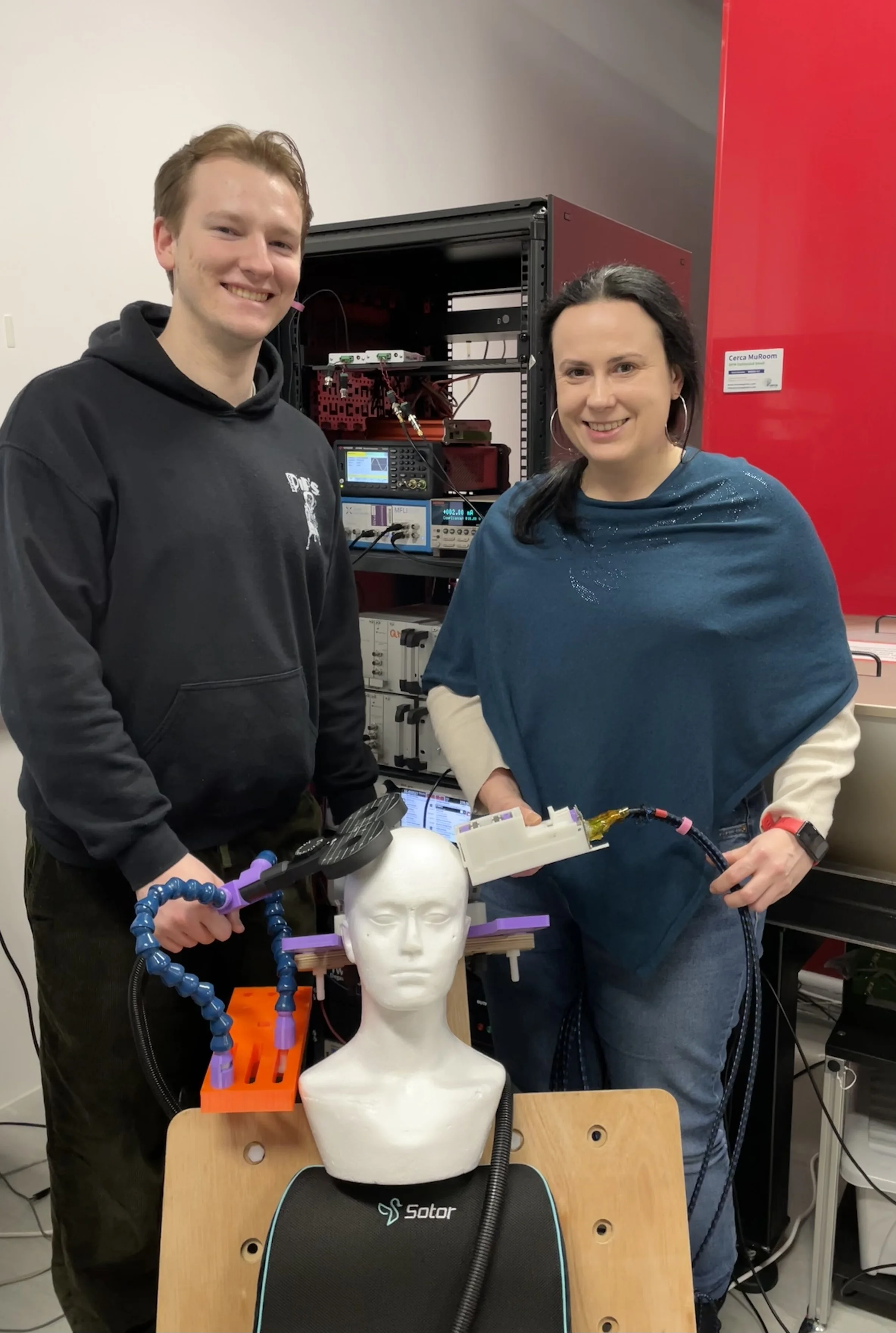
Tiny Sensors, Big Impact: Harry Cook and Dr. Anna Kowalczyk on Advancing Magnetometry for Brain Imaging

What is your academic background?
Anna: My background is in atomic physics. I started by building cold atoms experiments and then moved to optical magnetometry. As an assistant professor at the University of Birmingham, I am now developing optically pumped magnetometers (OPMs) for brain imaging applications.
Harry: I did my master’s in medical physics, so fewer lasers and atoms. I then joined Anna’s group for my PhD. In my undergrad and master’s, I was using OPMs, and now in my PhD, I am developing them - so a little sideways shift.
Brain imaging - can you dive into the details of your research?
Anna: We aim to make optically pumped magnetometers for magnetoencephalography. Magnetoencephalography is a brain imaging method that measures tiny magnetic fields that are stretching outside of the brain, when people think or do a task. When the neurons are engaged in a task, they generate dendritic currents, and these currents generate magnetic fields. By placing many small magnetometers around the head, we can measure these magnetic fields and then use mathematical algorithms to calculate where they originate in the brain. This method is used by neuroscientists to perform cognitive neuroscience and study the brain.
Harry: In this video, you can get a glimpse of our research.
Do you perform experiments with humans as well?
Harry: Yes, that was the result of our last paper. We played audio tones in a person’s ear and could then pick up the brain response with our sensor. We conducted measurements of the heartbeat as well – our sensors can pick up the heartbeat from five centimeters away.
Can you see a difference when playing classical music or rock?
Harry: In theory, yes.
Which role does the MFLI play?
Harry: Our sensor is based on cells filled with rubidium atoms. In the presence of a magnetic field, the magnetic moments of these atoms precess around an axis set by the magnetic field which is known as Larmor precession. The frequency of this precession depends on the magnetic field strength and can therefore be used as a sensor. To measure the magnetic field, we are using a resonant-driven experiment as we are tracking the Larmor frequency of the magneto-optic resonance, so we need an instrument to measure the amplitude and phase of the signal and drive the sensor such that the atoms always oscillate at resonance frequency. For this, we are using the MFLI Lock-in Amplifier with the PID option, and we are measuring small signals, so we are all about low noise and the amplifier is of course very useful for that.
What are you planning to do in the next few years?
Anna: We are moving towards assembling more sensors and combining them with other neuroscience modalities. We currently have two types in mind: one is to combine our sensors with transcranial magnetic stimulation (TMS). A TMS pulse can induce or suppress neural activity in the brain and then our sensors can measure the response. Our second idea is to combine our sensors with near infrared spectroscopy - our sensor is optical which means we would add some extra optical fibers - one delivering infrared light to brain tissue in order to measure brain metabolism by picking up the light scattered by the tissue. This will give us additional complementary information about brain activity.
What are the challenges?
Harry: Measuring tiny magnetic fields is challenging because there are a lot of magnetic fields in our surroundings, for example when an elevator is moving within a building. Even with magnetic shielding, these fields are much stronger than the magnetic fields due to brain activity. Also, the TMS coils create magnetic fields of 1-3 Tesla for brain stimulation, which is much larger than the roughly 50 femtotesla that we want to measure from someone’s brain activity. So, it is quite a tough task, but we have picked the correct physics to allow our sensor to recover from high field shock and subsequently measure tiny magnetic fields with femtotesla sensitivity.
What is your vision for the future?
Anna: We are not only developing sensors, but we are also interested in their application for medical therapies, since we are based in the Center for Human Brain Health. In the future, our sensors could be used to provide real-time feedback for medical doctors who stimulate the brain for treating depression or other neurological disorders. With our sensors, the doctor could immediately see whether the brain is responding to the treatment.
And what do you do in your free time?
Harry: Cooking, lots of cooking, and lots of badminton.
Anna: I love gardening. I'm trying to grow vegetables but right now it’s more like I'm growing a farm for slugs and other animals that are eating my veggies.