From Pork Chops to Pathology: A Hands-On Approach to Cancer Research
Tell us about your journey as a scientist up to now. What’s your academic background?
I received my mechanical engineering degree from the Budapest University of Technology and Economics in 2019. After graduation, I joined Bosch Hungary, first as a software development engineer in the field of autonomous driving, then as a design engineer for steering systems until 2022. In 2023, I joined the Institute for System Dynamics at the University of Stuttgart as a PhD researcher within the Graduate School GRK2543 “Intraoperative Multisensory Tissue Differentiation in Oncology.” The GRK2543 brings together interdisciplinary research groups from the University of Stuttgart and clinicians from the University Hospital of Tübingen, forging a close collaboration between technology development and clinical application.
Can you tell us what you are working on at the moment?
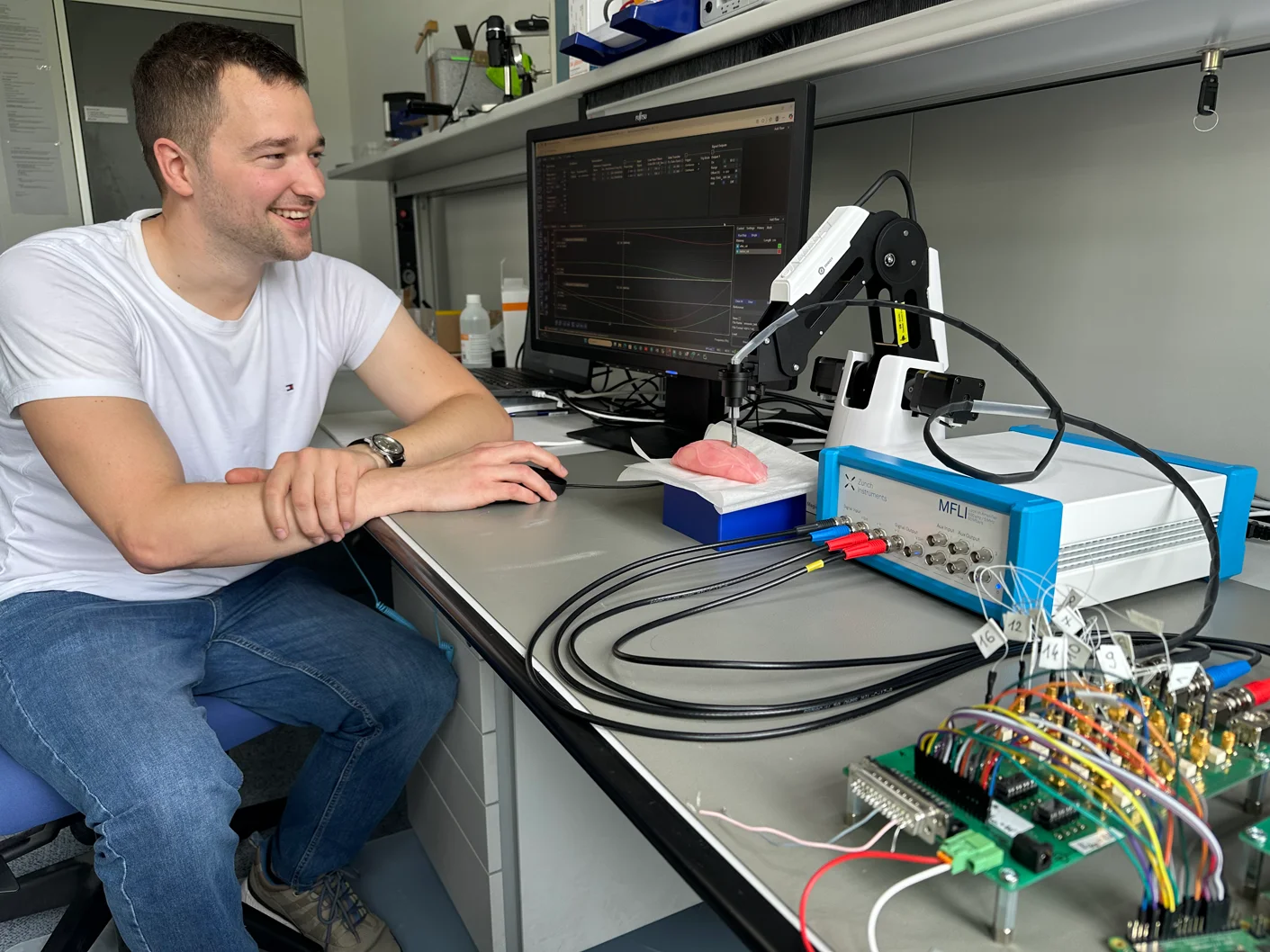
My work focuses on sensor development and data-driven tissue characterization. We use 4-electrode point-like sensors to distinguish early-stage cancerous lesions from healthy tissue, particularly in the context of bladder and breast cancer. Additionally, we are developing a multi-electrode sensor array that enables spatially distributed measurements. The goal is to reconstruct a conductivity map beneath the sensor to estimate tumor margins. In our latest work, we investigated the feasibility of this margin estimation. We trained a neural network to directly map impedance measurements performed with a multi-electrode sensor array to spatial conductivity distributions to estimate fat–muscle boundaries on ex vivo porcine tissue. One of the most exciting aspects of my PhD is the ability to perform measurements directly on freshly excised human tissue samples.
What is especially exciting about this topic in your view?
What makes this research area important is its potential to significantly improve patient outcomes by enabling more precise surgeries. In many oncological procedures, especially breast-conserving or bladder surgeries, surgeons must strike a delicate balance between removing all tumor tissue and preserving as much healthy tissue as possible.
Currently, due to the lack of real-time margin assessment tools, surgeons often are on the side of caution to not leave any tumor remnants behind. For instance, in bladder cancer surgeries, it’s not uncommon for the entire bladder to be removed, which drastically impacts a patient's quality of life. A reliable intraoperative sensing tool could help localize tumor boundaries more accurately, reducing the need for such radical interventions and improving functional outcomes for patients.
What do you view as the next big challenge(s) in this research field?
One of the main goals is ensuring intraoperative and minimally invasive applicability. However, this introduces several technical challenges: long and thin cables, small electrode sizes, and varying tissue contact conditions can all introduce significant noise or artifacts. Designing an electrode geometry that balances spatial resolution with reliable signal quality is also critical.
How does the Zurich Instruments MFIA Impedance Analyzer support your research?
We use the Zurich Instruments MFIA to perform high-precision impedance measurements across a range of frequencies, typically between 1 kHz and 1 MHz. These measurements are conducted on freshly excised human tissue samples directly in the pathology lab, immediately after surgery. In this setting, the MFIA’s speed, stability, and accuracy are crucial to obtaining clean, reproducible data.
The LabOne software is incredibly intuitive and enables fast and flexible adjustments during experimental setups. However, what truly sets the Zurich Instruments MFIA apart is its seamless integration into custom measurement systems via the Python API. Thanks to the clear documentation and robust interface, we were able to combine the MFIA with our own hardware extensions, such as a relay board for automated electrode switching, without any hurdles. This flexibility makes it an ideal tool for scalable measurement routines, working with multi-electrode arrays.
What is the craziest thing you’ve done (or would have liked to do) in your scientific career?
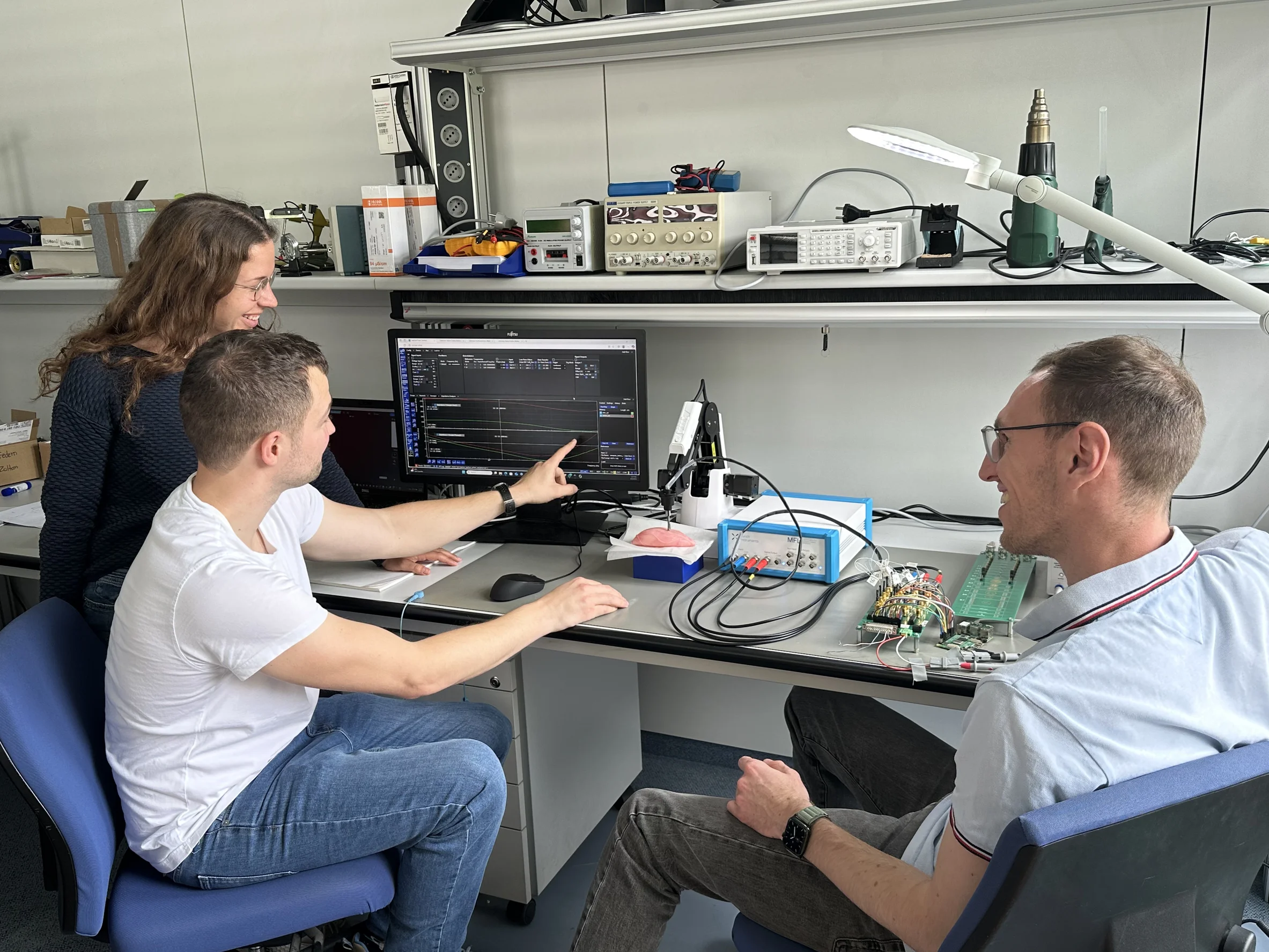
One of the more unusual aspects of my recent research was the data collection process for our latest study. To simulate soft biological tissue, I needed fresh fat-muscle interfaces on a daily basis - so I ended up visiting the local butcher every morning to get the right piece of pork. After conducting my impedance measurements during the day, I made sure nothing went to waste: I cooked and ate the same meat in the evening! It’s a fun reminder that science can sometimes be surprisingly hands-on.