Zurich Instruments Test & Measurement Newsletter - Edition Q2/2021

Welcome to the Q2/2021 Test & Measurement newsletter!
This edition features some of our most recent content on the rich and broad topic of imaging – from adding a lock-in amplifier to your atomic force microscopy setup to working out how to improve the signal-to-noise ratio of your laser-scanning microscope. If your experiments involve impedance measurements, read on to find important practical tips on fast frequency sweeps and cable compensation.
Knowledge Bits
Video: Boost your AFM with Zurich Instruments' Lock-in Amplifiers
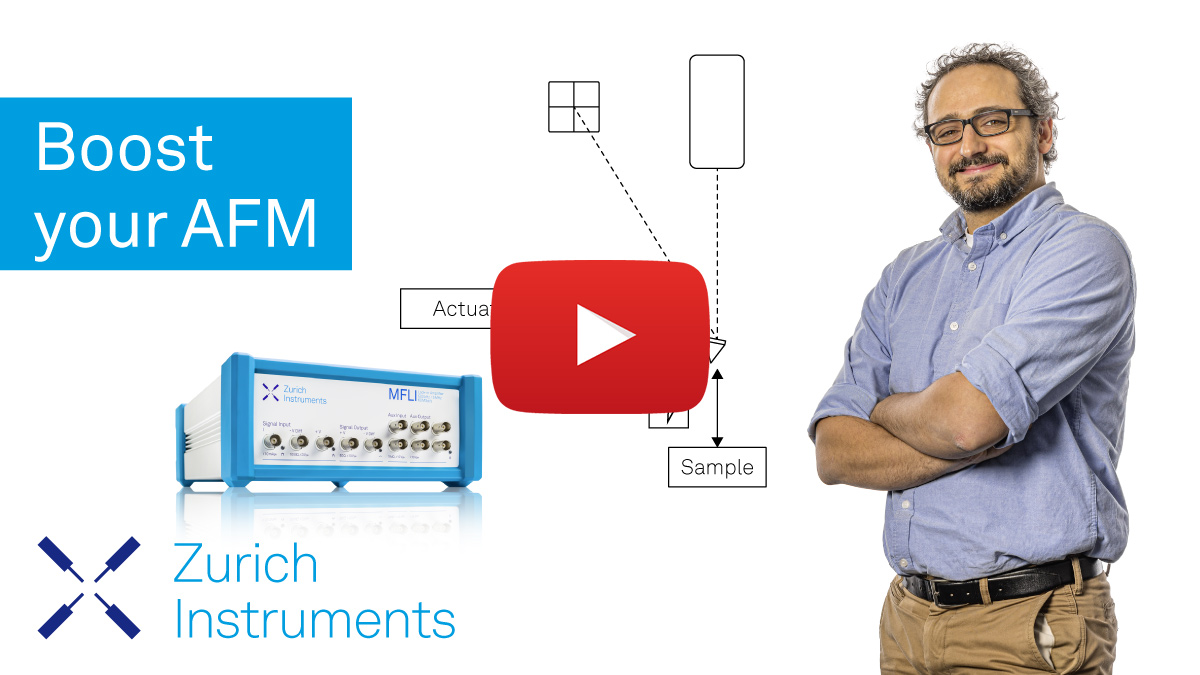
Learn how to interface a Zurich Instruments Lock-in Amplifier with a commercial atomic force microscope (AFM) in our latest video. Kıvanç Esat shows you how to enable advanced imaging methods, including single-pass-scan Kelvin probe force microscopy (KPFM) and dual-frequency resonance tracking (DFRT), thanks to an intuitive workflow and the LabOne® toolset. The LabOne software opens up possibilities such as the study of tip-sample interactions at multiple frequencies in the time and frequency domain. Kıvanç also looks at how to capture your data and record AFM images.
Blog Post: How to configure the DAQ module for image acquisition
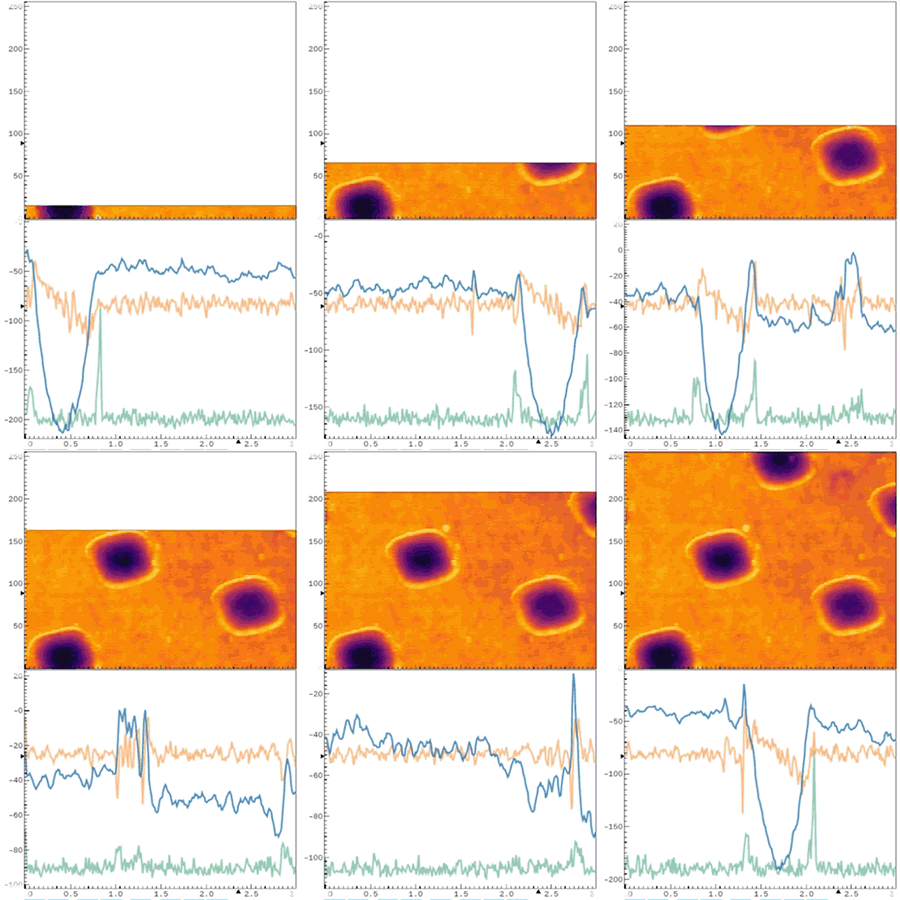
Do you need to scan over your sample while acquiring lock-in data to build up images? In this blog post, Kıvanç Esat demonstrates how to configure the LabOne Data Acquisition (DAQ) module for this purpose. With its trigger engine and grid mode, the DAQ module enables you to synchronize the lock-in measurement with the scan engine. You can thus construct images from multiple demodulators and auxiliary signals simultaneously, where each of them carries unique information about the sample.
Blog Post: How to improve your laser-scanning microscope with lock-in amplifiers
Improving the signal-to-noise ratio (SNR) of your laser-scanning microscope enables you to observe smaller changes or faster processes in your sample. In this blog post, Claudius Riek explains how lock-in amplifiers and boxcar averagers can boost the SNR for CARS, SRS, multi-photon and other laser-scanning microscopy techniques.
Blog Post: Fast frequency sweeps for impedance measurements
When characterizing a device or material as a function of frequency, the resulting spectrum may vary quickly over time as the environment or material itself changes. This temporal evolution can be captured on a short timescale through sequential fast sweeps, as Tim Ashworth discusses in this blog post. In particular, he demonstrates how adding the MF-PID option to the MFIA Impedance Analyzer makes it possible to perform fast impedance sweeps while maintaining a high level of accuracy. The data include frequency sweeps of 1024 points acquired in just 300 ms.
Blog Post: Compensating cables for accurate impedance measurements
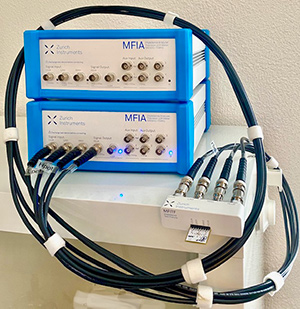
Measuring impedance accurately can be difficult, especially when the device or material under test is located some distance away from the impedance analyzer. In this blog post, Tim Ashworth addresses this challenge by considering a well-defined load located at the end of long cables: he performs impedance measurements with and without the User Compensation functionality in the LabOne instrument control software, showing how careful cable compensation allows you to not sacrifice accuracy in your measurements.
Company & Community

The Zurich Instruments Student Travel Grants are back for the seventh year in a row. The three winners of the grants will be able to spend their prizes to cover fees for virtual or physical conferences and events, to buy textbooks or to take online courses.
If you are a PhD student or a postdoctoral researcher who published a paper mentioning one of Zurich Instruments' products, apply by July 31st for a chance to win!
Recent publications featuring the MFLI and the MFIA
- Diveky, M.E., Gleichweit, M.J., Roy, S. & Signorell, R. Shining new light on the kinetics of water uptake by organic aerosol particles. J. Phys. Chem. A 125, 3528–3548 (2021).
- Vardar, Y. & Kuchenbecker, K.J. Finger motion and contact by a second finger influence the tactile perception of electrovibration. J. R. Soc. Interface 18: 20200783 (2021).