Zurich Instruments Quantum Technologies Newsletter - Edition Q2/2021
Welcome to the Q2/2021 Quantum Technologies newsletter!
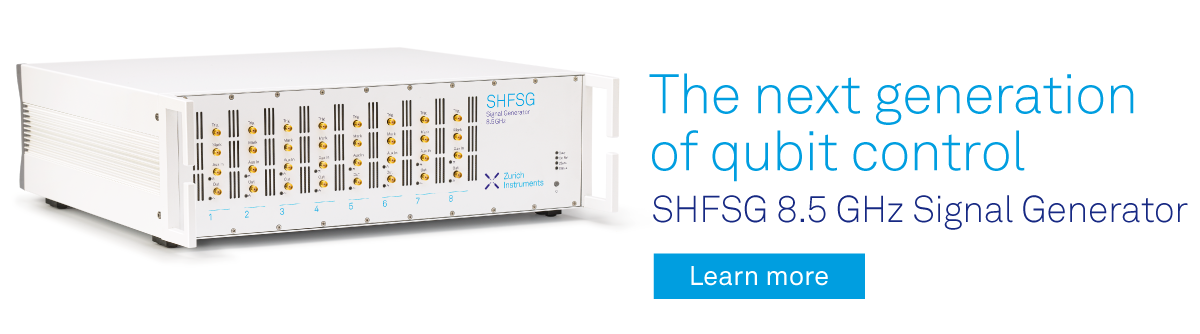
This edition follows closely the launch of our SHFSG Signal Generator, so this is the place to learn more about this new and innovative instrument if you missed our virtual launch event. Besides qubit control, we've been busy looking into randomized benchmarking and developing new drivers for QCoDeS and Labber.
Knowledge Bits
Video: The next generation of signal generators for quantum computing

What is Zurich Instruments' approach to qubit control? Designed to generate microwave pulse sequences directly at qubit frequencies, the SHFSG Signal Generator answers this question as part of our second generation of quantum computing systems. In this recent webinar, we discussed our approach to simplifying qubit control systems while aiming for high gate fidelities. You can now watch the video recording of the event on our YouTube channel and read the Q&A session summary in this blog post.
Blog Post: Randomized benchmarking in seconds
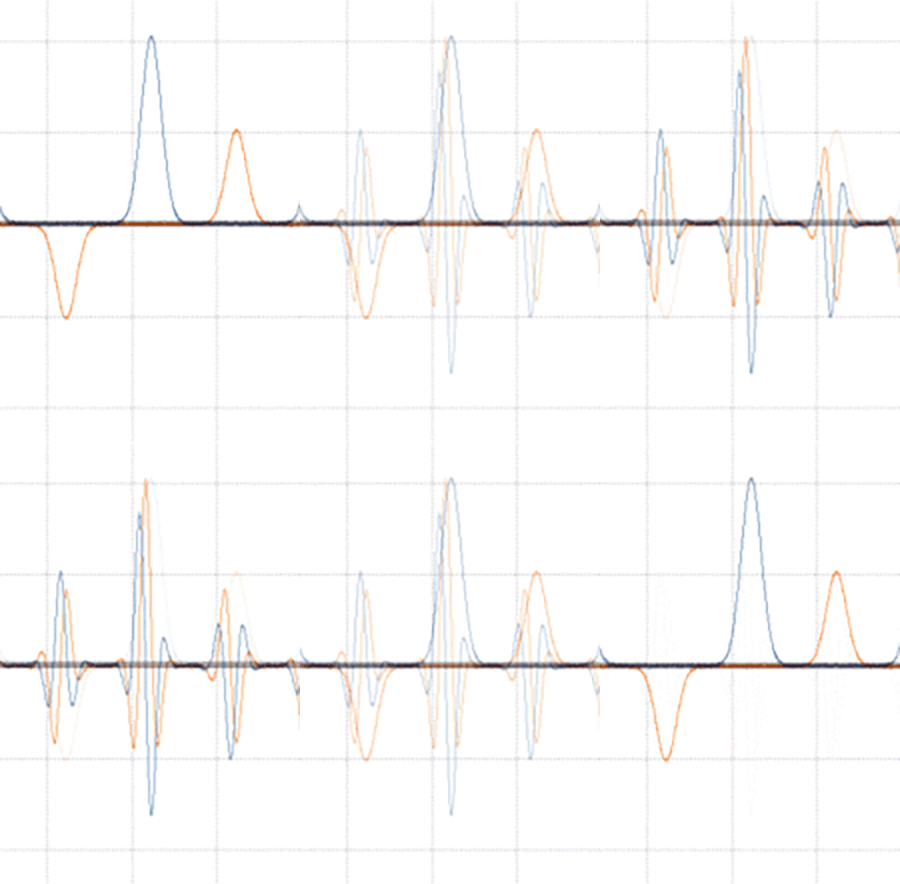
Do you characterize your qubit fidelities with randomized benchmarking but find that experiments take too long? Does your AWG require you to precalculate and upload the full waveforms, forcing you to spend time waiting for the upload to be completed? In this blog post, Andrea Corna and Clemens Müller demonstrate how to use the advanced feature set of the HDAWG Arbitrary Waveform Generator to speed up this process. Taking advantage of the command table and digital modulation features, they show how to minimize waveform generation and upload times to let you get back to measuring qubits without worrying about instrument downtime.
News
First data from the SHF platform in the field
Thanks to our close collaboration with the Quantum Device Lab at ETH Zurich, we have been testing the capabilities of the SHFSG and the SHFQA on real qubits. Here we’d like to share some of these early results.
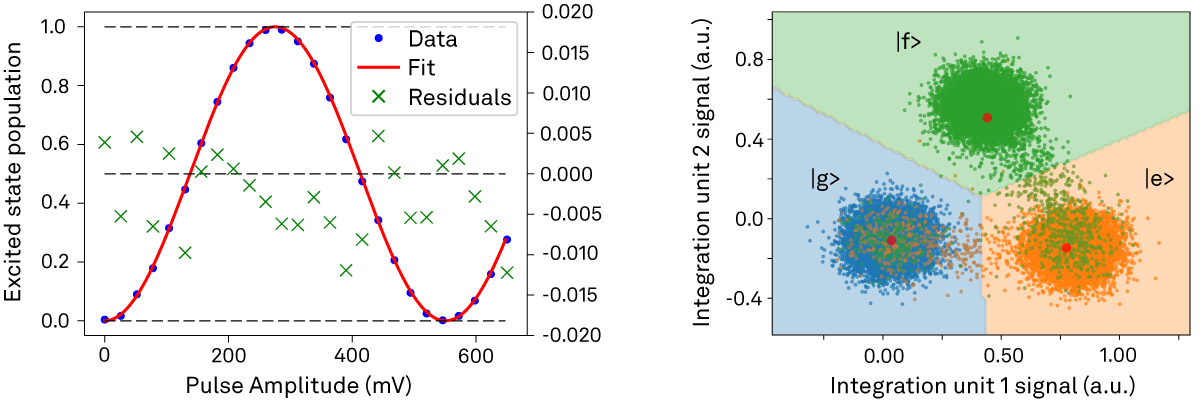
The SHFSG Signal Generator was used to carry out a full single-qubit gate tune-up, starting from qubit spectroscopy up to randomized benchmarking of the single-qubit gate. With the SHFSG you can perform these measurements using signals with a low spurious level and highly linear amplitude characteristics, without the need for mixer calibration. As shown in the above plot to the left, the Rabi oscillation measurement provides high-quality data (blue dots) in excellent agreement with a sinusoid fit curve (red line). This is a notable outcome, because the amplitude linearity limits how good the fit of the measurement data with a sinusoid curve can be in Rabi experiments. If the relation between the intended and the actual pulse amplitude is nonlinear, this causes a systematic error in the pulse amplitude calibration for a pi/2 rotation or any other rotation angle. Spurious components in the signal can lead to state leakage, which means the excited-state population on the vertical axis does not reach zero after a full cycle of the Rabi oscillation. None of these issues arises with the SHFSG.
As for the SHFQA Quantum Analyzer, we asked the question: how good is the readout fidelity? In the above plot to the right, you see 10'000 single-shot readout results on a qutrit measured with the SHFQA. The qutrit was prepared to equal proportions in the ground, first and second excited state, resulting in 3 point clouds of equal weights in the scatter plot. The averaged 3-level readout assignment fidelity of 95.5% is mainly limited by the thermal population of the qubit and relaxation during the 600-ns-long readout pulse, in full agreement with the results from an independent characterization of the qubit. Low-noise measurement data of this kind are at the core of reliable operation for a quantum computer. In an independent stress test, we let the SHFQA measure 16 signals simultaneously over 24 hours: we are happy to report that you won't notice any drift in phase or amplitude in your qubit measurements with the SHFQA.
QCoDeS and Labber interfaces for Zurich Instruments' PQSC
About a year ago we introduced drivers for QCoDeS and Labber, two leading frameworks used in the nanoelectronics and quantum computing communities, to allow you to operate and synchronize multiple instruments with a friendly programming interface and perform all essential qubit characterization tasks successfully. Now we have developed controllers for the PQSC Programmable Quantum System Controller, so that you can further extend your possibilities when working within QCoDeS and Labber. The new PQSC drivers enable rapid tune-up procedures, syndrome decoding, and error correction routines using these measurement frameworks. Upgrade your zhinst-qcodes and zhinst-labber drivers to the latest version to simplify instrument synchronization and control feedback experiments directly within QCoDeS and Labber!
A look at the full quantum stack
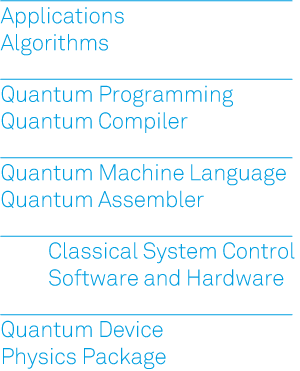
A quantum computing architecture based on superconducting qubits is a tremendously promising avenue, but those working in this research area know that it's also a path lined with challenges. In this feature article published in Nature Reviews Physics, Application Scientist Gaia Donati dives into the quantum stack and considers some of the open technical questions arising at different levels of this layered structure.
Company & Community

The Zurich Instruments Student Travel Grants are back for the seventh year in a row. The three winners of the grants will be able to spend their prizes to cover fees for virtual or physical conferences and events, to buy textbooks or to take online courses.
If you are a PhD student or a postdoctoral researcher who published a paper mentioning one of Zurich Instruments' products, apply by July 31st for a chance to win!
Recent publications featuring the UHFQA, the HDAWG and the HDIQ
- Simbierowicz,S. et al. Qubit energy-relaxation statistics in the Bluefors quantum measurement system. Application Note (June 2021).
- Werninghaus, M. et al. Leakage reduction in fast superconducting qubit gates via optimal control. npj Quantum Inf. 7, 14 (2021).