How Can We Measure the Gravitational Constant in a Modern Physics Lab?
Why the Gravitational Constant Matters
The gravitational constant G is the proportionality constant in Newton's law of universal gravitation: F = G·m₁·m₂ / r². It governs planetary orbits, cosmology, and remains a cornerstone of precision metrology. Unlike most other fundamental constants, G cannot be derived from first principles – it must be measured.
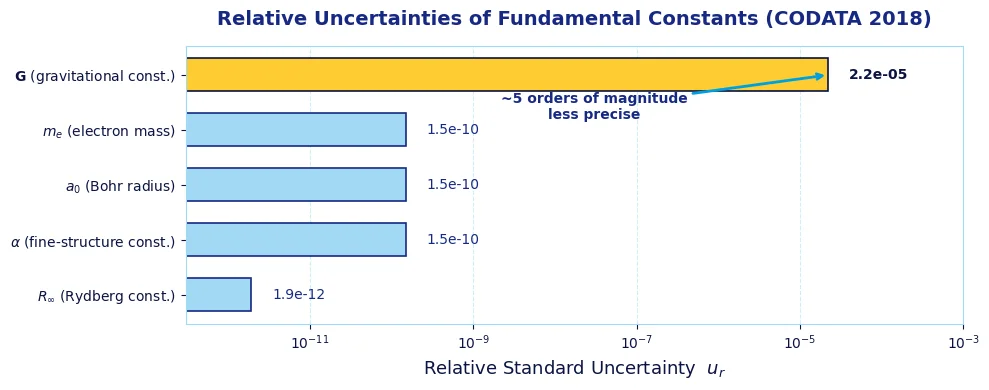
And here lies a striking paradox: while many fundamental constants are known to 10⁻⁹ relative precision or better, G is still uncertain at the 10⁻⁵ level, making G the least precisely determined of all fundamental physical constants.
Why Measuring G is So Hard
Gravity is inherently weak. You can pick up a paperclip with a small magnet, easily overcoming the gravitational pull of the entire planet. The signals in a G experiment reflect this: tiny torques, sub-nanometer displacements, micro-radian angular changes – all buried under noise.
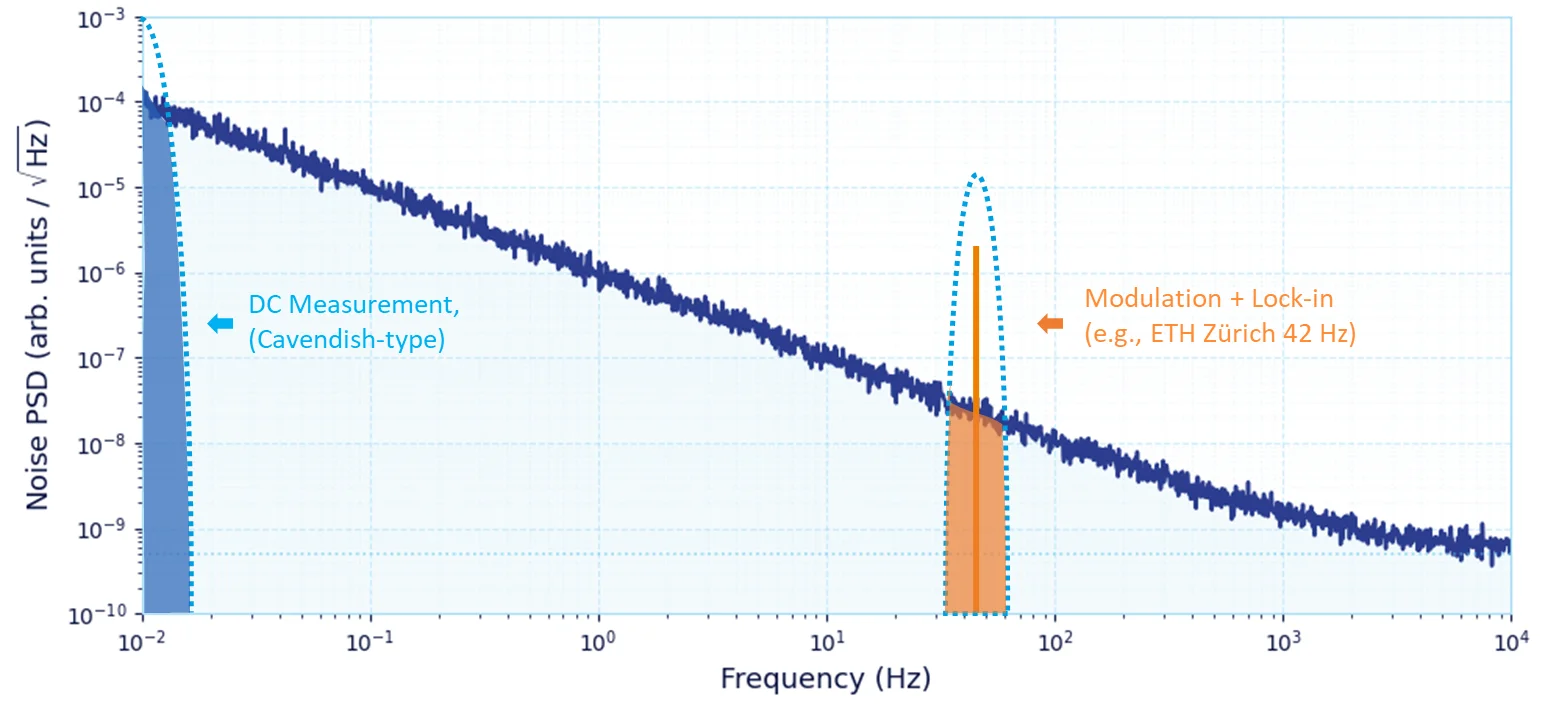
The dominant issues are long-term drift, thermal expansion, mechanical creep, environmental vibrations, and 1/f noise that rises steeply at the low frequencies where static measurements operate. As a result, many experiments must integrate over hours or days to achieve usable SNR.
The Classical Approach: Cavendish and the Torsion Balance
The first laboratory measurement of gravitational attraction dates to 1797, when Henry Cavendish used a torsion balance: small test masses suspended from a fiber are gravitationally attracted toward large source masses, twisting the fiber by a tiny, measurable angle. From the torsion constant of the fiber, the equilibrium deflection, and the known geometry, one can solve for G.
Modern torsion balances [2] still follow this core principle, as the method is conceptually simple and highly replicable. Cavendish's result was not improved upon for a hundred years. But the measurement is inherently static: you are reading a DC deflection, which makes it sensitive to every slowly varying perturbation, e.g. thermal/mechanical drifts and air currents. This is precisely where the approach hits its limit.
Modern Strategies: Turning Gravity Into a Time-Varying Signal
What if, instead of measuring a static deflection, you could modulate the gravitational force itself? By oscillating or rotating the source masses, the gravitational interaction becomes periodic: a signal at a well-defined frequency.
Why modulation helps:
- Moves the signal away from DC into a quieter frequency band, further away from the noisier regions.
- Enables synchronous (lock-in) detection, extracting only the signal at the modulation frequency.
- Reduces sensitivity to drifts, as slow baseline changes do not affect the AC amplitude.
- Allows long and stable integration times.
The principle of lock-in detection
Lock-in detection (phase-sensitive detection) is the technique that makes this possible. It works by mixing the measured signal with a reference at the modulation frequency, followed by low-pass filtering:
- Use a reference signal tied to the modulation, e.g., an encoder from a rotating mass or the drive signal of an oscillating beam.
- Demodulate the sensor output at exactly that frequency.
- Suppress broadband and low-frequency noise: everything not at the reference frequency is rejected.
The result is an extremely narrow-band measurement capable of extracting signals buried many orders of magnitude below the ambient noise floor.
Case Study: ETH Zürich's Dynamic Measurement of Gravity
A compelling demonstration of this AC approach was published in Nature Physics in 2022 by the group of Jürg Dual at ETH Zurich [3]. Their experiment introduced a fully characterized dynamic measurement of gravitational coupling at frequencies in the hertz regime, a domain where no controlled quantitative experiments existed previously.
The concept
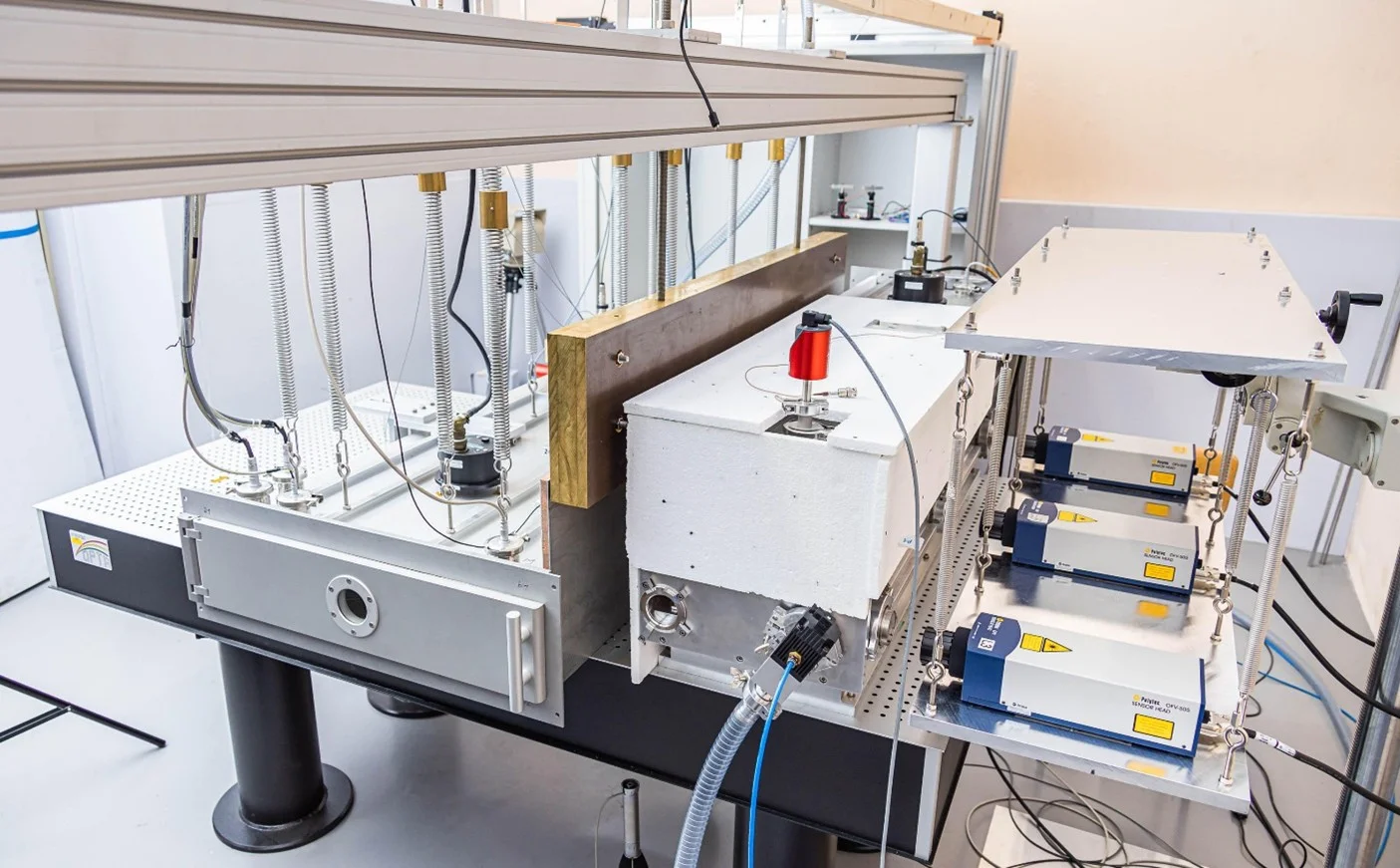
Two parallel beams are suspended in a vacuum. One beam (the ‘transmitter’) is set to vibrate at approximately 42 Hz. Through gravitational coupling alone, this induces motion in the second beam (the 'detector') – a high-quality-factor resonator tuned to the same frequency. The gravitationally-induced displacement is on the order of one picometre: roughly one-tenth the diameter of a hydrogen atom. This sub-picometre resolution is made possible by combining acoustical, mechanical, and electrical isolation; a temperature-stable environment; heterodyne laser interferometry; and lock-in detection.
To rule out interference, the researchers set up their experiment inside the Furggels fortress – a former Cold War military fortification deep inside a mountain near Bad Ragaz, Switzerland. The site offers exceptional temperature stability, seismic isolation, and freedom from human traffic. The researchers operated the experiment remotely from Zürich, viewing measurement data in real time.
How Lock-in Detection Enters the Picture
When gravitational signals are buried deep in noise, reliable synchronous detection becomes essential. Modern lock-in amplifiers enable:
- Measure only the signal of interest at the exact modulation frequency
- Adjustable filtering to optimise noise rejection
- Long-term measurements over hours or days
Additional capabilities relevant to dynamic gravitational experiments include multi-frequency demodulation for monitoring harmonics, digital filtering with controlled bandwidth, and real-time data streaming with long-duration recording.
Instruments suited to precision force or displacement readout:
- MFLI – covers DC to 500 kHz (upgradeable to 5 MHz), with input noise as low as 2.5 nV/√Hz. Thanks to its embedded web server, the MFLI can be operated remotely from any device with a browser; a feature that proved particularly valuable for the ETH Zürich team controlling their experiment from Zürich while the apparatus sat inside a Swiss mountain fortress.
- VHFLI – for broader-band or multi-harmonic studies up to 200 MHz.
How Accurate Are Modern Measurements of the Gravitational Constant?
The currently accepted value [1] is G ≈ 6.67430 × 10⁻¹¹ m³·kg⁻¹·s⁻², with a relative uncertainty of approximately 22 ppm. Inconsistencies between different experimental groups have puzzled the metrology community for decades.
| Method | Typical Uncertainty |
|---|---|
| Classical torsion balance (static DC readout) | ~100–200 ppm |
| Refined torsion balance with advanced isolation | ~40–50 ppm |
| Dynamic/modulated experiments (incl. ETH Zürich) | ~20–30 ppm |
Modulation shifts the signal into a defined frequency band where narrowband filtering, long coherent averaging, and strong rejection of low-frequency drift all work in the experimenter's favor. At this level, the limiting factors become mechanical modelling accuracy, mass positioning tolerances, and systematic uncertainties rather than electronic noise.
Without frequency-domain detection, sustaining ppm-level precision in realistic lab environments becomes extremely challenging. As experimental designs continue to shift toward dynamic approaches, lock-in-based detection is likely to remain a key ingredient in pushing G measurements beyond the current ~20 ppm frontier.
References
- Tiesinga, E., Mohr, P. J., Newell, D. B. & Taylor, B. N. CODATA recommended values of the fundamental physical constants: 2018. Rev. Mod. Phys. 93, 025010 (2021).
- Xue, C. et al. Precision Measurement of the Newtonian Gravitational Constant. National Science Review 7, 1803–1817 (2020).
- Brack, T., Zybach, B., Balabdaoui, F. et al. Dynamic measurement of gravitational coupling between resonating beams in the hertz regime. Nature Physics 18, 952–957 (2022).