RF Measurement Tools Compared: VNAs and Microwave Lock-in Amplifiers
From quantum labs to MEMS foundries, the ability to precisely measure resonances at radio and microwave frequencies is vital. But should you reach for a vector network analyzer (VNA) or a microwave lock-in amplifier (MLA)?
Zurich Instruments and Rohde & Schwarz came together in a joint webinar to answer exactly that. By comparing these two instruments side by side, the session highlighted how each tool shines in specific applications, and how using them together can unlock a deeper understanding of complex devices.
Measuring the Building Blocks of RF Systems
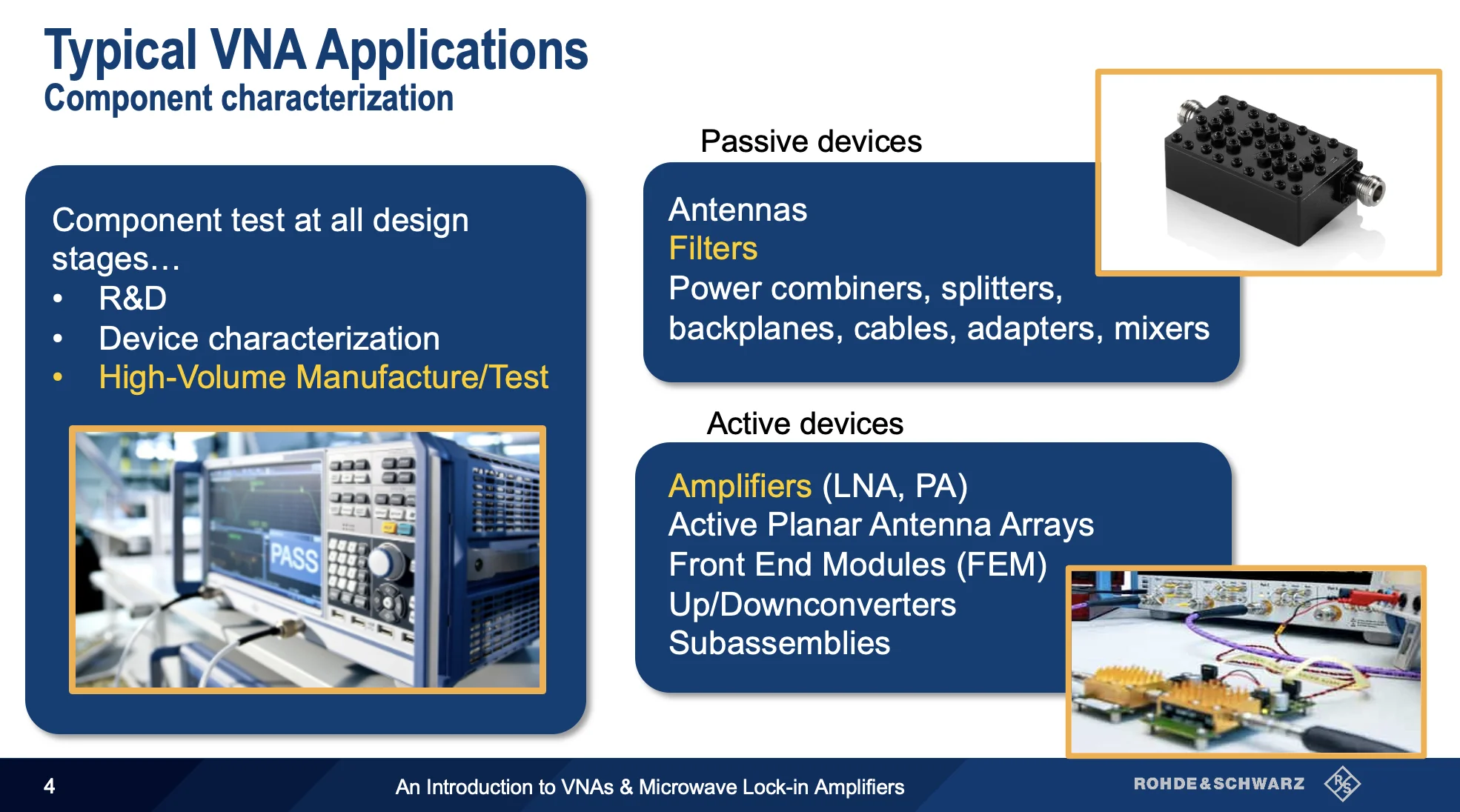
VNAs remain the gold standard for characterizing RF components across the entire frequency spectrum. When testing filters, antennas, or amplifiers, VNAs reveal the full S-parameter matrix, showing how signals are transmitted, reflected, or lost.
- In filter design, VNAs map the passband and stopband, revealing both gain and rejection.
- For amplifier development, they support power sweeps to locate compression points and track phase shifts.
- In antenna testing, VNAs quantify impedance matching, ensuring efficient signal transfer.
The result: VNAs provide the broad, calibrated picture researchers need at the design and characterization stage (Figure 1).
Tracking Resonances in Real Time
Lock-in amplifiers take a different approach. Instead of sweeping broadly, they excel at tracking a single resonance with unmatched precision. By demodulating weak periodic signals from noisy backgrounds, MLAs can stabilize and control operating points that would otherwise drift as the signal is lost in the noise.
- In surface acoustic wave (SAW) sensors, MLAs track frequency shifts caused by environmental changes such as pressure or temperature, enabling highly sensitive detection.
- In cavity optomechanics, they resolve faint sidebands that encode information about photon–phonon interactions, crucial for quantum science.
- In quantum sensing and qubit readout, their ability to run multiple demodulators and feedback loops simultaneously enables precise, noise-resilient experiments.
Modern RF-capable MLAs bring additional features: multi-frequency tracking, PID controllers, sideband analysis, and pulse measurements, making them adaptable for a wide range of dynamic experiments (Figure 2).

An Example Demonstrating the Strengths of Both Tools
Consider the simple case of measuring a resonator.
- A VNA can sweep across frequencies to identify the resonance peak and measure the full transmission spectrum.
- Once that peak is known, an MLA can lock onto it, track tiny detuning shifts in real time, and apply feedback to keep the system stable, even under disturbances.
This combined workflow allows researchers not only to characterize but also to control resonances, bridging the gap between static measurements and dynamic experiments.
Conclusion
By joining forces in this webinar, Zurich Instruments and Rohde & Schwarz gave researchers a unique opportunity to explore both perspectives in a single session, helping the scientific and engineering communities to tackle complex RF measurement challenges, from the design floor to the quantum lab.
Whether you are designing a filter, developing a MEMS sensor, or stabilizing a quantum cavity, knowing when to use a VNA or an MLA is key. VNAs provide the calibrated big picture; MLAs deliver real-time high-precision.
The joint insights from Zurich Instruments and Rohde & Schwarz highlight an important takeaway: the smartest labs don’t choose one over the other, they use both.
Register to watch the full webinar replay here.