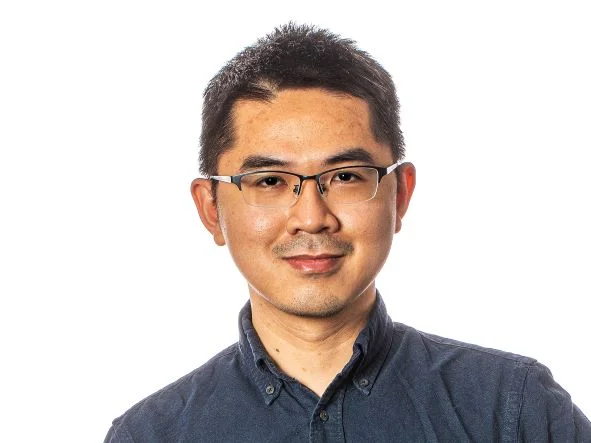
Interview: Dr. Chi-Huan Nguyen and Dr. Pol Welter
Can you tell us a bit about your background?
Pol: Just last winter, I finished my PhD in experimental physics in the group of Christian Degen at ETH Zurich. I worked on scanning microscopy with nitrogen vacancy centers. That's a quantum sensing application, and many of the concepts also apply to quantum computing. During my PhD I focused on the engineering side of the research effort. NowI'm in software engineering at Zurich Instrument, and I think it's a continuation of my PhD work in a way. And it's fun: the LabOne Q software that I work on now tackles many of the same problems that we were trying to solve back at ETH.
Chi-Huan: I'm an experimental atomic physicist by training. I did my PhD on trapped neutral atoms in the group of Christian Kurtsiefer. Then I moved to quantum computing working in the trapped ion group of Dzmitry Matsukevich in Singapore. Quite similarly to Pol, we needed to build the experiment by ourselves. Much of it concerned the laser optics, but also electronics and control software were a big part of it.
What do you like most about LabOne Q?
Chi-Huan: I think there’s a great mission behind it: simplify the complicated job of controlling multiple devices. This will help scientists a lot to focus on the physics side of problems in quantum computing research.
Pol: LabOne Q really allows you to model your quantum computing experiment rather than just writing low-level code that is executed on the instruments. All the orchestration of instruments is happening behind the scenes. The software manages to remove many of the peculiarities of the devices, but still allows for low-level access where it’s needed.
What was particularly challenging in the development?
Chi-Huan: I'm responsible for system testing. Here, the main challenge is for us to ensure that the software brings together scalability, reliability, and innovation. By innovation I mean that the software must allow for a lot of ways to use our system. But at the same time the outcome must be very well-controlled. In testing, we need to verify that the output from the device is exactly what we want from the perspective of the user, even if there is a complex machinery and rule set applied between a user’s input and the instrument output, for instance in the LabOne Q compiler’s handling of pulse alignment on instruments with different sampling rates.
Pol: One of the points that you raise, Chi-Huan, really resonates with me. We’re moving at a very fast pace, like the field of quantum computing itself. In that environment, it’s often difficult to pinpoint the specifications of a feature, when sometimes not even the experts in the field have a complete? view of how it should look. A recent example concerned the real-time oscillator control: how does a user specify when and how a signal phase should change? That must map smoothly onto the different ways that oscillators are realized in hardware, be it as LO sources, DDS oscillators, or waveform data. The design of the DSL is really crucial, as it should allow a user to model this in an expressive and compact way, but avoid surprises when it comes to the system’s behavior.
How do you collaborate with customers?
Chi-Huan: Two customers used LabOne Q as project collaborators even before the official release: Prof. Stefan Filipp and his group at WMI, and PGI 13 at Forschungszentrum Jülich headed by Rami Barends. With WMI we have a particularly strong link through Konstantin Korotkov, who is one of the developers of LabOne Q and now also works directly with WMI. In day-to-day life, we have touch points with end users via our issue tracker system, but we also see it’s sometimes essential to have real-life exchanges. For instance, we went to visit WMI with a developer team about half a year ago, to get a closer alignment between our plans for LabOne Q and WMI’s research plan within the OpenSuperQ project.
How do you work together as a team?
Chi-Huan: We have an agile workflow organized around bi-weekly development cycles, so-called sprints. This allows us to maintain a very close interaction between application scientists and developers. The application scientists are always involved in the feature testing, and each sprint concludes with a feature presentation meeting, which is a great opportunity to make our work visible to more people in the company.
What are your ideas for celebrating the LabOne Q release?
Chi-Huan: Well, the first question is, do we go out or do we stay in? The west end of Zurich where we’re located is a great place for going out, but we have serious competition in-house. Recently, we concluded a larger office remodeling which gave us a brand-new cafeteria which serves well as a party room, too. Perhaps we could arrange a patisserie workshop and express our creativity in making a LabOne Q birthday cake.
Pol: Some ideas that were tossed around included curling or indoor skydiving, too. Let’s see!