Achieving Higher SNR by Cascading Boxcar Averaging with Lock-in Detection for Pulsed Signals
Many measurement techniques combine a pulsed light source with an additional, slower modulation. In pump-probe spectroscopy, the pump beam is chopped while both beams are trains of short pulses; in scattering-type scanning near-field optical microscopy (s-SNOM) with a pulsed laser, the tip oscillation adds a modulation on top of the pulse train. In such cases, the choice of detection scheme can greatly improve the signal-to-noise ratio (SNR). In this blog post, we use pump-probe spectroscopy to show how cascading a boxcar averager with lock-in detection gets the most out of these measurements.
Pump-probe-based techniques live or die on the ability to extract small pump-induced changes on top of a much larger steady-state probe signal.
In a prototypical experimental configuration, pump and time-delayed probe pulses are shone onto a sample, whose dynamics are revealed by comparing the probe intensity variations induced by the presence (or absence) of the pump pulses.
Blanking out the pump pulses is achieved by modulation: chopping or otherwise switching the pump on and off, so that the difference between pump-on and pump-off pulses defines the quantity of interest.
While in other experiments the modulation (together with demodulation) is solely added to improve the measurement SNR, in this case, without modulation there is no observable to begin with. With it, the pump-induced change appears at a well-defined frequency that a lock-in amplifier or boxcar averager can isolate cleanly.
The choice of modulation frequency is, to a certain extent, a design parameter. The faster you can modulate, the further you escape the low-frequency drift, correlated laser noise, and 1/f noise. The fundamental limit is set by the laser repetition rate frep: you can modulate at most every other pulse, so the maximum useful modulation frequency is frep/2. In that regime, the pump is on for one pulse, off for the next, on for the third, and so on – and the difference between consecutive pulses is the pump-induced change: the information we need, clean and direct.
This blog is about the gap between the ideal case of frep/2 modulation and what’s practical in real laboratories. For low-repetition-rate lasers, frep/2 is achievable and the measurement is straightforward. For high-repetition-rate lasers, frep/2 modulation is not always practical: the chopper sits at a few kHz, fmod ≪ frep/2, and a direct lock-in measurement leaves a large fraction of the available signal on the table.
Cascading a boxcar averager with a lock-in amplifier maximizes the signal components contributing positively to the SNR.
For the fundamentals of boxcar averaging itself, i.e., gate width optimization, averaging periods, and spectral response, we refer the reader to our Principles of Boxcar Averaging white paper. The aim here is to give an intuition of why the boxcar + lock-in cascade is the right tool for regimes where frep/2 is not achievable.
Why the Modulation Frequency Matters
Low-repetition-rate lasers: modulation at frep/2
For amplified laser systems with repetition rates in the kHz range, e.g. regenerative amplifiers, modulation at frep/2 is routinely achievable with a mechanical chopper. A 5 kHz laser with a chopper running at 2.5 kHz blanks every other pulse, and the boxcar captures both pulse types in alternating gates: a “signal gate” on the pump-on pulse and a “baseline gate” on the pump-off pulse. The pump-induced change is the difference between the two gates, computed pulse-by-pulse.
This is the cleanest configuration available. There is no additional demodulation step, and no slow drift to worry about because the subtraction happens at the laser repetition rate. On Zurich Instruments hardware, the boxcar’s baseline-subtraction feature combined with the Arithmetic Unit performs this normalization in real time on the UHFLI Lock-in Amplifier with the UHF-BOX Boxcar Averager, a workflow described in detail in Setting up the UHFLI Boxcar Averager for a pulsed laser experiment. The same workflow extends to the VHFLI Lock-in Amplifier.
High-repetition-rate lasers: fmod < frep/2
For oscillators in the tens-to-hundreds of MHz range, e.g., femtosecond Ti:Sapphire oscillators, Yb-fiber oscillators, and most modern ultrafast laser systems, modulation at frep/2 is often not practical. A mechanical chopper tops out at around 10 kHz, several orders of magnitude below frep/2 for an 80 MHz oscillator. Acousto-optic modulators (AOMs) and electro-optic modulators (EOMs) can in principle modulate at higher frequencies, but driving them at tens of MHz with the stability and extinction ratio needed for clean pump-blanking is not straightforward: modulation depth degrades, drift becomes a problem, and alignment efforts and complexity grow significantly.
The practical outcome is that, often, for high-rep-rate experiments the modulation ends up at a few hundred Hz to a few kHz, set by the chopper, above the 1/f corner of the detection electronics, but very far below frep/2. The chopper still defines the experiment (without it there is no differential measurement), but it now sits at fmod ≪ frep/2, and the question becomes: how do you efficiently extract a small modulated signal carried by a high-repetition-rate pulse train?
The natural first answer, feeding the detector output into a lock-in amplifier referenced to the chopper, works, but leaves a large fraction of the available signal unused.
What a Direct Lock-in Demodulation Misses
Consider a periodic train of short pulses at repetition rate frep, modulated by a chopper at fmod. The pulse width Tp is much smaller than the repetition period Trep, giving a duty cycle d = Tp / Trep that can be as low as 10−3 at MHz repetition rates, or even lower for kHz amplified laser systems, where a pulse picker selects pulses from the oscillator for amplification. Note that Tp is the pulse width at the detector output: femtosecond pulses are never resolved electrically, so Tp is set by the detector response, and the argument below assumes a detector fast enough to resolve the pulse train. With a detector slower than the repetition period, instead, the pulses smear out into a quasi-continuous signal: a direct lock-in measurement works without issues, but the pulse-resolved information is lost, and with it the advantage of the boxcar discussed below.
A boxcar averager applies a gate of width Tbox ~ Tp around each pulse and outputs one value per period. Figure 1 summarizes the three stages.
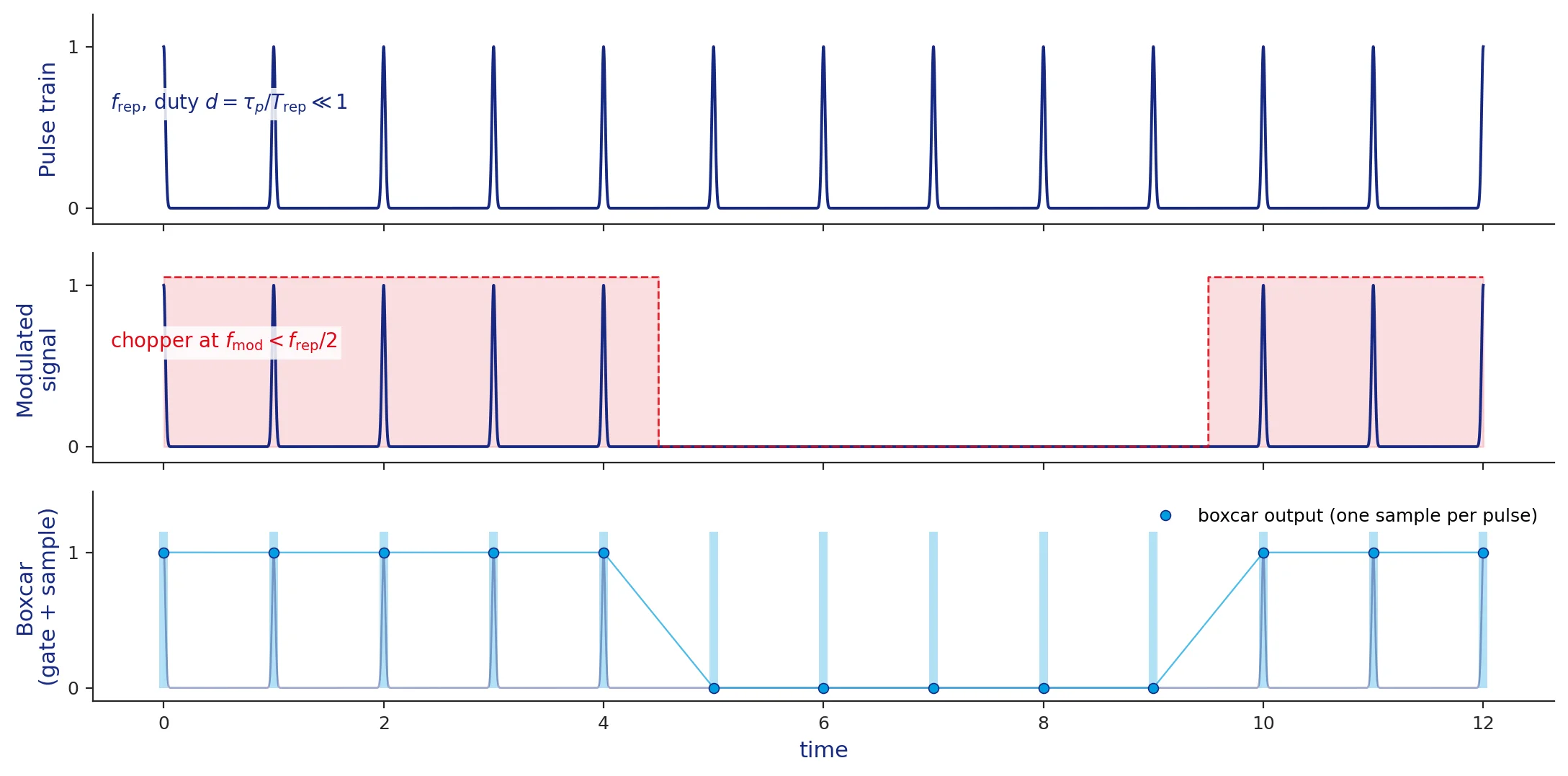
Why is the lock-in signal small?
Imagine, briefly, that the chopper is off. The pulse train is just a periodic sequence of pulses, and its time-averaged value is ⟨s⟩ = d · Apulse, where the pulse amplitude Apulse is the area under the pulse divided by Tp (simply the pulse height for a rectangular pulse) and d (a number ≪ 1) is the fraction of time the signal is “on.” This is the DC level of the pulse train.
Now turn the chopper on. The chopper switches the entire signal between “on” and “off” at frequency fmod, so every aspect of the pulse train, including its average level, gets modulated at fmod. In particular, the average level d · Apulse becomes a slow oscillation centered at fmod, with an amplitude ~ d · Apulse, proportional to, but smaller than, d · Apulse (how much smaller depends on the chopper-shape factor). This slow oscillation is what the lock-in detects.
Conversely, the boxcar output reproduces the full pulse amplitude Apulse.
So the boxcar output and the lock-in’s detected signal are two “amplitudes” measured from the same physical signal, but very different in size:
- The boxcar preserves the full pulse amplitude Apulse at the moments when the pulse is present.
- The direct lock-in sees only the slow envelope of the time-averaged signal with amplitude ~ d · Apulse, scaling with the pulse duty cycle.
With this observation, we start to get an intuition of why the final measurement result improves significantly if we first gate our signal with the boxcar and then route it to the lock-in: the signal that reaches the lock-in is “amplified” by a factor of order 1/d (a number ≫ 1) when a boxcar sits in front of it.
Where the missing signal went: the frequency-domain picture
To see where the rest of the signal went, and in turn why direct lock-in detection leads to poorer SNR, let’s look at the spectrum of the chopper-modulated pulse train. The pulse train is periodic at frep, so its Fourier transform is a comb of harmonics at n frep, with envelope set by the pulse shape. The chopper at fmod adds sidebands at ±fmod around each comb line.
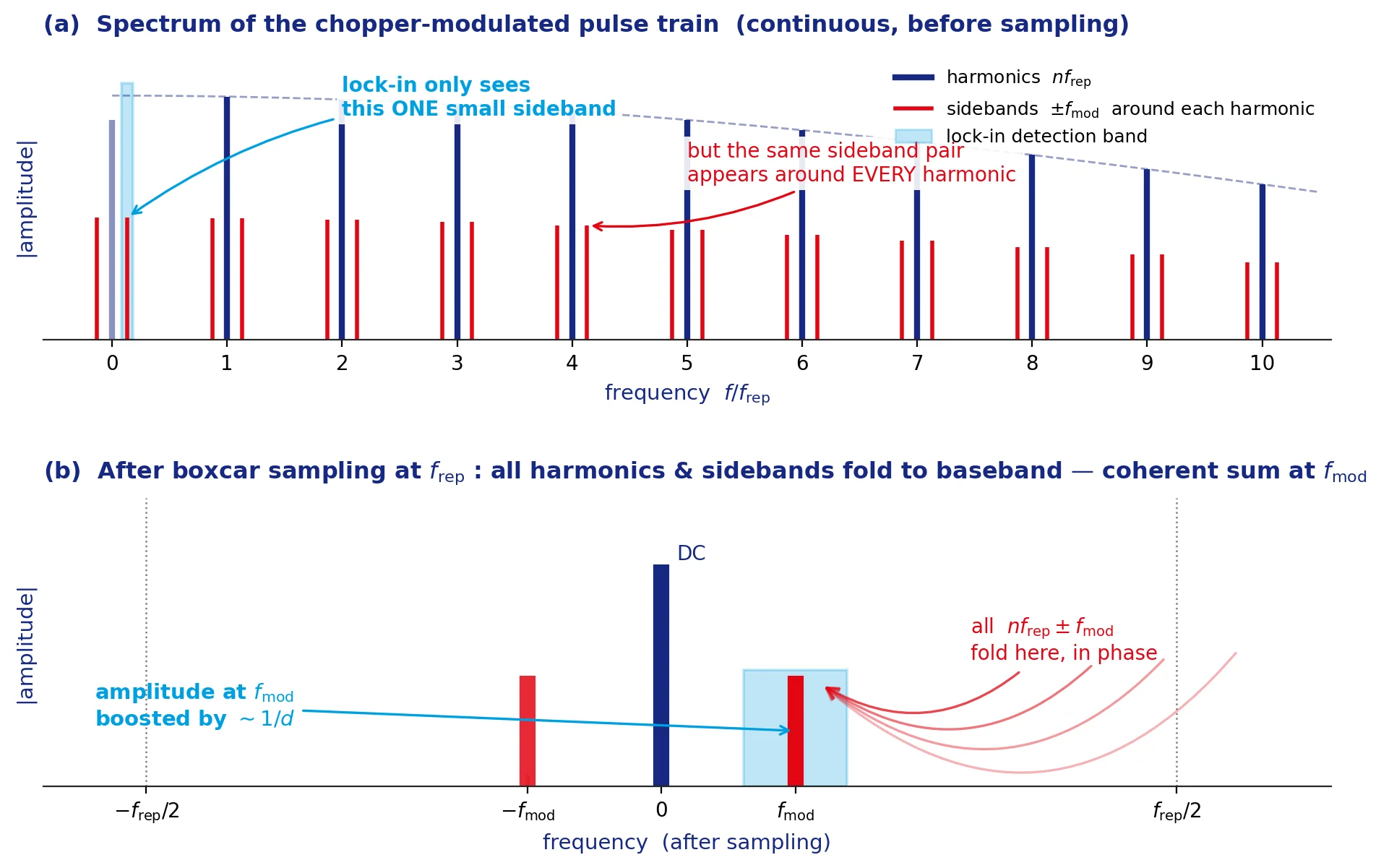
Figure 2a shows how the signal energy is distributed. The total signal power is split across many harmonics, roughly 1/d of them. A direct lock-in at fmod has a narrow detection band centered near DC; it captures only the single sideband closest to zero frequency. That sideband is the chopper-translated copy of the original DC line with amplitude ~ d · Apulse, exactly the slow-envelope amplitude we identified in the previous section. Every other sideband copy (the ones around frep, 2frep, 3frep, etc.) sits at a different frequency and is effectively ignored by a direct lock-in measurement. This means we are throwing away a large fraction of the available signal that would contribute positively to the SNR.
How the Boxcar + Lock-in Cascade Recovers the Signal
The boxcar can be viewed as two operations in series: it gates the signal in time (multiplying it by a rectangular window around each pulse), and it samples the gated signal at the pulse repetition rate frep, outputting one number per period. Each of the two operations plays a distinct role in improving the SNR:
- Gating (the rectangular window around each pulse) – rejects the noise
- Sampling (once per pulse, at frep) – concentrates the signal
Gating: the rectangular window rejects noise
Within the gate, the boxcar averages the signal over Tbox, so its output is the area under the pulse normalized by the gate width. Between pulses the gate is closed, and the noise present during the long dead time is never collected in the first place. Within the window, signal and noise accumulate differently. The signal is coherent: every instant inside the pulse contributes with the same sign, so the integrated signal grows linearly until the whole pulse is inside the window, and then stops growing. White noise, instead, is uncorrelated from one instant to the next, so its contributions add up only in power, and the integrated noise grows with √Tbox. Compared with measuring over the full period, the SNR therefore improves by roughly √(Trep/Tbox), i.e., ≈ 1/√d for a gate matched to the pulse, as discussed in our white paper.
Sampling: harmonic folding concentrates the signal
Because the input signal contains energy well above frep/2 (the harmonics extend up to ~ 1/Tp), the boxcar operation can be regarded as deliberate undersampling. While undersampling is usually referred to as something to avoid, in this case, we can use its properties in our favor.
Undersampling causes aliasing: every harmonic at n frep folds down to DC, and every chopper sideband at n frep ± fmod folds down to ±fmod. Because all these sidebands originate from the same coherent process, i.e., the same pulse train multiplied by the same chopper waveform, they add in phase at the aliased frequencies. Figure 2b depicts the idea: the bold red line at fmod is the coherent sum of all the “before sampling” copies.
The lock-in that follows the boxcar then sits on this concentrated component and demodulates it in the usual way. The signal amplitude it sees has been boosted by roughly 1/d compared with the direct lock-in case.
The noise folds too, but differently. The noise in each harmonic band is uncorrelated with that in the others, so while the signal copies add up in amplitude, the corresponding noise contributions add up only in power. The signal at fmod thus grows by ~1/d, the noise by ~1/√d, and the net SNR gain is ~1/√d – the same gain the gate provides, seen in the frequency domain.
The gate width essentially decides how many bands fold in, limiting the folding to the bandwidth actually occupied by the pulse rather than the full detector bandwidth.
As in the fmod = frep/2 case, this boxcar + lock-in cascade can be implemented as a single-instrument digital workflow on our lock-in amplifiers equipped with the corresponding boxcar averager option: the boxcar performs the gating and sampling, its output is routed internally to a lock-in demodulator referenced to the chopper, and both operations run in real time without any analog chain between them.
When does this matter most?
Not surprisingly, the smaller the duty cycle, the larger the overall SNR gain is. The amplitude advantage scales roughly as 1/d, so for example, for d = 10−3, the boxcar + lock-in cascade delivers around a thousand times the signal amplitude of direct lock-in demodulation, before any consideration of the noise spectrum. In experiments dominated by white noise, such as detector and amplifier noise, this corresponds to an SNR gain of roughly 1/√d, directly translating into a significant reduction in the measurement time needed to reach a target SNR.
The advantage also increases when the noise spectrum is not white. As described in our white paper, capturing many harmonics avoids the low-frequency 1/f noise that limits direct lock-in detection at the chopper frequency. The same argument applies to the boxcar + lock-in cascade: the lock-in stage operates on the boxcar output, where the noise spectrum has already been reshaped by the gating and sampling.
Summary
The choice of modulation frequency in pump-probe spectroscopy is an important parameter. The ideal modulation at frep/2, with pulse-by-pulse subtraction by a boxcar alone, is achievable for low-repetition-rate amplified lasers, where a mechanical chopper can keep up with the laser. For high-repetition-rate oscillators, it is not, and the chopper sits at fmod ≪ frep/2.
In that regime, a direct lock-in measurement captures only the small fraction of signal energy that lies in the sideband nearest DC: amplitude ~ d · Apulse. Most of the signal, distributed across the harmonics of frep, is filtered out and lost. A boxcar averager placed before the lock-in samples the gated pulse train at frep, folding those harmonic copies back to baseband and combining them in phase at fmod. The lock-in then demodulates a signal whose amplitude has been boosted by roughly the inverse duty cycle, while the gate limits the noise folded along with it to the pulse bandwidth, for a net SNR gain of roughly 1/√d in the presence of white noise.